
Operations · Defense tech
Six businesses looked equally defensible. Only one rule could say which deserved the next dollar.
Strong engineering, and a story that kept drifting across SaaS, service contracts, defence, logistics, grants, and investors. Narrowing it to one path put it on two grant shortlists and made it saleable.
A drone technology initiative building UAV systems for security and logistics had, on paper, an enviable position: SaaS fleet management, direct service contracts, defence work, logistics partnerships, grant funding, venture money — every path on the table, and every single one genuinely possible. The engineering was strong enough to plausibly support all six. Nobody arguing for any one of them was wrong. It is the first thing I now check in any drone company, in how I would evaluate a defense tech startup.
That is exactly what made it a hard problem to see from inside the building. A team that is capable enough to defend six directions at once doesn't look stuck. It looks busy. The cost stays invisible until someone from outside asks the question nobody inside had needed to answer yet: what are you validating first, and what specific result would tell you it's working? Investors ask that question before writing a check. So does anyone actually considering a purchase.
Running each of the six paths against that question did the real narrowing. Two survived it in the sense that mattered — a SaaS platform and a direct drone-as-service model — and they needed different companies, different sales motions, different proof, which meant running both at once would validate neither.
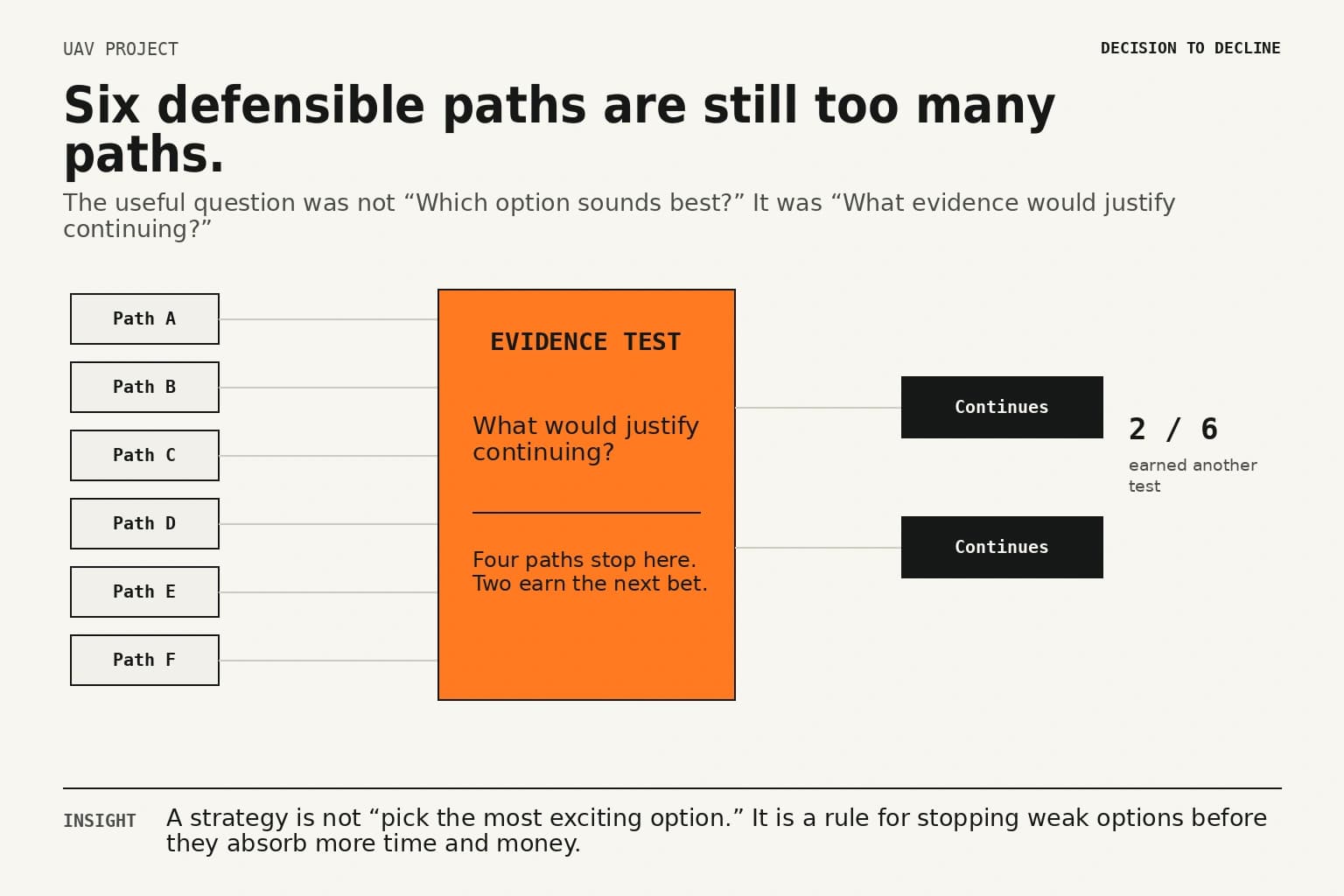
The other four weren't bad ideas. They were ideas nobody could prove or disprove inside a realistic window, which is a different kind of failure than being wrong.
For each of the two paths that survived, we sat down and wrote out, in advance, what evidence would justify continuing to the next phase and what evidence would mean stopping — before any more engineering time went into either one. That turned an open menu into a sequence: build the smallest piece that could produce evidence, get the answer, then decide the next step based on the answer instead of on how convincing the argument for it still sounded. A phase that failed to produce its evidence wasn't a setback to explain away. It was the system doing its job.
The hardest part wasn't picking which four paths to set aside. It was that the team could defend every one of them on the merits and had to set four aside anyway, because the roadmap needed an answer sooner than any of the four could produce one. Being right about an idea and being able to prove it in time are two different tests, and only one of them was available to this team on this clock.
What was left got tested fast enough to reach two European grant programmes and, eventually, a sale — the direct result of being able to prove the smaller thing instead of continuing to argue for the larger one.
If your team has more than one direction it can genuinely defend, try this before choosing between them: for each direction, write down in advance what specific evidence would justify the next dollar spent on it, and what evidence would mean stopping. Whichever direction you can't write that sentence for is the one you're defending on conviction alone — and conviction is exactly what a team with real capability always has enough of, for every option, including the ones that are quietly going nowhere.
- Cut the scope by about half, removing everything that couldn’t be validated in a realistic window
- Reduced the business model question to two options with a recommendation attached, instead of handing them a menu
- Built a modular validation roadmap, where each phase produced evidence that either justified the next one or stopped the programme
- Made the next step unambiguous. Not a plan. One obvious action.
The full engagement record
Confidential: European UAV initiative — case study