
Operations · Finance, mortgage and lending
A rural lending programme in Ukraine had low enrolment. The programme read it as low demand. I sat in on the borrower interviews instead of the next campaign meeting.
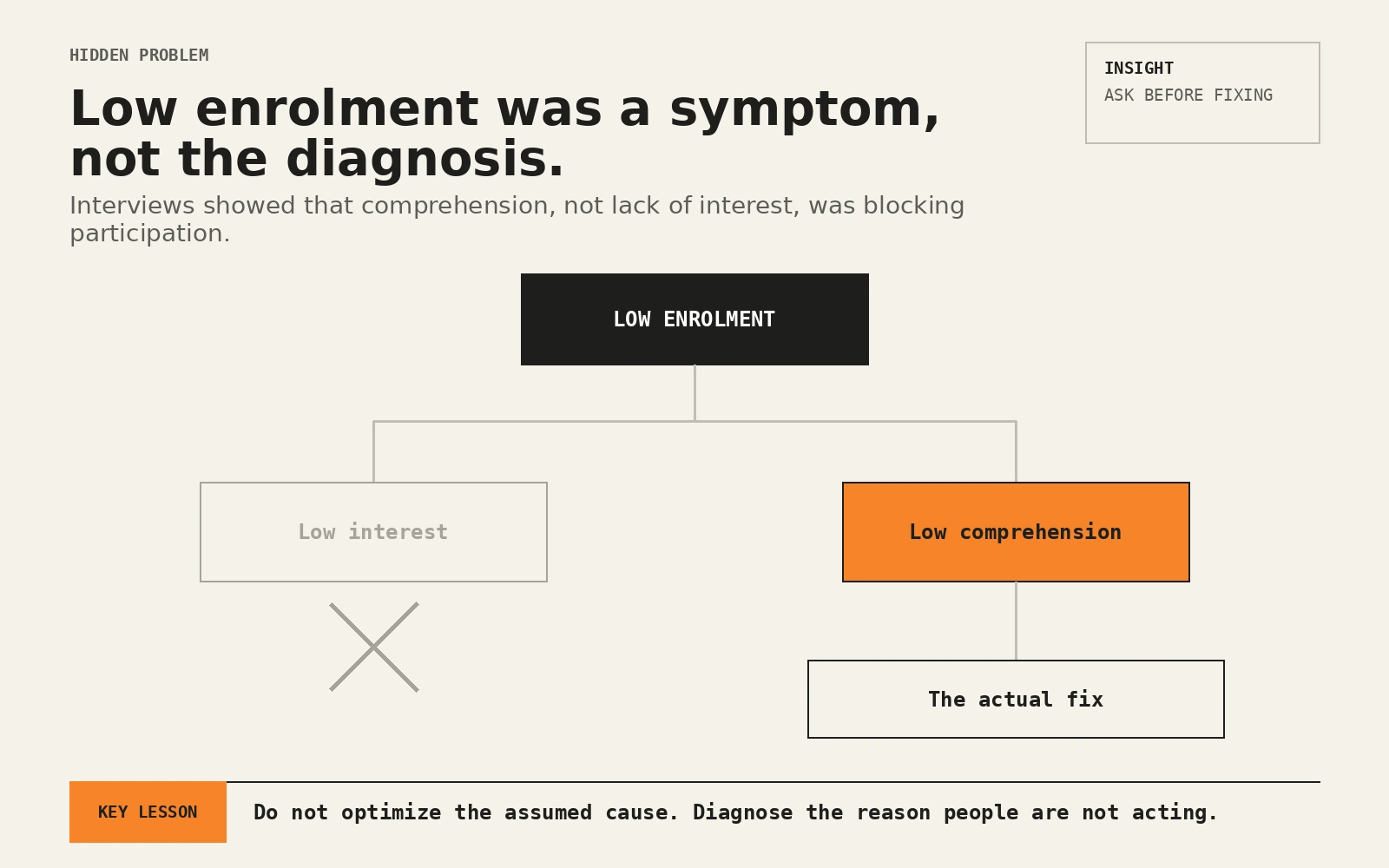
A rural microfinance programme run under the National Bank of Ukraine read low engagement as low interest. The borrower interviews said otherwise: people weren’t uninterested, they were scared, and nobody had explained it like a human.
A microfinance programme lending to small entrepreneurs in rural Ukraine had a problem the numbers described clearly: enrolment was low. The default reading of that number is low demand, and the standard answer to low demand is more promotion — more reach, more outreach, a bigger push toward the people who hadn't signed up yet.
The interviews said something different. Person after person didn't describe the loan as something they didn't want. They described a form they didn't understand, terms nobody had explained in words they actually used, and the social pressure that comes with discussing a loan in a village where everyone knows everyone. Several described a rational fear of a risk they couldn't fully explain back — not disinterest in borrowing, but hesitation about agreeing to something they didn't understand.
That distinction changed what the fix had to be. If the problem is low interest, the answer is more promotion. If the problem is comprehension, more promotion pushes people who already don't understand the terms toward a decision under more pressure — which can leave someone agreeing to a repayment schedule they don't actually follow.
- +28%
- loan programme enrolment
- −12%
- default rate, new borrowers
- ~1.4×
- healthy loan book growthMore borrowers, lower default rate
- 3
- channels rebuiltSMS, print, community briefings
There was a second thread in the same interviews, easy to miss if you were only listening for reasons people weren't signing up: some of the people who had already signed up didn't fully understand their own repayment schedule either. Someone who doesn't understand what they agreed to is more likely to miss a payment on it — not necessarily because they can't pay, but because the schedule didn't match how they were actually tracking what they owed. The same gap sitting between a form and a signature was also sitting between a loan and a repayment.
The education materials and the repayment touchpoints got rebuilt in plain local language, written for understanding rather than persuasion. New templates went out through SMS, print, and community briefings — the formats people already used, rather than a new channel introduced for the occasion. Outreach ran through people the community already trusted, instead of a broadcast aimed at everyone at once.
Enrolment rose 28%. Defaults among new borrowers fell 12% over the same period. Those two numbers normally move in opposite directions — a programme that grows its borrower base usually takes on more risk while doing it. Here they moved together, because both had been held down by the same unexplained form.
If a number in your business looks like disinterest — low signups, low usage, a feature nobody adopts — go talk to the people who didn't act, in their own words, before you spend anything to reach more of them. Pushing harder at someone who doesn't understand what they'd be agreeing to doesn't just fail to bring them in. In lending, and in anything with real consequences attached, it produces the exact outcome you were trying to avoid: someone committed to terms nobody actually explained to them.
The full engagement record
Confidential: rural microfinance initiative — case study