
Sales and marketing · Finance, mortgage and lending
The mortgage leads were arriving fast. Nobody could tell which ones meant it.
A California mortgage business was generating plenty of enquiries and burning its team on the ones that went nowhere. One confirmation step raised the share of usable leads by about half.
A California mortgage business — licensed only in that state, targeting real estate agents handling $2.5 to $5 million homes — needed a reliable flow of enquiries. Volume wasn't the problem. I followed a batch of leads past the form submission to find out what actually happened to them next.
A large share had been filled in by people who didn't mean it. In a category where every single lead gets a phone call from an actual person, that lands directly on the most expensive resource the business has — someone's time, spent chasing a form nobody was serious about. At roughly $50 a lead, it also made the channel impossible to evaluate on its own terms: a low result could mean the channel was underperforming, or it could mean the leads reaching it were junk, and nothing in the numbers separated the two.
The gap sat at intake, not in targeting. The form was too easy to fill out without intent behind it, which pushed the actual qualification work onto the sales team after the fact — the most expensive place in the business to do it, and the slowest.
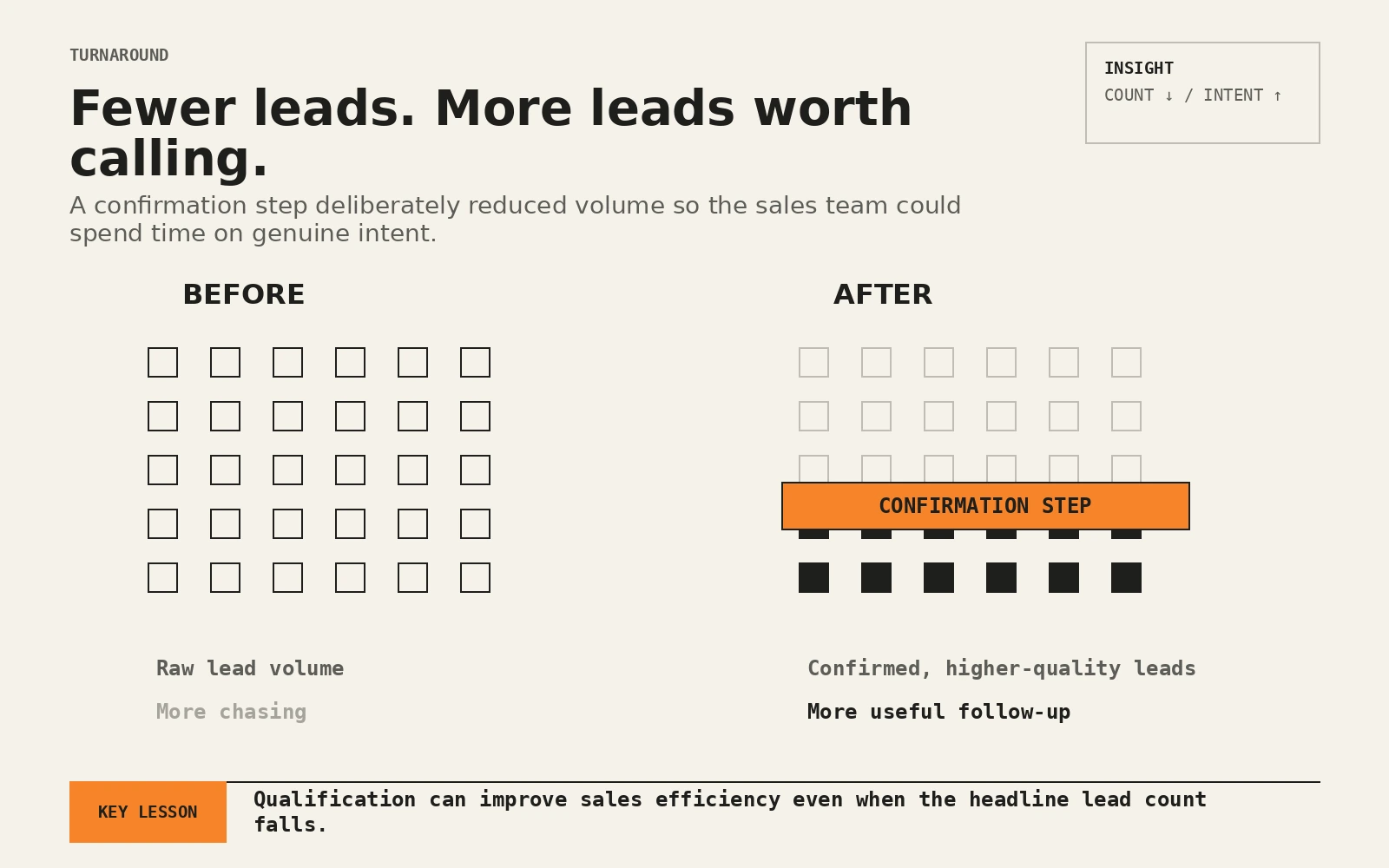
Before / after
- 01 / Before
Leads arriving fast, but a large share filled in by people who didn't mean it — sales time spent chasing forms nobody was serious about, at roughly $50 a lead.
- 02 / The fix
A confirmation step added, requiring intent before a lead counted at all — trading raw volume for a better mix on purpose.
- 03 / After
Quality leads up roughly 50%. 156 documented leads at $49.74 each on $7,759.44 of spend.
- Added a confirmation step so people had to affirm intent before the lead counted, trading raw volume for a better mix
- Optimised for calls and email follow-up, because at this level of the market buyers expect a person, not a form response
- Built routing and notifications into the CRM so a confirmed lead reached the right person without sitting in a queue
- Ran twice-monthly strategy sessions on lead quality and pipeline instead of reporting media metrics at them
A confirmation step went in, requiring someone to affirm intent before a lead counted at all — trading raw volume for a better mix on purpose. Follow-up shifted toward calls and email instead of automated sequences, better suited to a market where the buyer is a real estate agent handling million-dollar transactions, not a first-time homebuyer filling in a form at midnight. Routing and notifications got built directly into the CRM so a confirmed lead reached the right person immediately instead of sitting in a queue. Review meetings moved from reporting media metrics to reviewing lead quality and pipeline directly, twice a month.
Quality leads rose roughly 50%. That's a change in the mix, not the volume — raw count went down, usable count went up, and the sales team stopped spending time chasing people who were never going to answer. The documented campaign shows 156 leads at $49.74 each on $7,759.44 of total spend.
If your team is burning time on leads that go nowhere, check whether the problem is actually the channel or the form. The fix at intake is usually cheaper and faster to test than switching where the traffic comes from — and it tells you, for the first time, whether the channel was ever the actual problem. The full method, from defining a qualified lead to judging channels by cost per customer, is in how to improve lead quality.
- ~50%
- increase in quality leadsAfter adding intent confirmation
- 156
- leads$7,759.44 spend
The full engagement record
Confidential: California mortgage business — case study