
Sales and marketing · Finance, mortgage and lending
Thirty years of tennis judgment became 322 bets a model could actually test.
A client who had spent his working life around tennis wanted to bet on it seriously and had no way to turn what he knew into decisions. We got the knowledge out of his head, put thirty years of results behind it, tested around three million combinations, and shipped a system that wins close to four bets in five.
He'd spent thirty years around tennis — the players, the surfaces, how a match actually turns versus how commentators say it turns. He wanted to bet on it seriously. What he didn't have was any way to act on what he knew. It lived in his head as a confident opinion about a match, not as something you could write down and hand to anybody else.
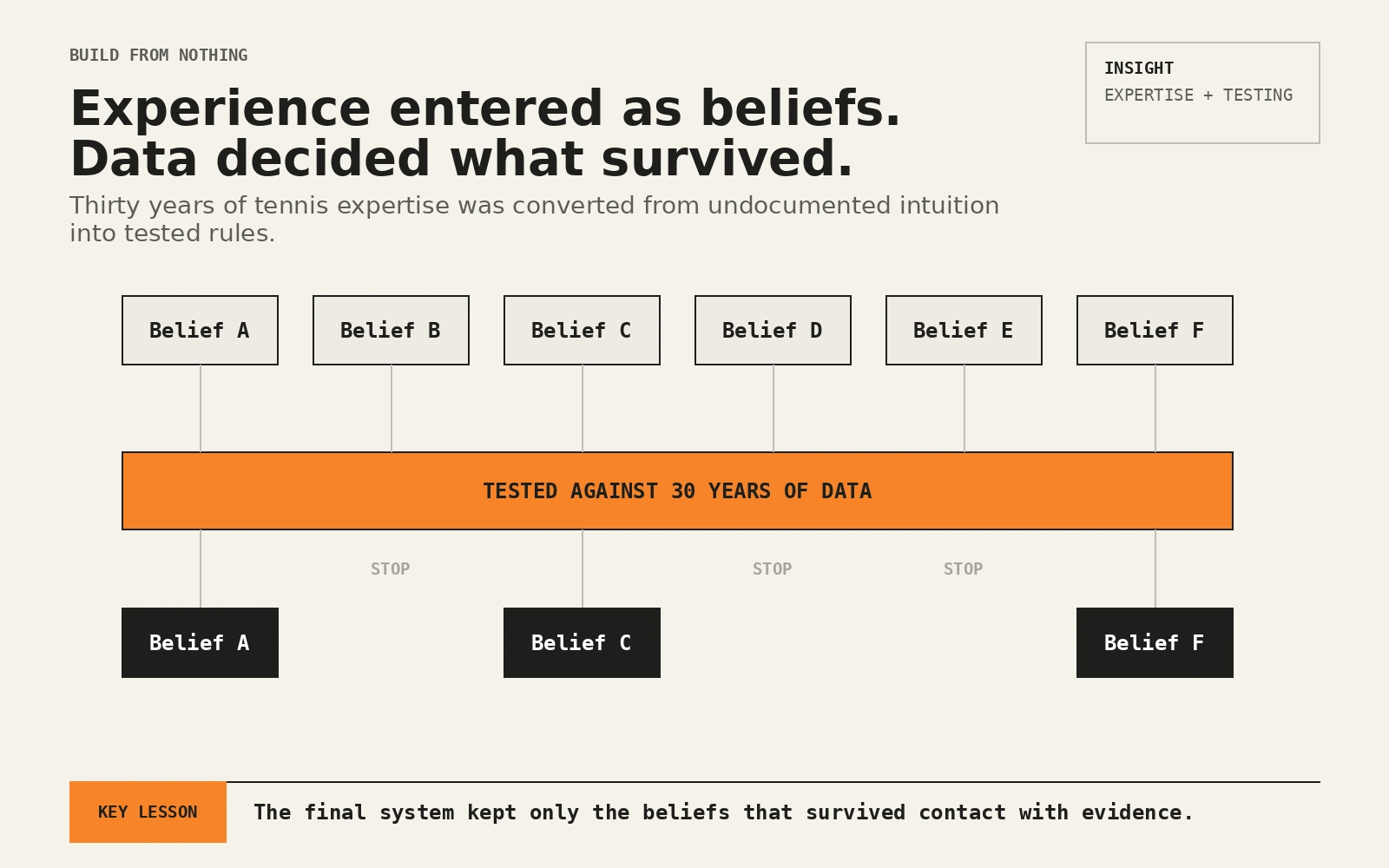
On this project the rules never got written down and automated directly. Instead, I asked him for his beliefs one at a time — every one I could get out of him, including the ones he couldn't fully justify: a surface tendency, a read on a player under pressure, a pattern he'd noticed but never counted. Each belief turned into a specific, checkable claim, and each claim got run against thirty years of match data to see whether it actually held.
How it was built
- 01 / Beliefs extracted
Every belief he had, including the ones he couldn't fully justify, turned into a specific, checkable claim.
- 02 / Tested against history
Roughly three million combinations tried against thirty years of match data, across both tours.
- 03 / Backtested result
322 bets, a 79% win rate on the ATP side and 78.8% on the WTA side.
- 30 years
- of match data behind the model
- ~3M
- combinations testedTo find the version that still held when the data changed under it
- 78.9%
- win rate, ATP171 bets backtested
- +21.7%
- best return, WTA with the language-model filterQuarter-Kelly staking, 140 bets, 36.2% maximum drawdown
A system nobody can read is a system nobody can correct when it's wrong.
Two things had to be true before any of this was worth building into something real. The edge had to hold against an actual market price, not against a feeling — which meant pricing every position point by point during a live match and comparing it to what the market was offering at that exact second. And the system had to stay readable while it ran, because a system nobody can read is a system nobody can correct when it's wrong.
Thirty years of match data went in, across both tours, so a claim had to survive different eras, surfaces, and generations of player rather than just one good season. Roughly three million combinations of his extracted rules got tried against each other and against that history, checking which ones still held once they had to work together instead of standing alone in a conversation. Men's and women's tours got separate models, because treating them as one thing was itself one of the beliefs that looked fine until it got checked. A paper account ran beside the live one from the start, so every result could be read against something instead of remembered.
Backtested across 322 bets on both tours, the system that came out of this held close to a 79% win rate on the ATP side and 78.8% on the WTA side.
What made it work wasn't automating what he already believed. It was turning thirty years of judgment into individual claims specific enough that each one could be checked on its own, against a record neither of us had memorized.
If you're running a business on expertise that lives in one person's head — yours or someone else's — take one decision that person makes often and write down the actual belief behind it, specific enough that you could check whether it's true. Then go find the record of the last several dozen times that decision got made. You will not be able to do this for everything you know. Do it for the one decision your business leans on most, and you'll have something you can build on instead of something you can only repeat.
The full engagement record
Confidential: sports trading client — case study