
Sales and marketing · E-commerce and retail
A product with zero sales history got $10,000 and three months to prove itself, one stage at a time.
Artopad had no sales history anywhere. No audience data, no pixel history, no idea what a customer should cost. The budget had to cover the fee, the media, and everything else.
Artopad had a product and nothing else. No prior sales meant no audience data, no pixel history, no benchmark for what a customer should even cost. Roughly $10,000 had to cover the agency fee, the media, and everything in between. The instruction was narrower than growing an existing business: find out whether this sells, without burning the entire budget on the finding out.
At that size, most channels were ruled out before the first ad ran. A channel without enough volume to produce real purchases inside a few weeks would have returned impressions and clicks and nothing that actually answered whether the product sold. Meta was the only channel that could generate enough purchases fast enough for the budget to answer that question at all.
The website itself was the weaker part of the whole system, and that was flagged before the campaign ever launched. The client wanted to test the product on the existing site first rather than rebuild it up front — a reasonable position, since rebuilding a site for a product nobody had proven wanted buying yet would have spent money before the real question was answered. So the first month became a test of the product itself, not a test of the buying process wrapped around it.
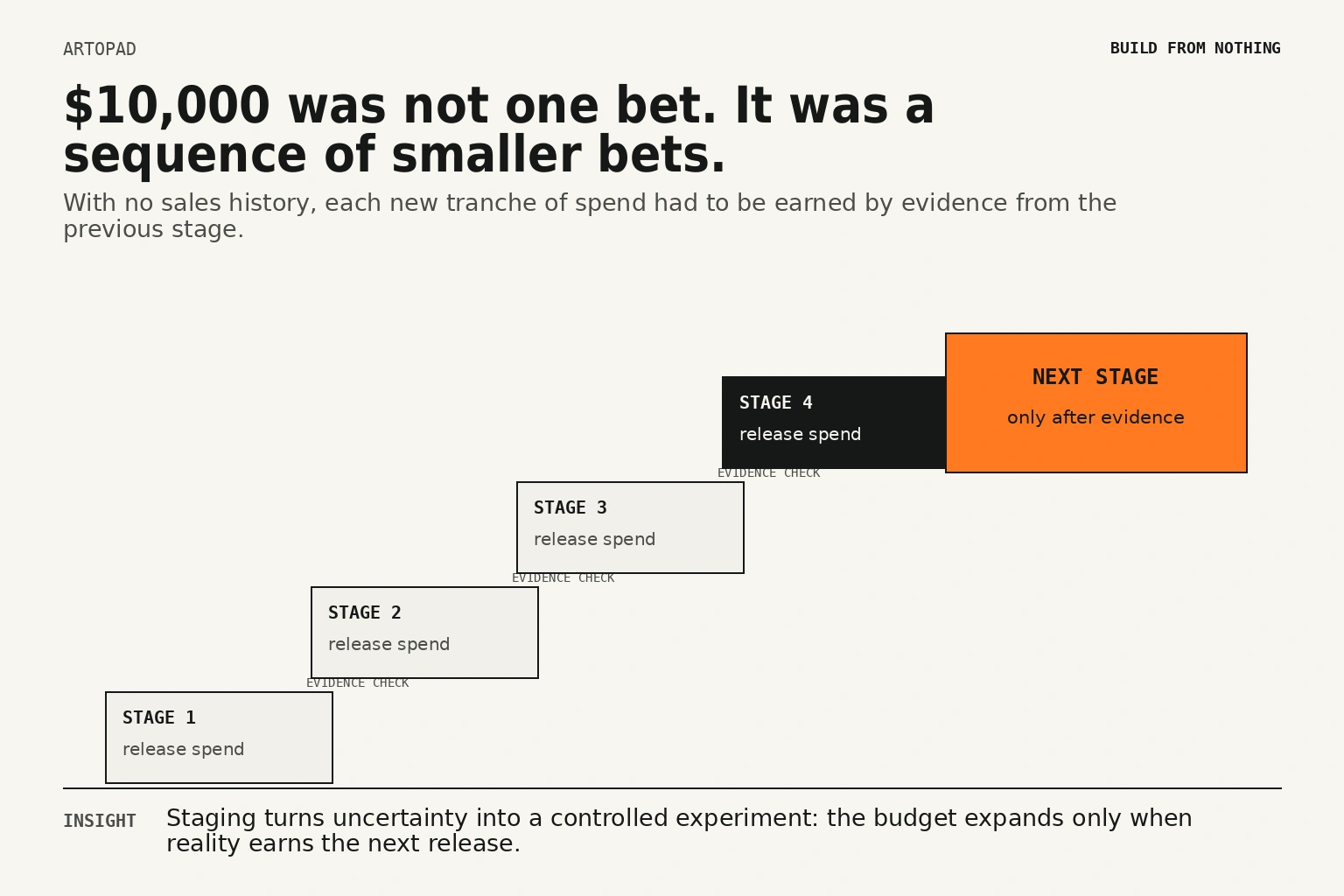
The budget went out in stages against evidence, not committed up front. Each stage had to earn the next one.
How it was built
- 01 / $10,000, zero sales history
No pixel history, no audience data, no benchmark for what a customer should cost.
- 02 / Staged spend
Budget released in stages against evidence, not committed up front — each stage had to earn the next.
- 03 / Three months
~800 orders, ~2,000 units, under 1% returns, inventory sold out.
A separate campaign ran purely to fill the audience pool, deliberately excluding anyone already reached, and those people were closed separately through remarketing rather than mixed back into the same pool. The US and Canada ran as one campaign with separate ad sets, because the two markets behaved similarly enough that splitting the budget between them would have fragmented a signal that was already thin. The UK ran on its own, because it didn't behave the same way, and pretending it did would have blurred the read on both.
The first purchasing pattern that changed the calculation showed up early: most people bought more than one unit, and a two-pack was the typical order. That reset which number was worth holding against acquisition cost — not the single unit's price on the box, but what a typical order actually contained once people bought more than the one puzzle the ad had shown them. How I set a price for a product with no sales history is in startup pricing strategy before the first sale.
Roughly 800 orders and 2,000 units moved across three months, with returns under 1%, and the inventory sold out. The strongest single month ran 377 purchases on $2,798.61 of spend — a blended $7.42 per purchase. Video worked best, and specifically footage of someone actually handling the product, not footage of the product alone. Conversion improved again once the client made the site changes that had been flagged as the weak point from the start. The engagement ended when the stock ran out, and by then tariff changes had made restocking the product uneconomic anyway.
If you're about to spend money finding out whether something sells, split the budget into stages before you spend the first dollar of it, and decide in advance what result unlocks the next stage. A product with zero history doesn't need a bigger initial bet to prove itself. It needs a small first bet structured so you actually learn something from it, whichever way it goes. For a business product, where ads rarely find the first buyer, the route is in how to get the first customers for a startup.
A product with zero history doesn't need a bigger initial bet to prove itself.
- ~800
- orders in three months
- ~2,000
- units sold
- <1%
- return rateAcross the three-month project
- $7.42
- blended cost per purchaseBest month: 377 purchases on $2,798.61
The full engagement record
Artopad — case study