
Operations · Trades and local services
Sixteen years of licences and a 70 NPS. Search for either one, and AutoAmerica didn't exist.
AutoAmerica buys cars at US auctions for Ukrainian buyers. The customers were loyal and the reputation was real. None of it existed anywhere a new buyer could find it.
AutoAmerica sources cars at US auctions and delivers them to buyers in Ukraine — free vehicle selection, structural and legal checks, a full landed-cost calculation, sixteen years of auction licences behind it. Before touching any campaign, I went looking for what a stranger considering this company would actually find: reviews, proof, any evidence of the track record. There wasn't much there.
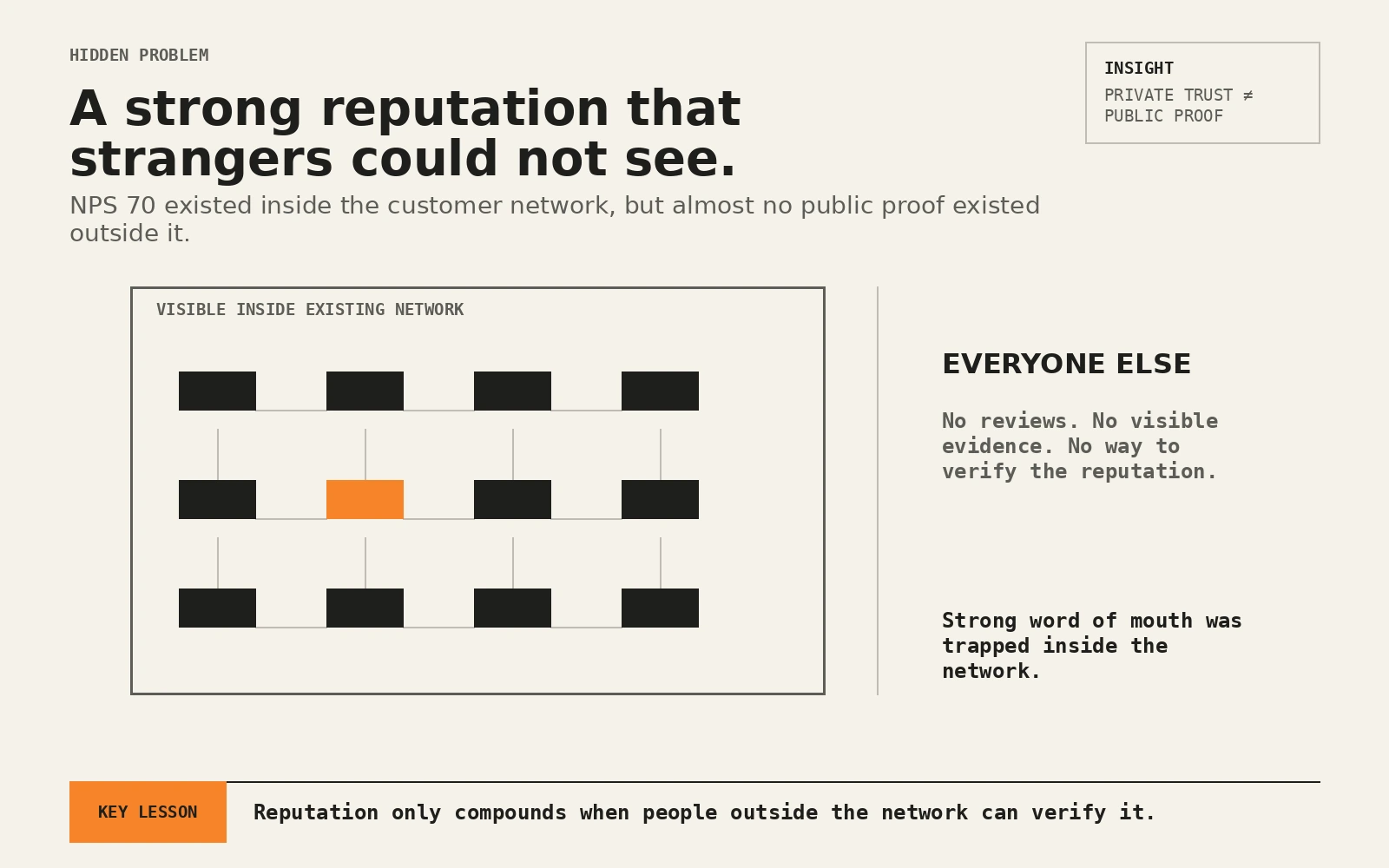
Depth interviews with existing clients returned an NPS of 70 — a real, strong number. And 54% of customers had arrived through a recommendation or a review from someone they already knew; another 34% had found the company online. More than half the business was already running on word of mouth, which explained the NPS and also explained the actual problem: word of mouth was carrying the company, and almost nothing existed to carry it further than the people already inside that network.
- 70
- NPS at the time of the auditFrom depth interviews with existing clients
- 16 yrs
- of auction licences never shown publicly
- 54%
- of clients arrived by recommendation
- 34%
- of clients found the company onlineThe remaining 12% arrived by other routes
The category makes that gap expensive. A buyer wiring five figures abroad for a car they've never physically seen has one real question before anything else: who else did this, and did it work out for them? AutoAmerica had sixteen years of answers to that exact question and no published way for a stranger to hear any of them. The auction licences had the identical problem — mentioned in conversation, never actually shown.
Review collection became the first priority, starting with clients from the past eighteen months in Kyiv and Odesa, where the cars were still physically reachable to film. Video became the default format, with a standing rule to request a review at the close of every deal and publish all of them, including the negative ones. The auction licences went onto the site directly instead of staying a claim made in conversation. Buyers got segmented five ways, with messaging written for each type rather than one pitch aimed at everyone at once.
The engagement produced a 125-page document — a full review, depth-interview findings, five buyer segments, competitor analysis across four rivals, a content plan, channel-level goals. The most uncomfortable section was the last one: the company's own replies to customers, quoted back and rewritten one by one. A dismissive line aimed at a commenter. A price question answered with "leave your phone number" and no explanation of where or why. A misspelled customer name sitting next to the correct name Facebook had already supplied in the same thread. Every one of those had a paying customer reading it at the time.
If your business runs on a reputation you know is real — clients who stay, a track record you could defend in a room — go check whether a stranger outside your existing network could actually find any evidence of it. Word of mouth only reaches as far as the mouths already talking. Everyone else sees whatever's public, which for most businesses running well on reputation alone is close to nothing. The same gap costs an owner at sale time, when a buyer can price only what can be checked; see how to prepare a small business for sale.
The full engagement record
AutoAmerica — case study