
Operations · Trades and local services
A $46 lead looks expensive next to one $375 booking. It looks cheap next to three years of them.
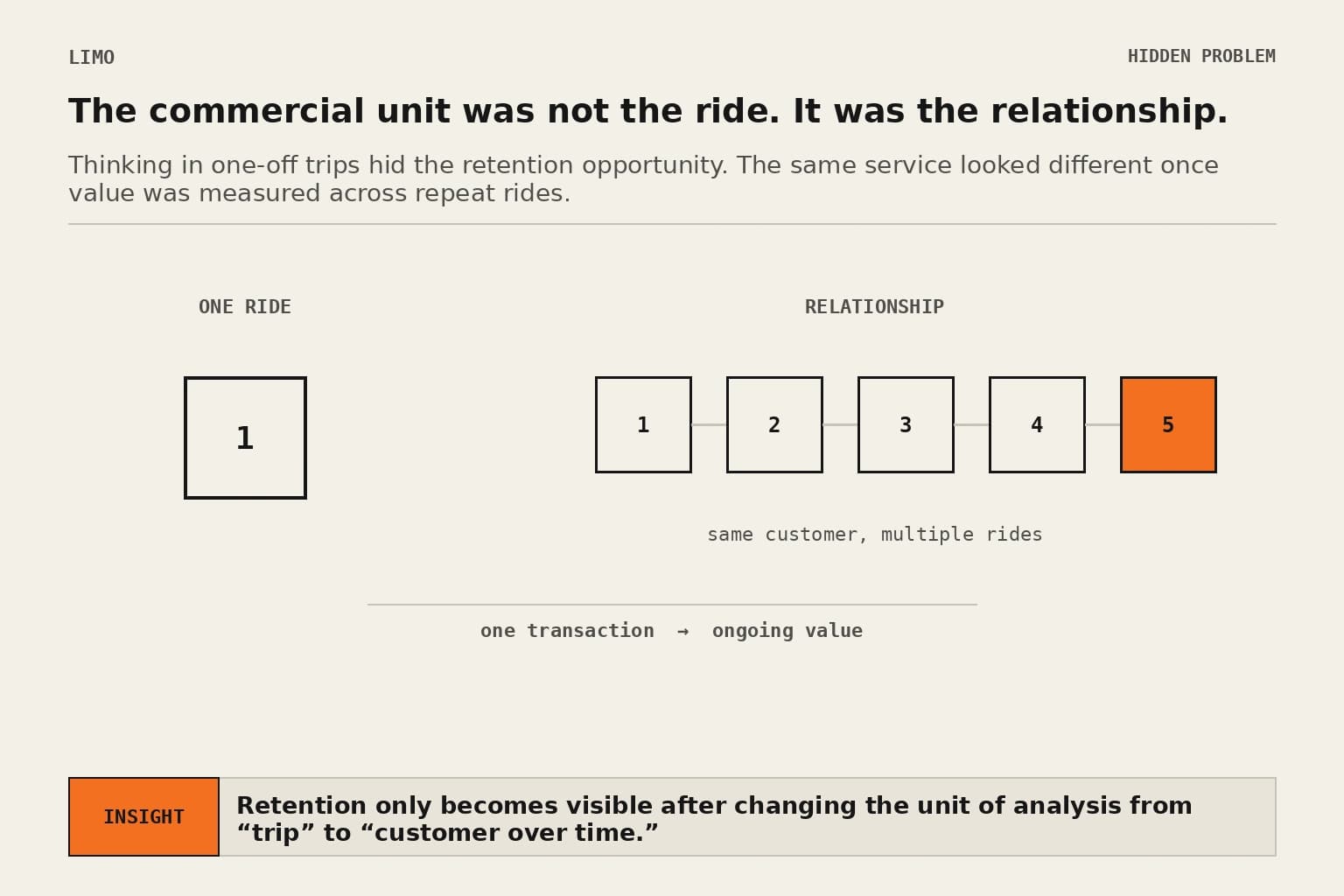
No brand, no site, no way to get a lead. The economics worked because we weren’t buying one ride: we were buying a two-to-three year relationship.
An intercity chauffeur service running routes across the US — New York to Washington, Portland to Seattle, Las Vegas to Los Angeles — had no brand, no website, no advertising, and no process for handling an enquiry when one came in. Before spending a dollar on acquisition, I looked at what one client was actually worth, not what one ride cost to book.
The minimum reservation was three hours at $125 an hour — $375, minimum, on day one. Clients booked two to five times a month. They stayed two to three years. Against that, a $45.97 lead isn't a cost to minimize. It's an entry price into a relationship that pays out for three years.
- 234
- booking leads$10,756.98 spend
- $45.97
- cost per lead
- $375
- minimum bookingThree-hour minimum from $125/hour
- 2–3 yrs
- typical client lifetime
Demand was real, and occasionally intense — during the shutdown, with airports running unpredictably, intercity ground transport became the reliable option for people who needed to move anyway. But demand arriving at a company with no brand and no way to track an enquiry leaks straight back out. The gap was never reach. There was nothing built yet for reach to land on.
Brand, website, and analytics went in before spend scaled at all — paying $46 for a lead that has nowhere to go once it arrives is the expensive version of this mistake, not the cheap one. States got split into separate ad sets instead of one blended campaign, so California — roughly 80% of the actual orders — stayed visible in the numbers instead of getting averaged away into a blended cost figure that meant nothing. The acquisition target was set against client lifetime, not first booking, and the client's own team got trained on the CRM directly rather than having me run their sales process for them indefinitely. It is the same order of work as at KYI AVIA: tracking first, spend second.
234 booking leads came in at $45.97 each, on $10,756.98 of spend at a $132 daily budget — and the business went from nothing to a working commercial setup: identity, website, paid acquisition, analytics, a CRM process the client's own staff could run without me.
The owner sold the company afterward and moved into another sector. The system kept working; he just got a better offer for the thing it had built.
If a cost-per-lead number in your own business looks too high, check what you're holding it against. A lead that costs $46 and turns into three years of repeat business is cheap. A lead that costs $5 and buys one purchase that never repeats might not be. The number on its own tells you nothing until you know which of the two you're actually looking at.
The full engagement record
Confidential: intercity chauffeur service — case study