
Team and contractors · Trades and local services
KYI AVIA wanted more campaigns. Nobody could follow a single lead to the booking it became.
It arrived as a campaign problem. It was an infrastructure problem. Tools didn’t talk, leads couldn’t be followed, and nobody could see what was working.
KYI AVIA, a national travel agency, came in with lead flow that rose and fell depending on the month, and an ask that sounded simple: launch more ads, publish more content, get more leads.
The request assumed the channels were the constraint. Trying to trace an actual lead from the first click to a completed booking showed something else. The tools running the agency's marketing didn't talk to each other. No one could follow a person from an ad through to a sale, which meant no one could say which spend had actually produced a booking and which hadn't.
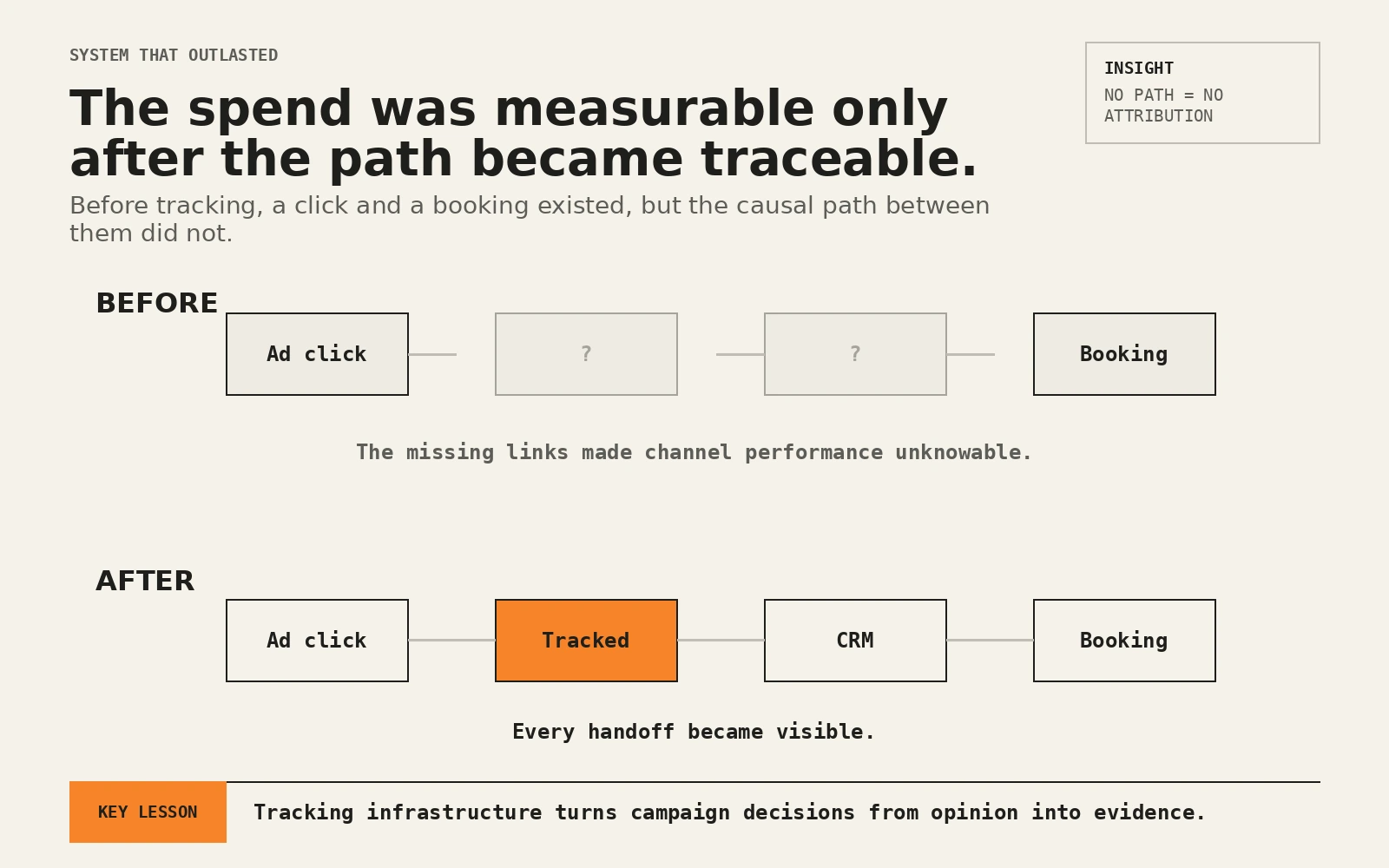
A decision about where to put money next was a guess dressed up to look like a decision.
Running more campaigns into that gap wouldn't have fixed it — it would have produced more leads nobody could trace and more confident guessing about which ones mattered. A second problem sat inside the same funnel: someone still researching which country to visit and someone comparing prices for dates they'd already picked were being sent the exact same message at the exact same stage, as if they were the same buyer.
The choice that shaped everything after it was building the fix as a department inside KYI AVIA rather than as an outside team running the work for them. CRM and lead tracking went in first, before any campaign scaled — the slow, unglamorous part of the engagement, since infrastructure produces nothing visible for weeks while a campaign produces impressions on day one. A US limousine company needed the same order for the same reason. Funnels then split by where a buyer actually was — a country-researcher, a date-and-price comparer, someone ready to book — with content built for that specific stage instead of published as general output, and the partnerships and remarketing the agency already had access to got scaled properly instead of left as an afterthought. None of it sat with an outside vendor afterward. It sat with the department that had just been built, because that was the version of this fix that didn't need the same outside call again next quarter.
More than 60% of leads became traceable across the funnel, up from effectively zero — the number everything else in the result depends on. Online bookings rose 35% and acquisition cost fell 18%, a roughly 1.6× return on the same budget, and neither figure was reachable before a booking could be traced back to what produced it.
If your own team is asking for more campaigns, more content, or more outreach to fix a number that's stuck, go trace one actual customer from their first contact with your business to the sale, by hand if you have to. Where you lose the trail is usually the real project, and whatever you build to fix it is worth keeping inside your own team rather than handing to an outside vendor to run for you indefinitely. If the campaigns are run by an agency, the same trace is the first of seven checks an owner can run on a marketing agency.
- +35%
- online bookings
- −18%
- customer acquisition cost
- 60%+
- of leads traceable through the funnelFrom effectively zero
- ~1.6×
- return on the same acquisition budgetBooking growth against lower CAC
- Put CRM and lead tracking in before scaling anything
- Built the marketing department in-house instead of outsourcing it, so the capability stayed in the business
- Segmented funnels by where the buyer actually was
- Tied content to those stages, so it had a job instead of existing as output
- Scaled partnerships and remarketing properly, turning relationships they already had into a channel
- Made traceability the early success metric, ahead of volume
The full engagement record
KYI AVIA — case study