
Sales and marketing · Software, AI and technology
CITAUA built banking software. Its own website looked like it hadn't been touched since 2004.
CITAUA had real delivery experience across finance, banking, and travel, and no way to prove any of it. We rebuilt what the company was: product line, positioning, brand, and where the engineering hours went.
CITAUA was a Kyiv IT firm building digital products for banks, financial companies, and travel businesses across Ukraine, Europe, and the US. The delivery work was real — the kind of client list that should open doors on its own. None of it had ever been written down anywhere a prospective client could look at and judge for themselves. The public face of the company was a website that looked a decade and a half older than the work behind it.
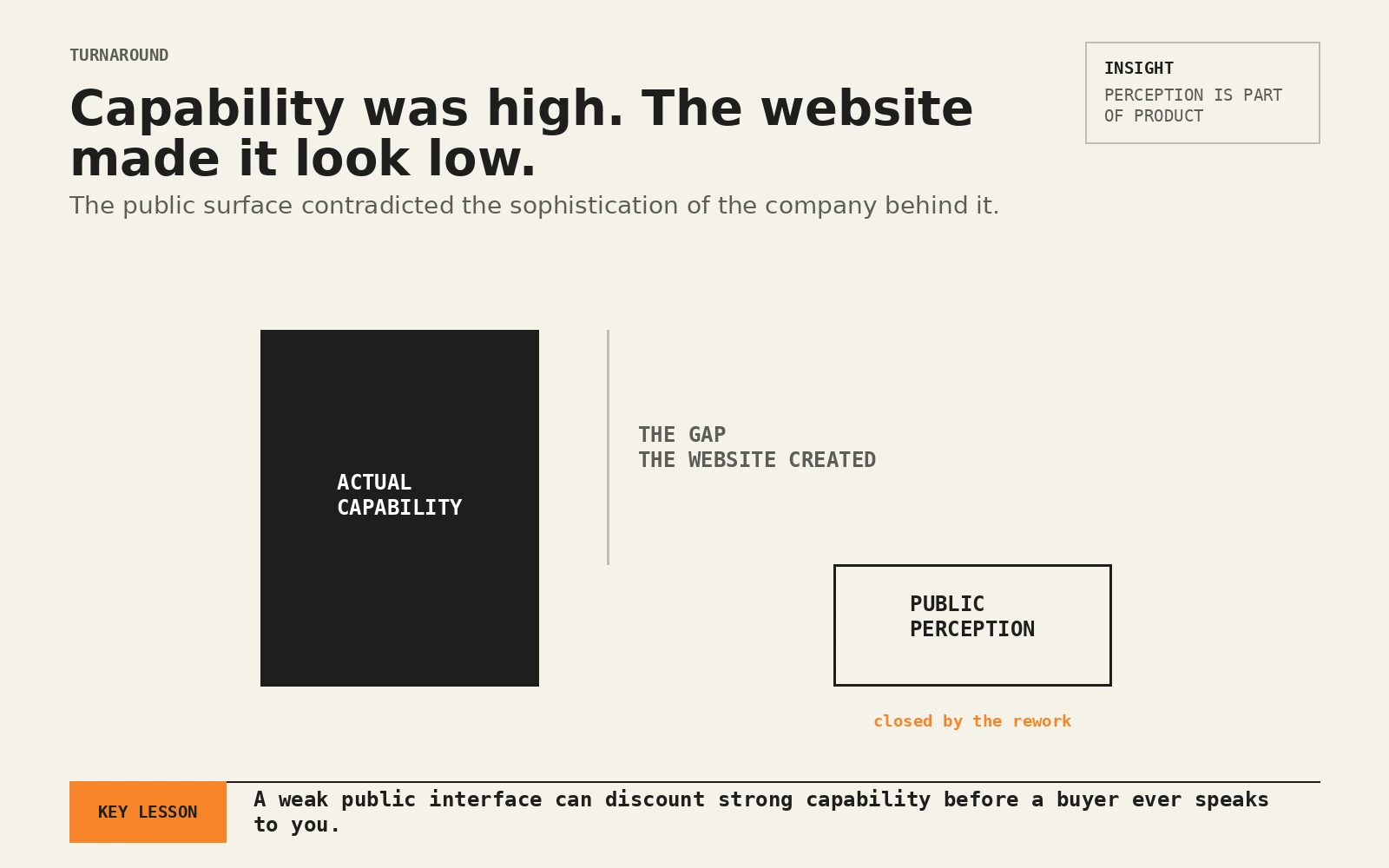
Before / after
- 01 / Before
A website that looked a decade and a half older than the delivery work behind it, no defined product line, and a real share of engineering capacity tied up maintaining a legacy line worth about $20,000 a year to two clients.
- 02 / The fix
Product portfolio mapped first, positioning rebuilt on proof instead of a claim, one communication script used at every touchpoint.
- 03 / After
Website traffic up 60% over six months. The same "what does CITAUA do" question, answered the same way regardless of who's asked.
- Systematised the product portfolio first: what exists, what is inside each one, what to grow, what to update, what to retire
- Rebuilt positioning on proof: sectors served, problems solved, outcomes. Not another "digital transformation" claim, which tells a buyer nothing about what the company actually delivers
- Recommended releasing the resources tied up in the legacy line
- Wrote one communication script and had them use it at every touchpoint
The website was the visible part. Underneath it there was no marketing function and no defined product line — and asking different people at CITAUA what the company's products actually were got back different structures depending on who answered.
Going through where the engineering hours actually went turned up the sharpest finding in the whole review. A real share of capacity was tied up maintaining a legacy product line that no longer matched the market, kept alive for two clients worth roughly $20,000 a year between them. That number wasn't a marketing problem. It was the answer to where the capacity for anything new had actually gone.
The fix started before any brand work: the product portfolio got mapped first — what exists, what's inside each one, what to grow, what to update, what to retire. Positioning was rebuilt on proof instead of a claim: which sectors, which problems, which outcomes, not another line about "digital transformation" that tells a buyer nothing about what the company actually ships. Releasing the resources tied up in the legacy line was recommended directly, once the review had made it visible where they were going. And one communication script got written and used at every touchpoint, so the answer to "what do you do" stopped depending on which person in the building was answering it.
Website traffic rose 60% over six months. Ask the same "what does CITAUA do" question after the engagement, and the answer no longer changed depending on who you asked or which page you happened to land on.
If your business does work that's genuinely good and your public materials don't reflect it, don't start with the website. Ask five people inside your own company to describe your product line in one sentence each, in writing, without comparing notes first. Read the five sentences side by side before you spend anything on a redesign — the gap between them is usually the actual problem.
- +60%
- website trafficOver six months; from original case records
- 2
- clients propping up a legacy product lineWorth roughly 20,000 a year between them
The full engagement record
Center of IT and Innovations (CITAUA) — case study