
Sales and marketing · Defense tech
A seven-month aviation engine and a sixty-day car engine turned out to be the same question.
A Czech manufacturer selling into fourteen countries, running four unrelated business lines, and using at least three different names for the same aircraft. It started with a European grant and ended with a product line that didn’t exist when I arrived.
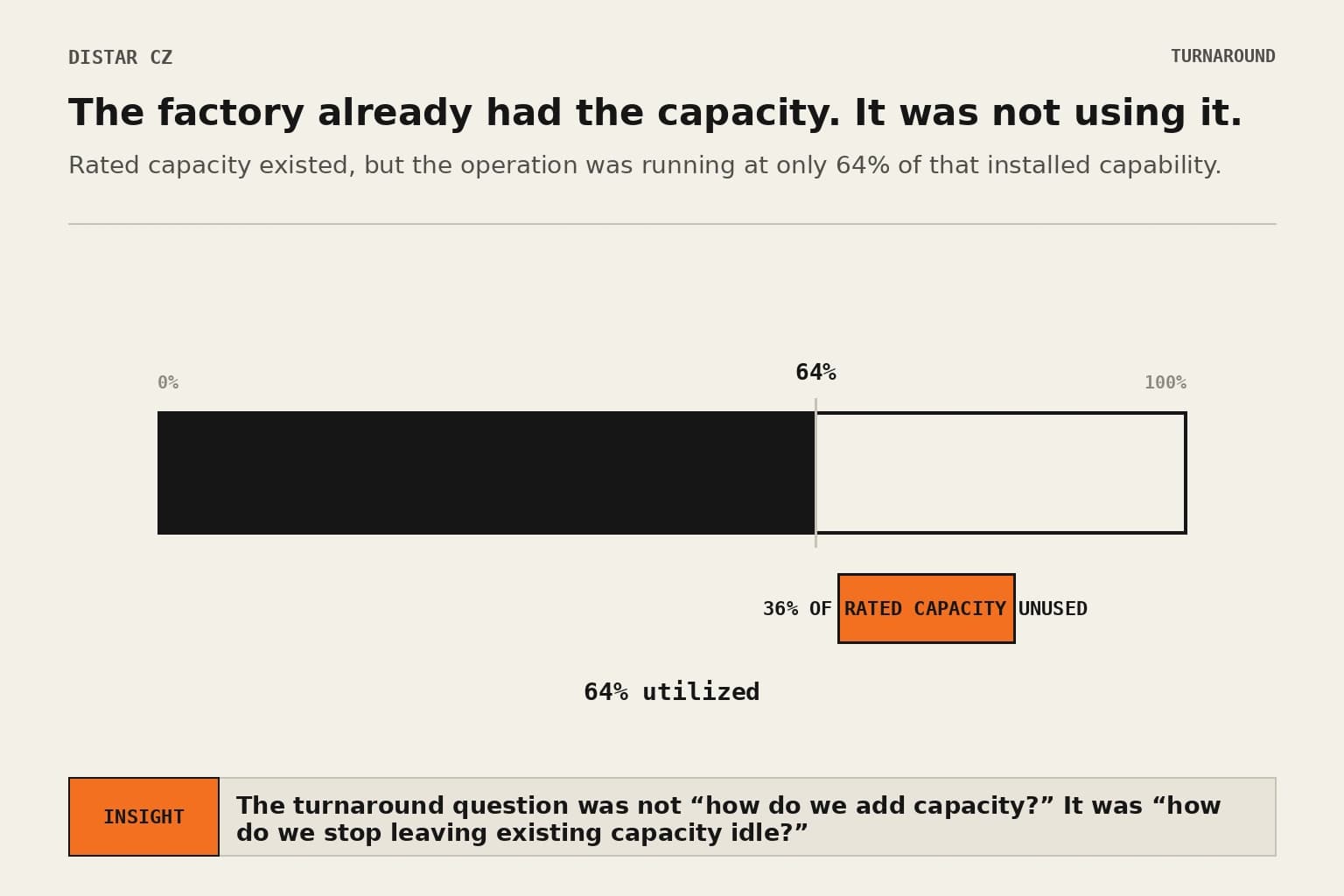
Distar CZ builds composite aircraft and unmanned platforms in a factory outside Prague — its own engines, its own tooling, a dealer network across fourteen countries, aircraft certified in Europe and the US. I found the same platform listed under three separate names: URBAN CONQUEROR and SKY PROTECTOR in the English catalogue, Intruder and Watcher in a Russian teaser, "SAMBA UAV" in an Indonesian proposal. Three audiences, three naming systems, one actual product line — and the factory building it was running at 64% of its own capacity, sixteen aircraft a year against room for twenty-five.
Before / after
- 01 / Before
64% of rated factory capacity used — 16 aircraft a year against room for 25 — the same platform sold under three different names in three markets, and an aviation engine costing $16,100–$29,900 with a six-to-seven-month lead time.
- 02 / The substitution
A Škoda 1.0 TSI, already flying on an aircraft since 2012, replaced the aviation-engine shortlist: under $4,600, delivered inside 60 days.
- 03 / After
One consistent product line, a repositioned brand, and a completed UAV-programme transaction with a Chinese partner.
Production was never the constraint. Much of what the company had built had sold through relationships and reputation, with little marketing behind any of it. That works until a grant committee, a new partner, or a buyer outside the existing network needs the company to explain what it actually is — and without a consistent way to answer that question, the company had three different answers ready depending on which catalogue someone picked up.
The clearest version of the whole problem showed up in the engine. Every aircraft flew on a bought-in aviation engine, and the market had four real options: $16,100 to $29,900, burning sixteen to thirty-five litres an hour, six to seven months from order to delivery — which meant next year's engines had to be ordered in June, with prices already expected to rise another 12 to 15% on rising demand elsewhere.
Instead of picking among the four, I wrote down what the engine actually had to do: 110 to 120 horsepower, no more than eight or nine litres an hour, under $5,750 all in, under 75 kilos dry, delivered inside sixty days, with a manufacturing history and parts supply that a low-volume aviation-specific engine couldn't offer at that price. Nothing in the aviation-engine category met that list. So the aviation-engine category wasn't where the answer was. A Škoda 1.0 TSI — installed and flying on an aircraft since 2012, seven years of operation without the failures that review was checking for — came in under $4,600. The last requirement on the list turned out to be tied to the price itself: an engine built in the millions is cheap and available for the same reason its parts and failure history are well understood. The constraint and the answer were one property, not two. It is the same rule I apply to defense hardware in what breaks first between prototype and series production.
The rest of the engagement followed from there. The naming inconsistency led to a full repositioning; the engine problem led to a sourcing process built the same way for other components; a separate review of what the company actually owned found that converting existing airframes into unmanned platforms wasn't a new product to invent. It was a new use for assets Distar already had — which is what eventually justified digitalising the company's processes, rebuilding the brand, and putting an ERP and a shared supply chain under all four of its unrelated business lines.
That last thread ended in a completed transaction with a Chinese partner — which reads as a lucky meeting until you notice the board already had a Chinese vice-president, certification was already running with the Chinese aviation authority, and the energy arm's solar equipment already came from a Chinese manufacturer. The sale was the end of a line that had been running the whole time, not a coincidence.
If you're solving a supply problem inside one category and the numbers keep not working, write down what the thing actually has to do — the real specification, not the category you've been shopping in — and check whether something outside that category already meets it at a fraction of the price. The category is often just the place you started looking, not the actual requirement. For a hardware startup facing its first production run, the same reasoning is in hardware startup manufacturing.
- 64%
- factory capacity utilisation16 aircraft a year against capacity for 25; this was unused capacity, not a capacity increase
- 14
- countries in the dealer network
- $29,900 → <$4,600
- engine acquisition costAbout seven months for an aviation engine versus about 60 days for a Škoda 1.0 TSI; cost and availability were decision criteria
- Completed
- UAV programme transactionWith a Chinese partner
The full engagement record
Distar CZ — case study