
Sales and marketing · Defense tech
Omnipol's engineering was never in question. Its paperwork was what kept it out of the room.
An established Czech defence and aerospace group needed more than tidier materials. The work was business development, compliance, and getting a technology transfer over the line.
A defence and aerospace group can have engineering strong enough to win on merit and still lose ground in a procurement process, because the room deciding whether to buy isn't reading the engineering the way an engineer would. Omnipol was exactly that group: established, Czech, real history and engineering depth, losing ground for reasons that had nothing to do with the engineering itself.
In defence procurement, evaluating a product on its own merits is only part of the decision. Institutional buyers move a purchase through committees, and what those committees need before they can approve anything is evidence that the supplier's compliance and operational requirements are covered — documentation a reviewer can point to, not a technical argument they'd have to make themselves. A group can have stronger engineering than its competitors and still lose, because "stronger engineering" isn't something a compliance file can show.
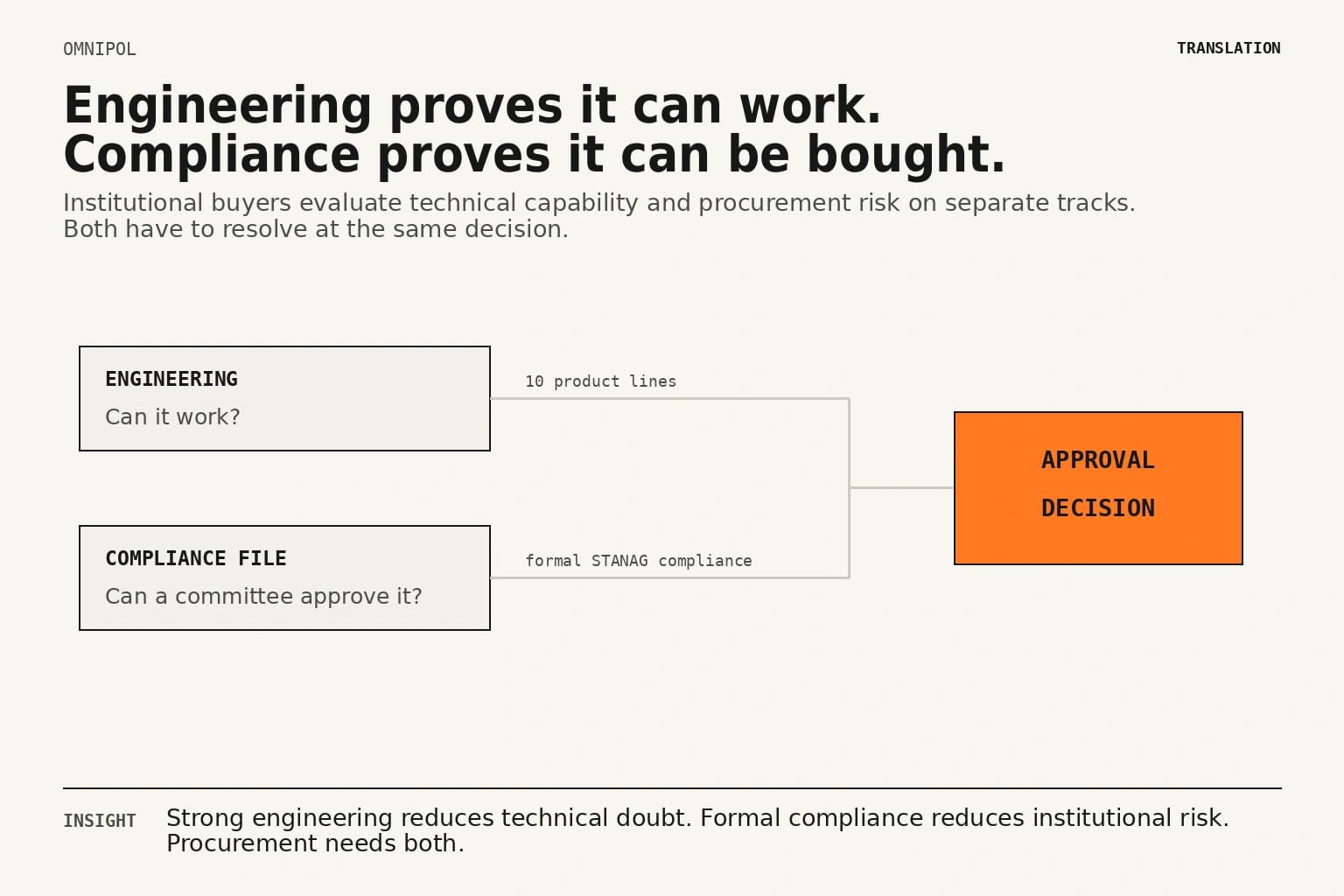
Going through the product lines against NATO STANAG requirements — the standards a supplier has to meet before a buyer's compliance process will take the submission further — found the actual gap: real engineering capability with no compliance record attached to it. Ten product lines were brought into NATO STANAG compliance, and that work was treated as commercial work rather than a paperwork formality, because without it the group wasn't in the conversation at all, regardless of how strong the underlying engineering was.
The negotiation materials themselves changed target. They stopped being written to the engineer who already understood the capability and agreed with it, and started being written to the committee that had to approve the supplier before the engineering was even up for discussion. Engineering answers whether something can work. A compliance file answers whether a committee can approve it. Only one of those was actually on the table in the room that mattered.
- 10
- product lines brought into NATO STANAG compliance
Engineering answers whether something can work. A compliance file answers whether a committee can approve it.
A second finding changed the commercial structure. For some buyers, a completed sale is worth less than a technology transfer with local production rights, since it answers a concern the buyer usually won't raise directly: dependence on an outside supplier who could, at some point, stop supplying. Structuring the offer around transfer and local production rather than a one-off sale changed what the buyer was actually being asked to agree to. The same move works for Ukrainian drone makers looking for European partners, as I describe in finding a European partner for a Ukrainian drone company.
The engagement contributed to a deal that closed as a technology transfer rather than a shipment. The engineering had been sufficient the entire time. What hadn't existed was a compliance record the buyer's own process could actually act on.
If your business sells into any process with a formal buyer-side committee — procurement, compliance, an approval board, a bank's credit committee — go find out what evidence that specific committee needs before it can say yes, separately from whether your product or service is actually good. Those are two different questions, and a business that only ever answers the first one is leaving the second one to guesswork right up until it loses on it.
The full engagement record
Omnipol — case study