
Team and contractors · Defense tech
A founder sold his stake and left the country. The community he built outlasted the exit.
Not a client project: a venture I started with a partner to get aviation people into the same room. It reached self-sustaining, paid for its own events, and kept going after I sold my share.
A partner and I started the community because there was nowhere for aviation people to actually meet each other — enthusiasts, industry people, specialists, potential partners, all sitting in separate corners of the same industry with no room that held all of them at once.
Everyone was excited about drones and aerial data in the way an industry gets excited before anyone has answered the boring questions. Who joins. Who pays. Who verifies a pilot's credentials. Who actually answers the emails when a member has a problem. Excitement about the technology doesn't answer any of those.
The specific problem sitting underneath all of it was financial shape, and it had almost no room to move in. A community that loses money closes. A community that chases profit stops being a community, and members can see the shift in what gets prioritized. The value was never a product sitting on top of the network — it was the network itself, and what actually delivers that value is events and introductions, both of which cost real money to run. So membership had to fund the events, the events had to make the membership worth renewing, and the actual target from the start wasn't expansion. It was breaking even, on purpose, indefinitely.
It got there, across roughly two years. Revenue came in, most of it went straight back out into events, and the thing never ran at a loss. It also never made serious money, which was never what it was built to do.
When a move to the United States meant stepping away from day-to-day involvement, the choice wasn't to wind it down. My share went to my partner for an agreed percentage, and the community kept running under him — in a different format than the one I'd left, which is exactly what you'd expect from something that's still alive rather than preserved under glass.
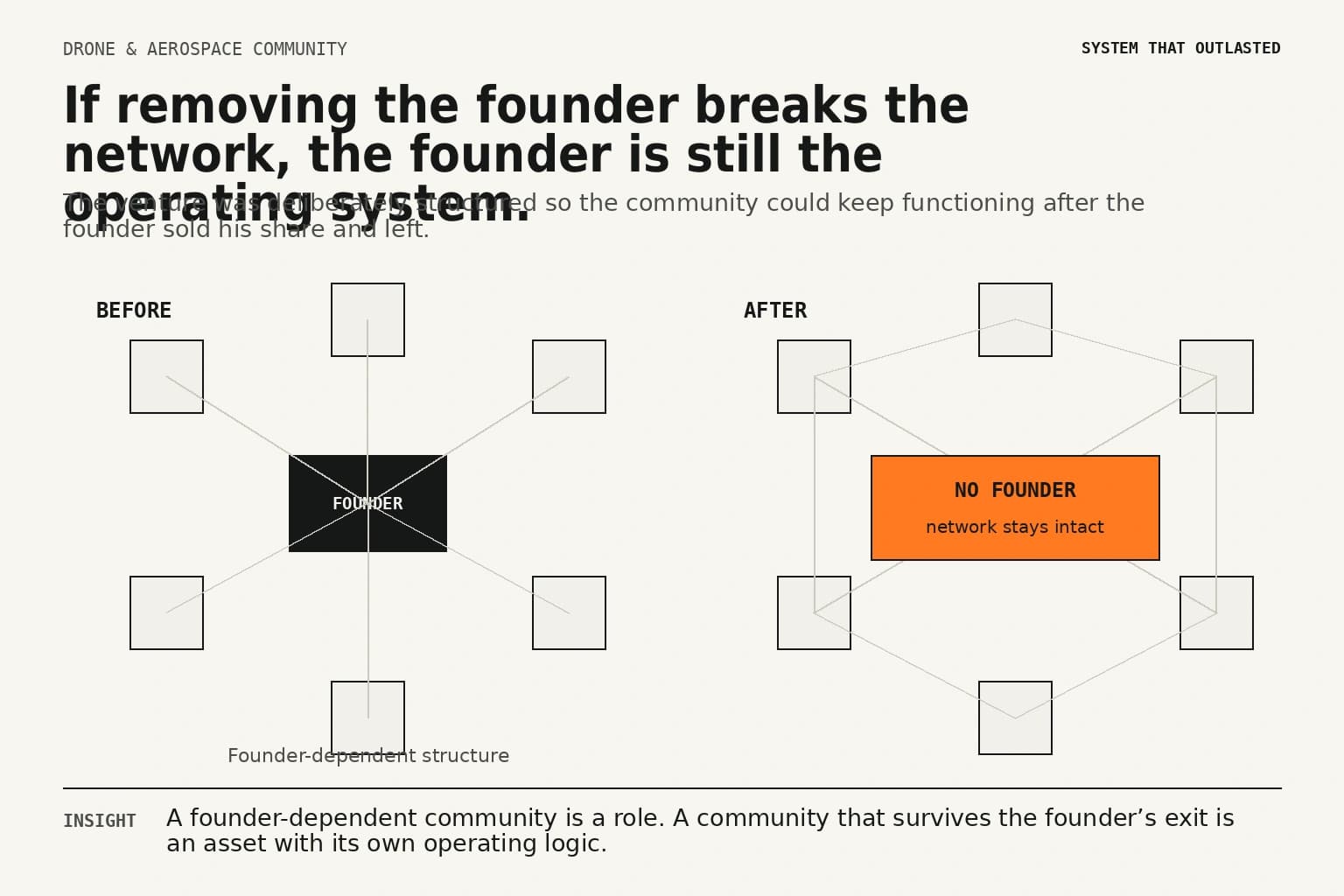
That's the part actually worth pointing at, more than any single event or membership number. Most founder-led communities don't survive the founder leaving, because the thing holding them together was one person's presence rather than a structure that could keep working without it. This one had a financial shape simple enough — and disciplined enough — that somebody else could pick it up and keep it breaking even without needing to be me to do it.
If you're building something that depends on you specifically showing up — a community, a client relationship, an internal process only you fully understand — write down every cost that only exists because you're the one there, and check whether someone else could keep the same thing breaking even without adding people or money to cover for your absence. If the honest answer is no, that's the actual project. Fix the financial shape before you worry about anything else it needs.
The full engagement record
Own venture, founded with a partner — case study