
Sales and marketing · Defense tech
The same drone meant three different things to a defence buyer, an industrial buyer, and a commercial one.
Serious technology spread across too many use cases, civilian, industrial, military, flagship, custom. Everything mattered, which meant nothing was easy to buy.
Robodrone Industries builds unmanned aerial systems for defence and surveillance — serious engineering, spread across civilian, industrial, and military applications, in flagship and custom configurations. I went through the product catalogue asking a single question of every entry: which specific buyer lands here and recognizes their own situation? Most pages didn't have an answer. The method that came out of it is in dual-use drone companies sell capabilities to buyers who buy situations.
Nothing on that list was wrong. Every capability was real. That was exactly what made it hard to fix — there was no broken claim to point at, just a catalogue organized around what the technology could do, handed to buyers who were organized around what they actually needed to happen.
Many defence and dual-use procurement processes involve multiple reviewers and additional risk checks before a decision moves forward. Landing on a catalogue and having to work out which of ten capabilities applies to a specific situation is often enough on its own to lose that kind of buyer — not because the product is wrong, but because nothing told them it was obviously right. Most procurement conversations start from an operational requirement, not a specification list — watching a perimeter, transporting equipment or supplies, supporting a team on the ground — and the catalogue was never organized around any of those situations directly.
- +30%
- qualified deal flowIn under two months. Baseline counts to be confirmed
- 3
- buyer verticals definedSurveillance, logistics, tactical support
- 3
- buyer tiers addressedGovernment, NGO, commercial
- <2 mo
- time to measurable effect
Nothing about the underlying technology changed. Only the arrangement of it, for the person trying to buy it.
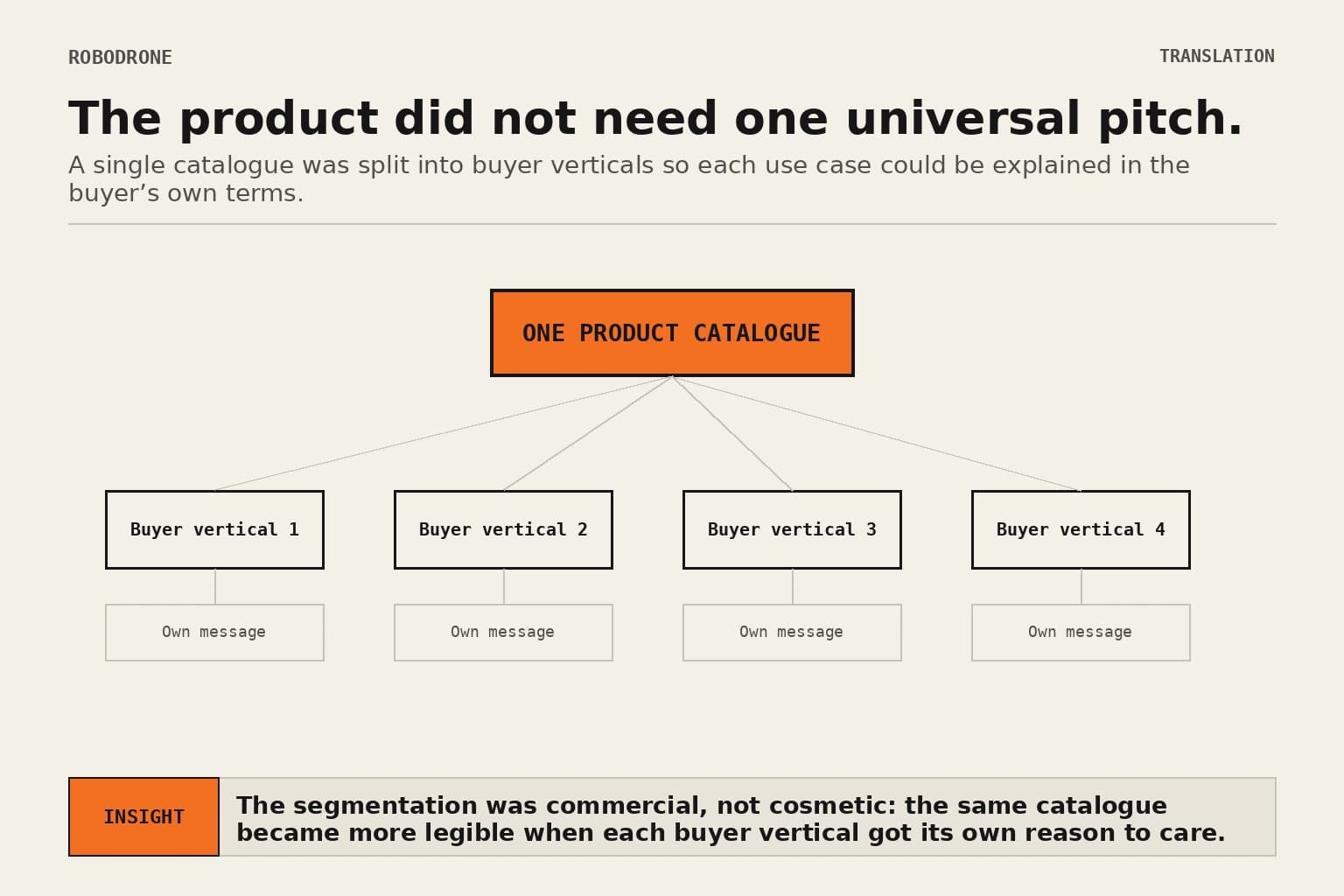
The communication got rebuilt around three buyer verticals instead of product capability: surveillance, logistics, tactical support. Each one got its own proof and its own compliance language, since the same system has to justify itself differently to a government buyer, an NGO, and a commercial one. The flagship-versus-custom distinction — previously a decision left entirely to the buyer to work out alone — got resolved before the buyer ever had to ask.
The number of qualified opportunities rose 30% within two months. Conversations at defence expos matched buyer questions more closely, and the flagship-versus-custom question stopped being something a prospect had to puzzle out from outside.
Nothing about the underlying technology changed. Only the arrangement of it, for the person trying to buy it.
The harder part of this work was subtraction, not addition. Narrowing what a technical company says it can address is an uncomfortable conversation internally — every capability on a catalogue like that has someone who built it and wants it represented. The fix here wasn't simplifying the technology. It was giving a buyer an entry point they could find without reading the entire catalogue first.
If your product or service does genuinely many things, check whether your own materials are organized around your capabilities or around the three or four situations that actually bring someone to you. A buyer who has to translate your capability list into their own problem before they can even start evaluating you has already done work you should have done for them.
The full engagement record
Robodrone Industries — case study