
Operations · Healthcare and wellness
Elomia had five personas and twenty-six data points each. Two of them explained everything.
An AI that stands in for a psychologist, 24/7, at a ninth of the price. The product worked. Nobody could see where users were dropping out, and the media buying was aimed at the wrong variable.
I went through the five customer personas Elomia's team had built, twenty-six attributes each, expecting the useful signal to be scattered across most of them. Two fields actually predicted anything: the emotional trigger, and the moment it hit. Work stress, loneliness, low self-esteem, anxiety, chronic fatigue. Almost nobody used Elomia during a scheduled therapy hour. People used it at work, or in the evening, doing something else entirely, close to the opposite of when a session normally gets booked in advance.
Elomia is an AI that gives round-the-clock psychological support, and a controlled study had already put it close behind a human psychologist and ahead of every other bot tested; the product itself wasn't the open question. Nobody could see where users were actually dropping off, and the media buying was built to reach a person Elomia's own data said didn't exist.
Before any of that reached the media buying, names and locations were stripped from the signal entirely — the targeting worked on population-level emotional patterns, never on an individual conversation.
The clinical data pointed at a related gap from a different direction: up to 45% of suicides happen between six in the evening and one in the morning, hours when almost no psychologist is on duty. That doesn't mean everyone active in that window needs urgent support — it means the hours when mental-health risk runs highest and the hours when professional support is staffed don't overlap, a service-availability gap the industry's own scheduling model doesn't address.
Every other product in this category buys media on age, gender, and interests. Age and location didn't explain the moment someone actually opened the app — people opened it in response to a specific emotional state, not a demographic profile.
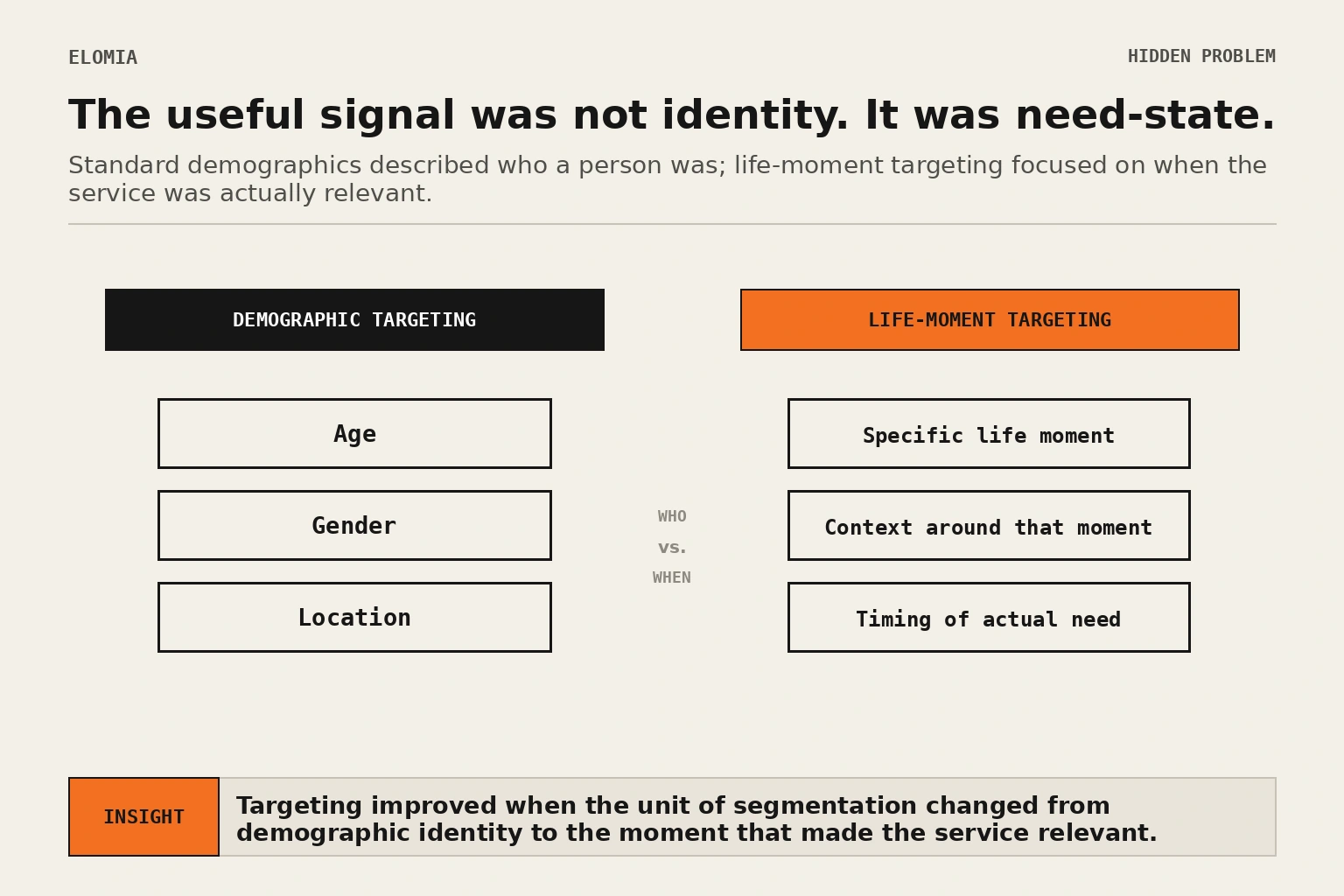
Elomia's own product already measured that: it classifies twelve emotions in conversation and tracks how a state moves across a day. That signal sat inside the app, unconnected to the media buying happening right next to it.
Reliable measurement got fixed first, with the development team, before anything else moved — without it, every test result was impossible to interpret either way. Targeting shifted from socio-demographics to the emotional-state signal already live inside the product. Twitter became the primary channel at $0.03 a click, against $0.60 on Google Ads for a better-qualified audience elsewhere. Onboarding lost steps and moved its explanations earlier, so the first few minutes matched whatever had just led someone to open the app.
The changes touched both how people found Elomia and what happened right after. Acquisition cost fell 70%. Lead-to-install conversion rose 32% within a month. 47.3% of users recommended Elomia to someone else. On the UK launch, the bot ran 1,848 consultations in fourteen days — a single psychologist running that volume would need roughly 300 days to match it.
Two things stayed genuinely hard, documented rather than smoothed over. Ad platforms flag mental health content constantly, and account blocks forced repeated changes of creative. The model misread context in about 10% of dialogues — sixteen psychologists covered that share directly and trained it as they went.
If your product already measures something about how people actually use it — a state, a moment, a pattern — check whether that information ever reaches the people deciding how to find your next customer, or whether it's sitting inside the product doing nothing for the budget spent finding one.
- −70%
- customer acquisition costFrom the proprietary emotional-state targeting system
- $0.03
- cost per click on the primary channelTwitter, against $0.60 on Google Ads
- +32%
- lead to install conversionWithin one month of the funnel and messaging changes
- 1,848
- consultations in the first 14 days in the UKA single psychologist would need roughly 300 days
The full engagement record
Elomia — case study