
Sales and marketing · Healthcare and wellness
An ad for a hospice kept getting blocked. Each time, I had to find a version of the same sentence that still meant something once the parts that sounded like pressure were gone.
The goal was two admissions. About twelve arrived. Most of the work was finding a way to speak honestly to families that Meta would actually approve.
Westlake Village Hospice needed a small number of new patients — two would have met the goal — on about $1,000 a month. The budget wasn't the constraint that shaped the work. The category was.
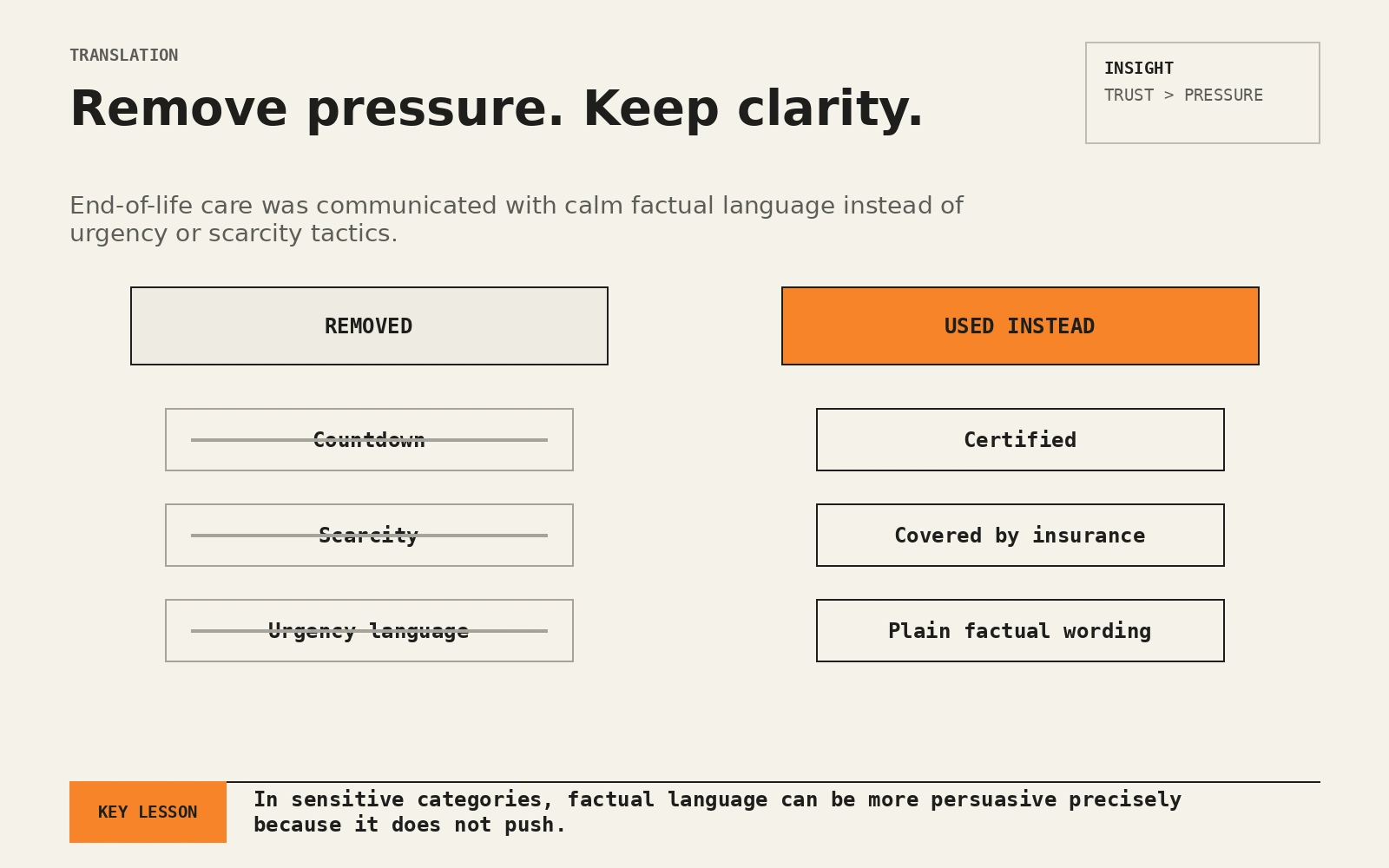
Almost everything a normal ad account uses to move someone to act works through pressure: a countdown, a limited number of places, a reason to act now instead of later. None of that belongs in front of a family whose relative may not have long left, and Meta's own review policy blocks most of it in this category — along with some ordinary, factual advertising that gets caught in the same net. What was allowed was narrower than what was needed: describe the service clearly enough for a family to act on it, add no pressure, and stay inside rules written for a category most performance marketing shouldn't be operating in to begin with.
Every ad that went up was rejected at least once. Each rejection meant going back through the same sentence and the same photograph to find wording and images that still carried the point, still passed review, and still read like they came from a person rather than a policy document. There was no single fix. It took repeated passes before an ad both stayed live and said what it was there to say.
What survived settled on one word: certified. It answered a factual question about the provider without making any claim about what would happen, which is the only kind of claim an ad in this category should be allowed to make. A second line noted that the care is typically covered by insurance in the US — a fact, not a pitch, and one most families don't already know.
Every photograph carried a hand, an arm, or eye contact: something that showed care without showing or naming what the care was for. The ads were addressed to the adult child, since the adult child is the one making the call, not the patient.
The client reported about twelve new patients against a goal of two, on the same roughly $1,000 monthly budget, and reported that the hospice reached full capacity. Those are the client's own figures, not a platform export, and they're labelled that way here for the same reason they're labelled that way in the case record itself. After that, the enquiries requested stopped, which in this business is what the result looks like: a hospice at capacity has nothing left to advertise for.
If you're advertising into a category where the person reading your copy is already carrying something heavy — grief, illness, debt, anything with real weight behind it — go through your own ad copy line by line and remove everything whose only job is to create urgency. What's usually left after that is thin. Replace the gap with one fact that is true and specific to what you actually do, the way "certified" or "covered by insurance" did here, rather than reaching for a new way to create the same pressure you just removed.
A hospice at capacity has nothing left to advertise for.
- ~12
- new patientsClient-reported; against a minimum goal of two
- 6×
- the stated objectiveDerived from the client’s reported count
- ~$1,000
- monthly budgetClient-reported
- Full
- available capacityClient-reported outcome
The full engagement record
Westlake Village Hospice — case study