
Sales and marketing · Manufacturing and industrial
A founder wasn't deciding between suppliers. He was deciding if packaging was worth the money at all.
A packaging manufacturer producing runs from 10 units. The buyer isn’t comparing suppliers, he’s deciding whether the category is worth any money at all.
Nadrukuemo makes labels and packaging for finished products, in runs from ten units — most of the market needs volume, so that small-batch capability was the real asset. The page selling it read like a spec sheet: materials, minimums, turnaround. I opened the company's own persona research to see how two actual buyers talked about packaging before either of them ever reached that page.
A first-time founder's objection was sitting right there in the research, stated plainly: he doubts unique packaging is worth spending anything on at launch at all — twenties, regional city, limited budget, packaging competing directly against product spending. A second buyer's file read differently: established, forties or fifties, running a jewellery shop or a mini-market, working by phone rather than online, who had never had anyone make the case to him for what packaging could do.
Neither one was comparing Nadrukuemo to a competitor. One doubted the whole category. The other had never considered it. Materials and price don't answer either objection, because neither objection was about materials or price.
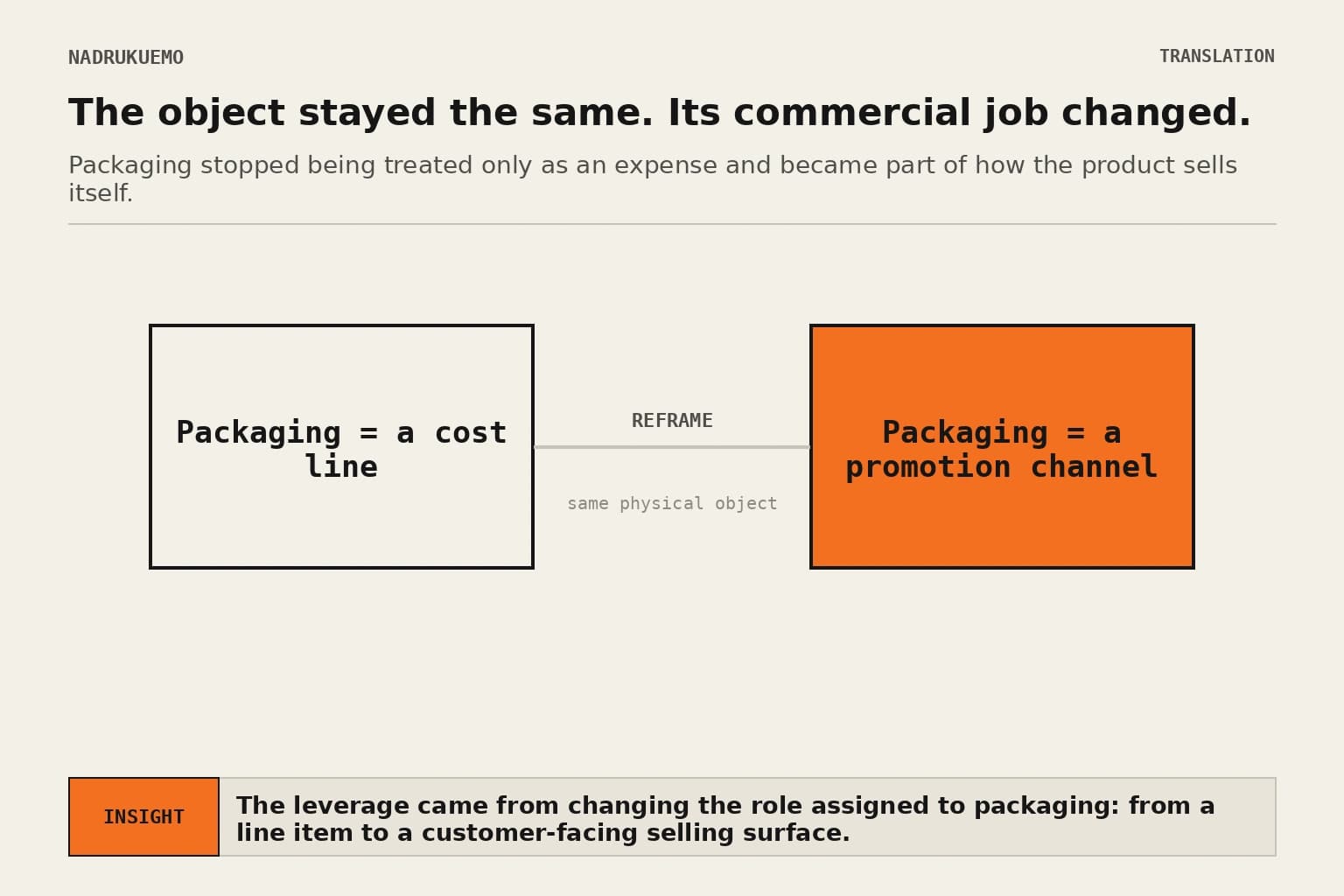
One line in the research changed the first buyer's math entirely: he wants packaging his customer will photograph and post. That single sentence moves packaging out of the cost column and into a budget this buyer had already committed to spending on promotion — just not on this line item, until someone connected the two out loud.
- 2 days → 4 hrs
- quote response time
- ~12×
- faster time to quote
- 10
- unit minimum orderWhere competitors need volume
- 1 hr
- quote guarantee, or 10% offThe commitment written into the new site
He wants packaging his customer will photograph and post.
The operational side had its own gap. Quotes were taking two days. By the time Nadrukuemo answered, a founder on a tight timeline had often already bought from whoever picked up the phone first.
Packaging got repositioned as promotion, connected directly to spending the founder had already planned for. Quote turnaround became the first target, ahead of any campaign work. The ten-unit minimum — the one requirement most competitors couldn't match — moved to the front of the pitch. An online configurator replaced the brochure-style site, letting a buyer filter, configure, and price a job without calling anyone. The catalogue got filtered by what goes inside the box — food, cosmetics, alcohol, flowers — instead of by manufacturing specification, since a buyer selling soap knows they sell soap and has no reason to search by corrugated-board terminology. A commitment went on the front page: a costed project within the hour, or 10% off.
Quotes went from two days to under four hours — roughly twelve times faster — and it held after the engagement ended, because the client's own team ran the new process themselves. Why response time belongs on every supplier scorecard, buyer's side as well as seller's, is in the supplier scorecard.
If you sell something your buyer keeps quietly deciding isn't worth the money, stop rewriting the specifications page. Go find the one sentence your actual buyer says about it to someone else, and check whether your price sits in the budget they've already agreed to spend — just under a different name.
The full engagement record
Nadrukuemo — case study