
Sales and marketing · Government, policy and non-profit
The grants existed. Finding out you qualified was the actual application.
A cultural grant programme was reaching people who then didn’t apply. Eligibility was never the barrier. The process just felt hostile to anyone who hadn’t done it before.
I opened House of Europe's grant catalogue the way a first-time applicant would, and timed how long it took to reach something realistic to apply for. The search took longer than expected before the catalogue surfaced something a realistic applicant could pursue: the catalogue itself was the first barrier, before eligibility rules, before the application form, before anything about the grant itself. House of Europe runs cultural grant opportunities in Ukraine for artists, educators, and NGOs, and had come to me wanting more applicants.
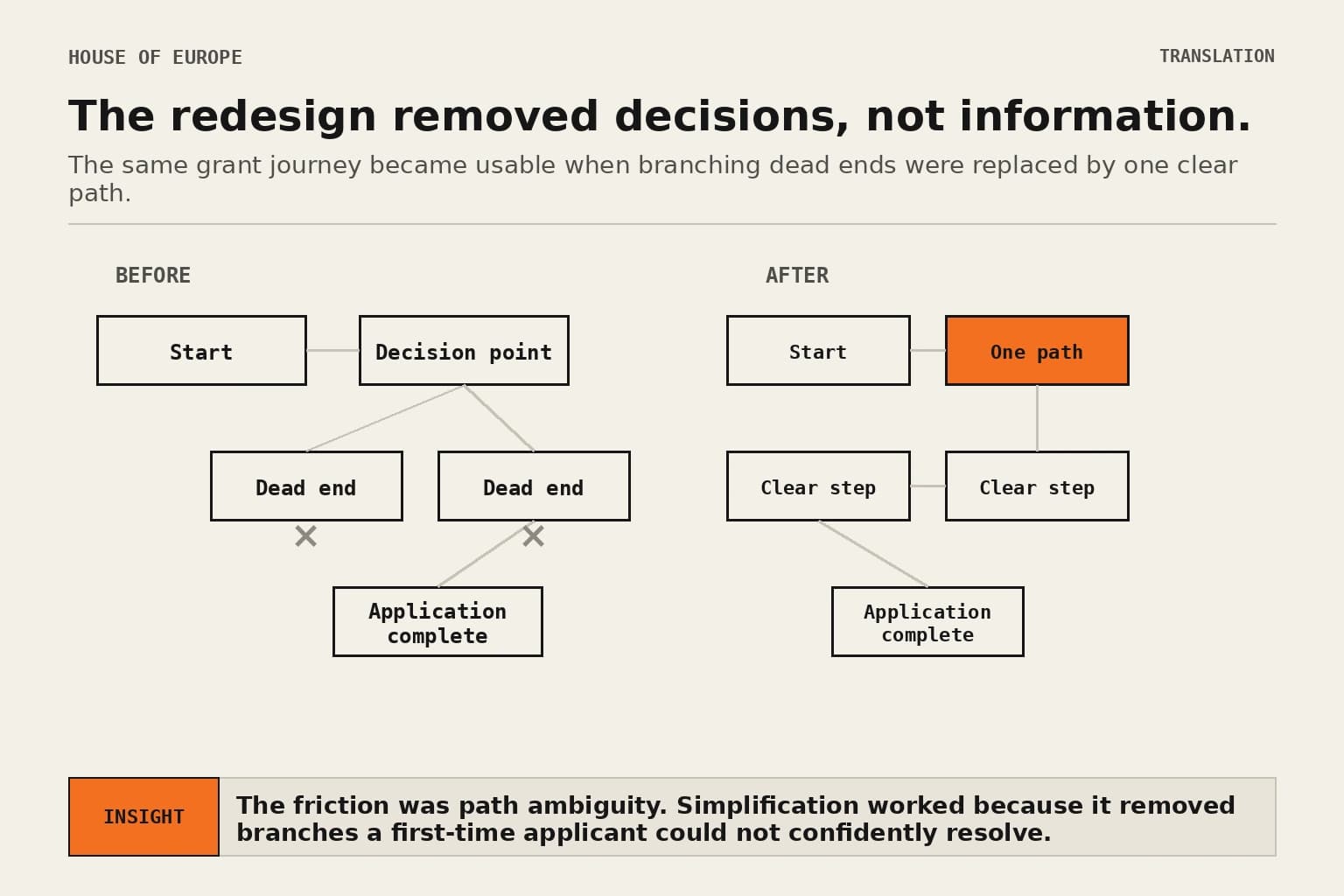
The entry-level opportunities were on the page. They just weren't first. A newcomer worked through tabs and eligibility rules written in formal language, and reached the hardest opportunities before anything matching their own eligibility. The gap appeared before the application ever started: a visitor had to identify themselves inside a catalogue organized around the programme's structure, not around who was reading it.
- +22%
- first-time applicant conversionPilot phase
- −40%
- information search time
- 3
- applicant segments addressed separatelyArtists, educators, NGOs
- Reusable
- communication modelApplied to later grant rounds
A visitor had to identify themselves inside a catalogue organized around the programme's structure, not around who was reading it.
Artists, university educators, and NGOs were reading the same page from three different starting points. One catalogue, written in one register, was organized for none of those three specifically.
Entry-level opportunities moved to the front of the information, so the first thing a newcomer saw was something matching their own eligibility. Communication split into three separate tracks — artists, educators, NGOs — instead of one general version, so a visitor could identify a relevant opportunity without reading through the full catalogue first. The tracking shifted to whether a first-time visitor moved from reading to actually submitting an application, since repeat applicants were never the group getting stuck. The process itself was documented, so a later grant round could reuse it.
The rules themselves couldn't be rewritten casually. Eligibility carries legal and financial consequences, so every rule that touched a legal requirement got checked sentence by sentence against what it needed to actually say — readable and accurate had to both hold at once.
First-time applicant conversion rose 22% in the pilot. Information search time fell 40% over the same period. The documented process was used again in later grant rounds. The 22% increase appeared after entry-level opportunities and audience-specific information moved earlier in the page — not after the programme reached anyone new.
If you run something first-timers have to navigate — an application, a signup, an onboarding flow — open it yourself and time how long it takes to reach something you could realistically complete. The problem may not be getting more people to show up. It may be helping the ones already there find their next step before they close the tab. The wider research on why eligible people stop before applying, and what raises take-up, is in why eligible people don't apply.
The full engagement record
House of Europe — case study