
Sales and marketing · Government, policy and non-profit
In the first weeks of the invasion, I measured how long a visitor stayed on the page before taking any action. About six seconds.
In the first weeks of the 2022 invasion, a humanitarian platform had to connect people who needed help with people offering it, fast enough to matter, and trusted on sight by both sides.
Needhelp.com.ua had to connect people who needed help with people offering it, at a scale nobody had planned for, on a budget close to zero. Six seconds wasn't enough time to explain what the platform was. It was enough time to answer four questions: is this real, is this safe, will anyone actually answer, and can I hand these people my information.
People arriving on that site weren't comparing options the way a buyer would. Two sides needed convincing inside those same six seconds — someone requesting help needed a reason to believe a response would come, and someone offering help needed a reason to believe their effort would reach an actual person. Losing either side stopped the platform from working for anyone. There was no time to build that confidence slowly. It had to already be there on first contact.
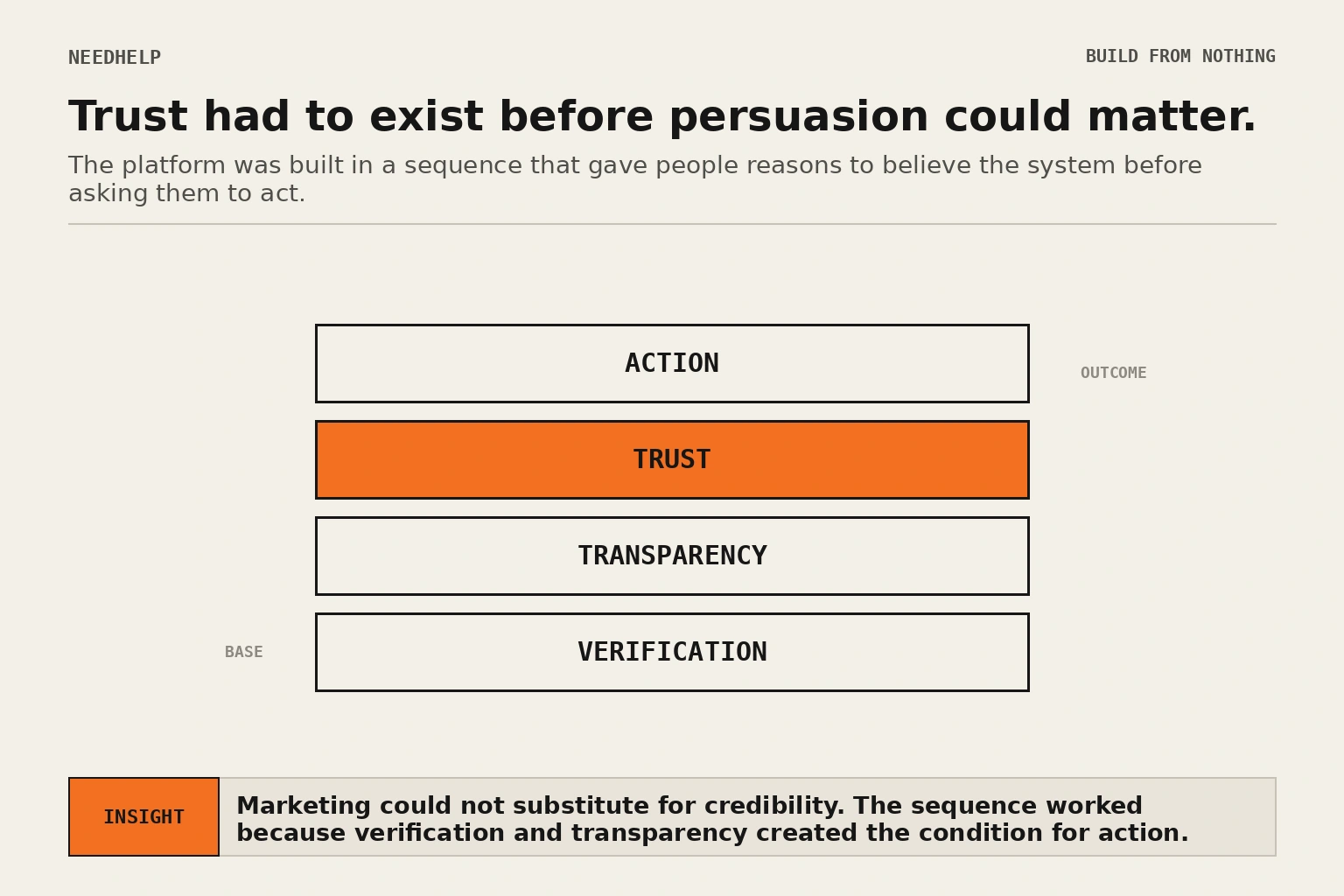
The fastest route to it wasn't a design choice. It was official recognition — pursuing endorsement from Ukraine's Ministry of Digital Transformation specifically because "is this real" gets answered faster by an independent confirmation than by any amount of copy on the page itself. Both sides of the platform had to grow at the same time, because a service connecting two groups doesn't work with only one of them showing up. Guides, updates, and documented examples of aid that had actually been delivered showed visitors what the service did, instead of asking them to take a claim on faith. Site performance under load got treated the same way — not a technical number to optimize, but part of the same six-second question, because a page that fails during someone's first visit answers "is this real" the same way a lie would.
How it was built
- 01 / First 6 seconds
Enough time to answer four questions: is this real, is this safe, will anyone answer, can I hand over my information.
- 02 / Trust built, both sides
Ministry of Digital Transformation endorsement pursued specifically because independent confirmation answers "is this real" faster than any copy on the page could.
- 03 / Scale reached
12 million people reached, 720,000 unique visitors, aid delivered to more than 17,850 people.
- 12M
- people reached
- 17,850
- individuals received aid
- 720,000
- unique visitors
- Top 3
- Ministry of Digital Transformation recognition
A page that fails during someone's first visit answers "is this real" the same way a lie would.
12 million people reached. 720,000 unique visitors. Aid delivered to more than 17,850 people. The Ministry of Digital Transformation recognized it among the top three digital projects of that period in Ukraine.
None of that was one person's work. Developers, volunteers, state partners, and the organizations moving aid on the ground carried the actual weight of it. The work described here mattered only because there was something real behind it for people to be pointed toward.
If you're asking someone to trust you in seconds, not minutes — a crisis line, a first-time buyer with something real on the line, a donor deciding where money goes — find the fastest independent confirmation you can put in front of them before you ask what they need. Something you say about yourself and something an outside source already confirmed answer two different questions, and only one of them works when there's no time left to build the case slowly.
The full engagement record
Needhelp.com.ua — case study