
Team and contractors · Government, policy and non-profit
The same request for aid could get answered twice, or not at all, depending only on which door it came through.
Dozens of separate channels connected volunteer groups to regional hubs. We replaced improvised coordination with light SOPs people could use without asking permission every five minutes.
Rapid-response aid distribution in Ukraine, coordinated in part through a UN agency, ran through decentralised volunteer networks — dozens of separate channels carrying requests, logistics, and reporting between grassroots teams and regional hubs. Every one of those channels was staffed by people working under real pressure, moving as fast as the need in front of them demanded.
When every request coming in feels urgent, something still has to decide who gets helped first, and in a system spread across dozens of channels with no shared picture, that decision wasn't being made by policy or by anyone's intent. It was being made by which channel happened to carry the message. The result was a specific, recognisable mess: the same need served twice by two different teams who couldn't see each other's work, another need missed entirely because it landed somewhere nobody was watching, and coordinators holding the whole picture from memory until they burned out.
The line that was actually missing wasn't a channel or a process. It was a written answer to one question: what can a local team decide on its own, and what has to go to a hub first?
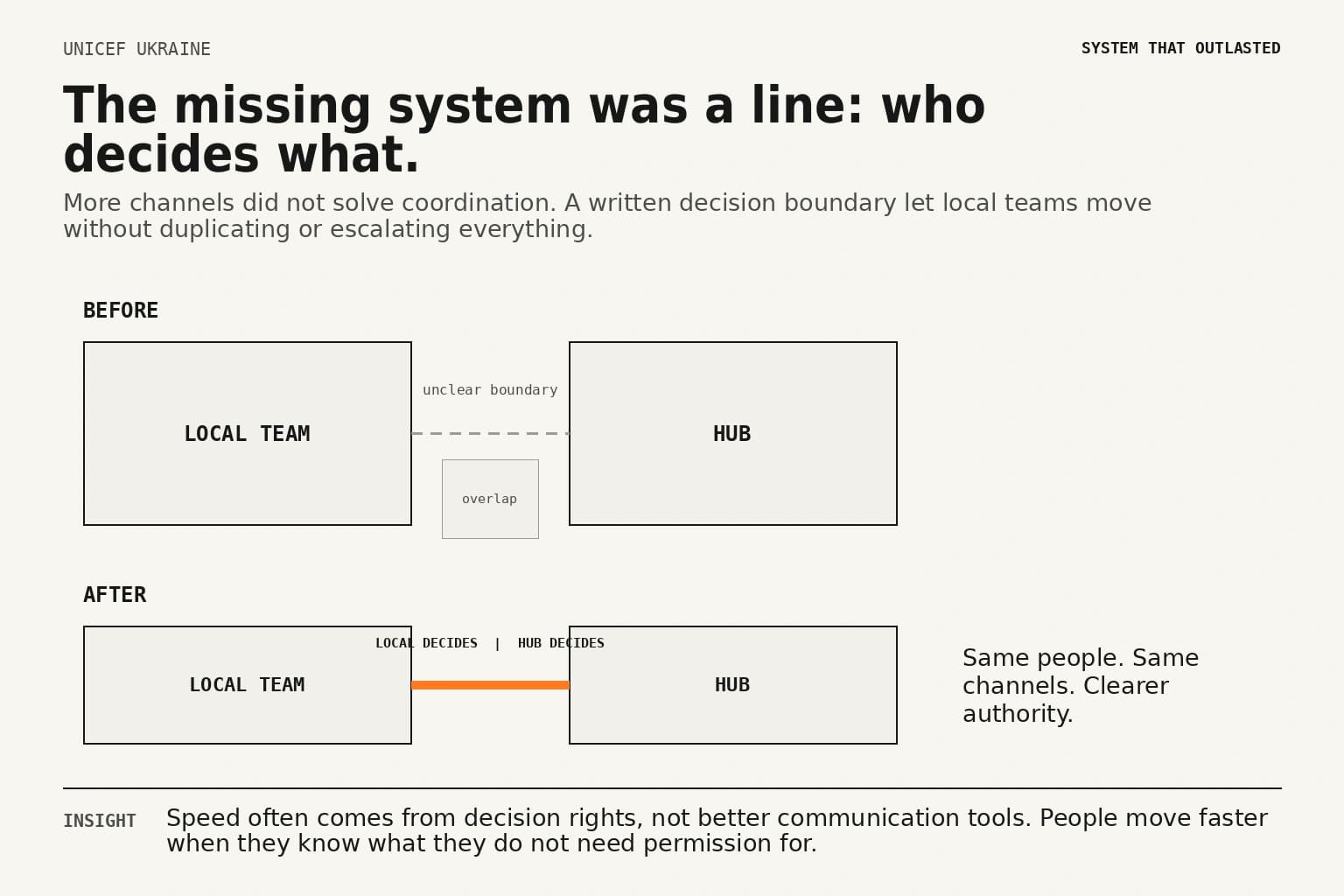
Nobody had ever written that line down. Without it, teams either escalated everything, which created a bottleneck right when speed mattered most, or acted alone on everything, which produced the duplication and the gaps.
Any fix had to work inside that pressure rather than pause it, which ruled out almost everything a normal operations project would reach for. Training gets skipped. Central approval gets bypassed the first time it costs someone urgent time they don't have. What went in instead were light SOPs and standard formats for requests, supply flows, and reporting — built to be usable by someone mid-crisis, not admired in a manual afterward. Several of them got simplified more than once before people actually used them without being reminded, because a template that adds friction to something urgent has to earn its place against the cost of a volunteer stopping to fill it in.
What came out of it wasn't a new team or a new authority sitting on top of the volunteer networks. It was a written line the teams themselves could use going forward, without anyone from a hub needing to be on the other end of every decision. Duplicated work dropped as requests and supply flows moved through the same formats, and resource use became something that could actually be traced instead of reconstructed from memory. Local teams kept acting fast — that was never the problem — but now with a shared basis for knowing which decisions were theirs to make alone.
If your organisation runs on people who are already working past capacity — volunteers, an on-call team, anyone making fast decisions under real pressure — look for the line that's missing rather than the process that's missing. Write down, in one short sentence, which decisions your own people can make without asking and which ones genuinely need someone else, and keep it short enough that someone under pressure will actually use it. How to draw that line and the formats around it is in volunteer coordination across dozens of channels.
The full engagement record
A UN agency in Ukraine — case study