
Operations · Software, AI and technology
Influence'AR's pitch said it would "redefine reality." I asked the founders what a buyer actually got for their money, and the deck didn't have an answer.
Influence’AR was an augmented-reality app built around influencer-linked NFTs. Buyers could place the objects in the real world, create content with them, and later resell them.
Influence'AR had built an augmented-reality app around 3D NFT objects linked to popular influencers — buy one, place it in the real world, film or photograph it, share the content, sell it later. The stated vision was a metaverse; the stated mission was to redefine reality. Neither sentence said what someone got for their money.
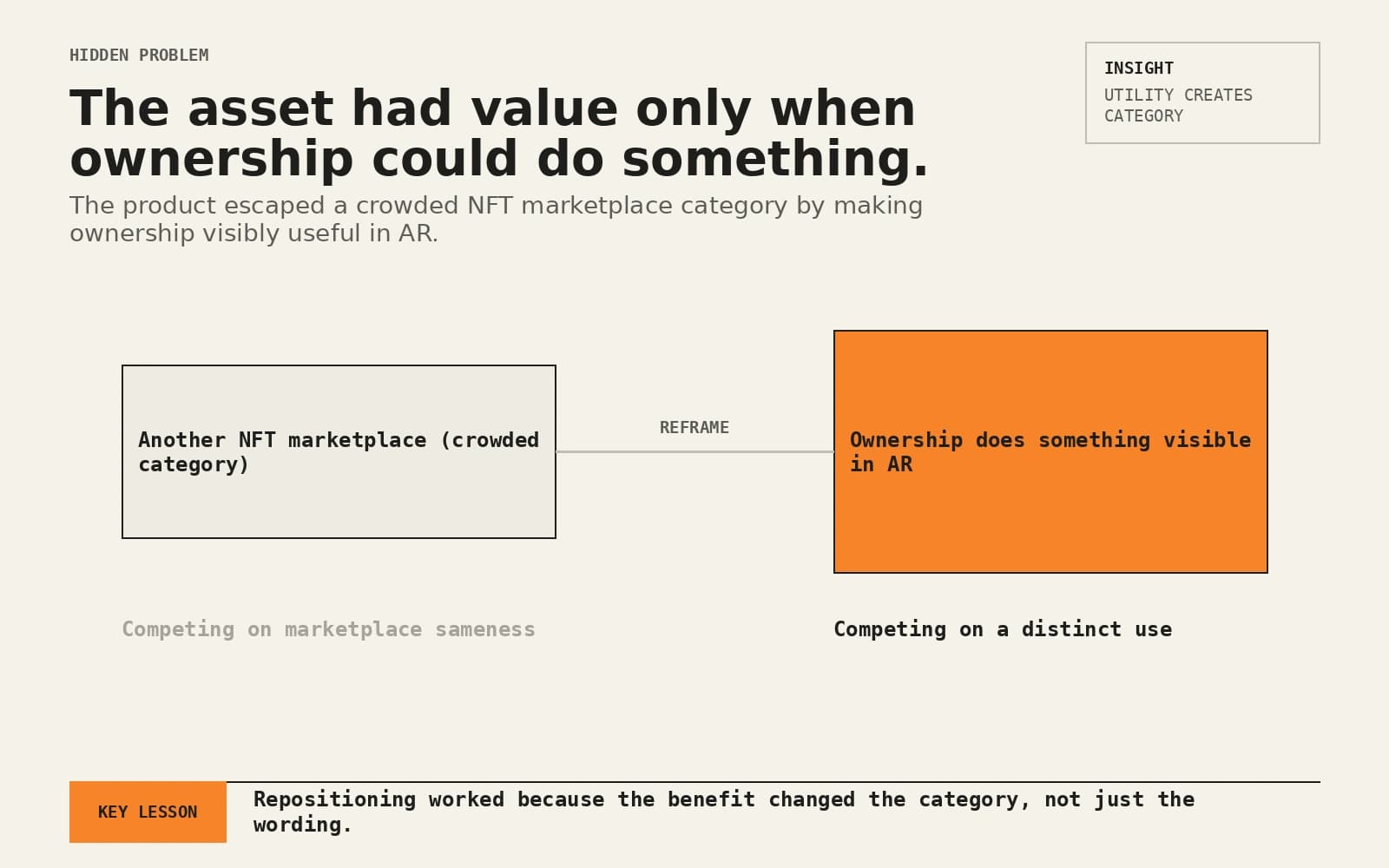
The market it was walking into was already crowded — OpenSea, Binance, VeVe, companies with more liquidity and lower fees than a new entrant could match. Positioned as another place to trade NFTs, Influence'AR was entering a fight it had no way to win.
One sentence, once somebody went looking for it instead of at the vision statement, said more than the whole deck: an NFT is an asset sitting in a wallet with no way to interact with it. Across the category, most of what had been sold was ownership and nothing after it — no way to place the thing anywhere, film it, or show it to anyone. That sentence moved the AR layer from a feature on a list to the reason the product existed at all — not another marketplace, but a product where owning the object triggered something you could actually do with it: place it in a real room, film it, post it, sell it on.
- 3
- named alternatives to displaceOpenSea, Binance, VeVe
- 3
- customer segments definedYoung trend adopters, investors, influencer audiences
- 50%
- of each sale paid to the influencerPlus 3% of every resale, indefinitely
- Shipped
- app on the App StoreMarketable MVP, not a deck
The audience split along the same line, once it was framed as purchase reasons rather than a single fanbase: a younger audience chasing a new trend, investors following something with a return, and existing fans buying to be closer to someone they already followed. An influencer's own following did most of the work of making the object desirable — the product didn't have to build recognition from nothing, only give that recognition somewhere to go.
The objects themselves carried that logic further. Not the influencer's own likeness, but the things around them — pets, interior pieces, accessories, personal items. A fan photographed next to a celebrity's dog is a photo anyone would post. The same fan holding a digital token shaped like the celebrity's face doesn't produce the same picture. Object choice was what let the loop — buy, place, film, post, resell — actually happen in public instead of staying inside a wallet.
The acquisition channel came out of the same logic instead of a media budget: the influencer's own audience was already there, so the influencer became the channel, not a target for it. Getting an influencer to promote the platform meant giving them a reason to keep doing it — 50% of the first sale, and 3% of every resale after that, for as long as the object kept changing hands. An influencer promoting the platform was promoting their own ongoing income, which is a different kind of promotion than one paid for once and forgotten.
The engagement shipped an app to the App Store with the full loop working, plus the positioning, the segmentation, and the investor materials built on the same reframe.
If your own pitch currently describes what your product does or what it stands for, try writing one sentence instead about what the person paying you cannot currently do without it. If that sentence is harder to write than your vision statement was, it's worth writing anyway — that difficulty is usually the sign you're closer to the sentence a buyer actually needs to hear.
The full engagement record
Influence’AR — case study