
Sales and marketing · Education, media and political campaigns
Ten years of practice produced habits. Only one test turned them into instructions someone else could follow.
Ten years of practice existed as habit rather than method. Turning it into a teachable framework meant breaking every part of it into steps somebody else could follow without asking a follow-up question.
An education brand wanted a digital marketing curriculum — take ten years of practice and turn it into something teachable. The brief sounded straightforward until I actually tried it. Most of what a decade of practice produces is habit, not a rule you could hand someone. You know an ad account is wrong within a minute of opening it. Saying why, in a form someone else could copy on their own, is a completely different skill.
Every rule I tried to write started sliding toward "understand your audience" or some version of it — true, ungradable, and useless to someone staring at a blank ad account the next morning. Courses built that way teach principles a student can agree with and still not know what to do with, which is a different failure than bad content.
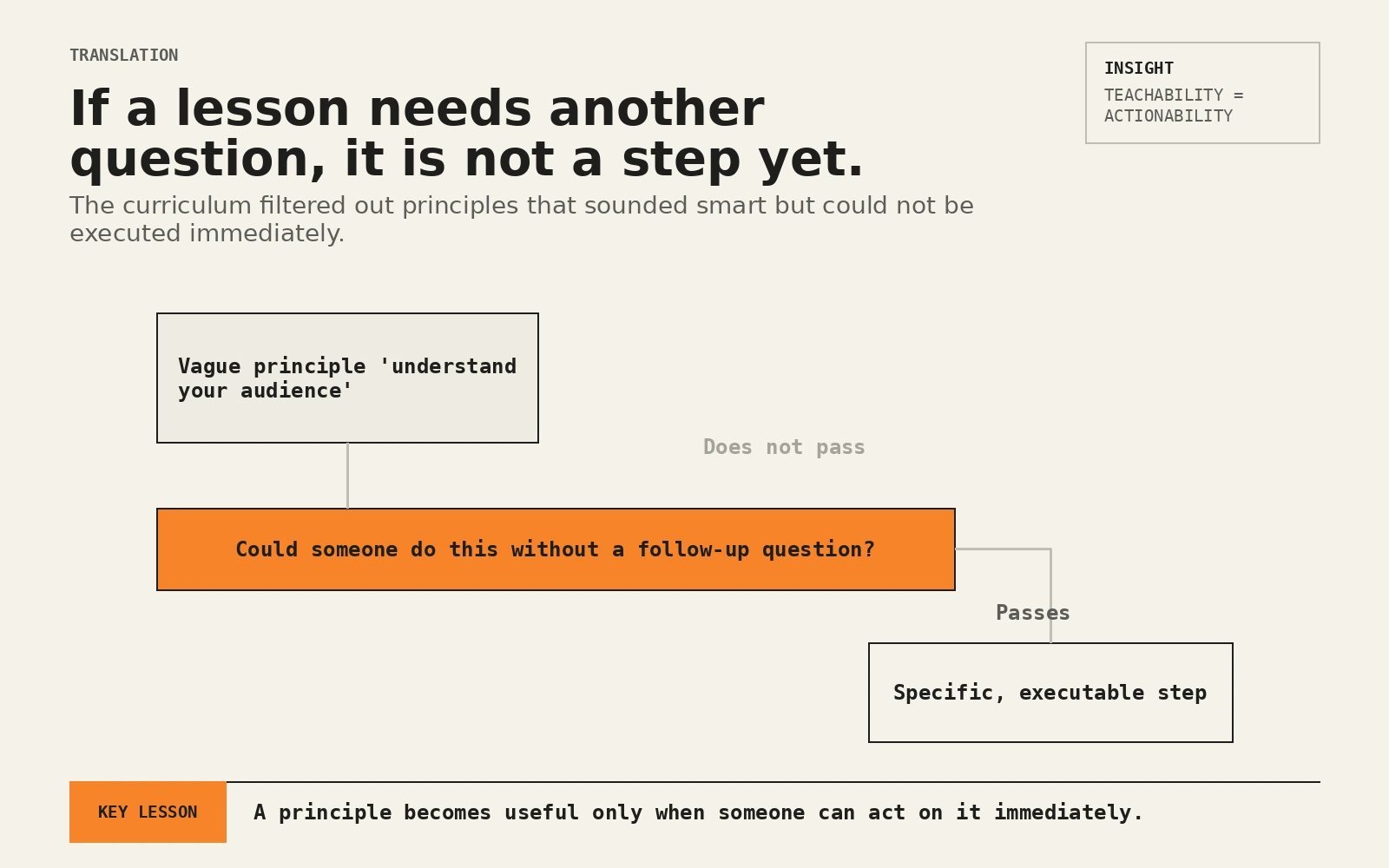
So I set one test for everything that went into the material: could someone actually do this without a follow-up question? That test killed most of what ten years of practice usually gets described as. Theory failed it immediately. So did any framework that needed interpretation, and anything phrased as advice rather than as a specific step.
- 6
- modules builtCustomer development through to KPI control
- 15+
- named frameworksEach one executable, not descriptive
- 0
- pages of theory
- 3
- delivery blocks in enforced orderEconomics, then technical, then traffic
You have a habit, and habits don't transfer until someone forces them into steps.
What survived: every page written as a numbered list with a fixed count — ten rules for an ad, three pillars of search, fourteen rules of a site — so a student always knew exactly when they were finished, not just when they felt finished. Key performance measures split into two classes that became the spine of the reporting module: ones you watch daily to steer, and ones that only arrive as fact after a period ends. Confusing the two is a recurring argument in marketing, and separating them into different tools removed the argument entirely for this material. Each objective — sales, brand reputation, image — got its own set of measures, because judging all of them with one shared number is how good work gets misread as bad. The whole sequence from first contact to purchase got built as product design, not as a flow diagram: each stage defined by its actual purpose, where a free resource's real job isn't the resource itself, it's getting someone to look at the next thing after it.
Six modules came out of this, more than fifteen named, executable frameworks, with almost none of it left as theory a student had to interpret for themselves.
The part that matters most in practice, and the one most often skipped under deadline pressure, is forecasting the numbers before building anything. Without a forecast written down in advance, every result afterward turns into an argument about whether the work underperformed or the forecast was just wrong — there's no way to tell the difference after the fact if nobody wrote the prediction down first.
Pieces of this now show up in most engagements — the personality-based messaging split, the purpose-defined stages, the daily-versus-after-the-fact measurement split. When someone asks how I'd approach their specific problem, this is what I'm actually drawing from.
If you're trying to teach or delegate something you're genuinely good at, take the first instruction you'd naturally give and ask whether someone could execute it without asking you a follow-up question. If the honest answer is no, you don't have a principle to hand off yet. You have a habit, and habits don't transfer until someone forces them into steps.
The full engagement record
Confidential, digital marketing education brand — case study