
Sales and marketing · Education, media and political campaigns
The course wasn't the first thing parents wanted. A straight answer about their kid was.
Student CZ sells Czech tuition and university preparation to families relocating to the Czech Republic. The product was good. There was no path from a worried parent to a paying student.
Student CZ teaches Czech and prepares students for Czech universities. The tuition itself worked — students who went through it did well. What didn't exist was any route from a parent searching "moving to Prague" at eleven at night to that same family enrolled in a twelve-month programme two months later.
Advertising the course directly was the obvious move, and it was also the wrong one. Nobody buys a twelve-month language programme as their first interaction with a company they found the day before. Whatever came first had to be small enough to say yes to without thinking, and useful enough to actually deserve the yes.
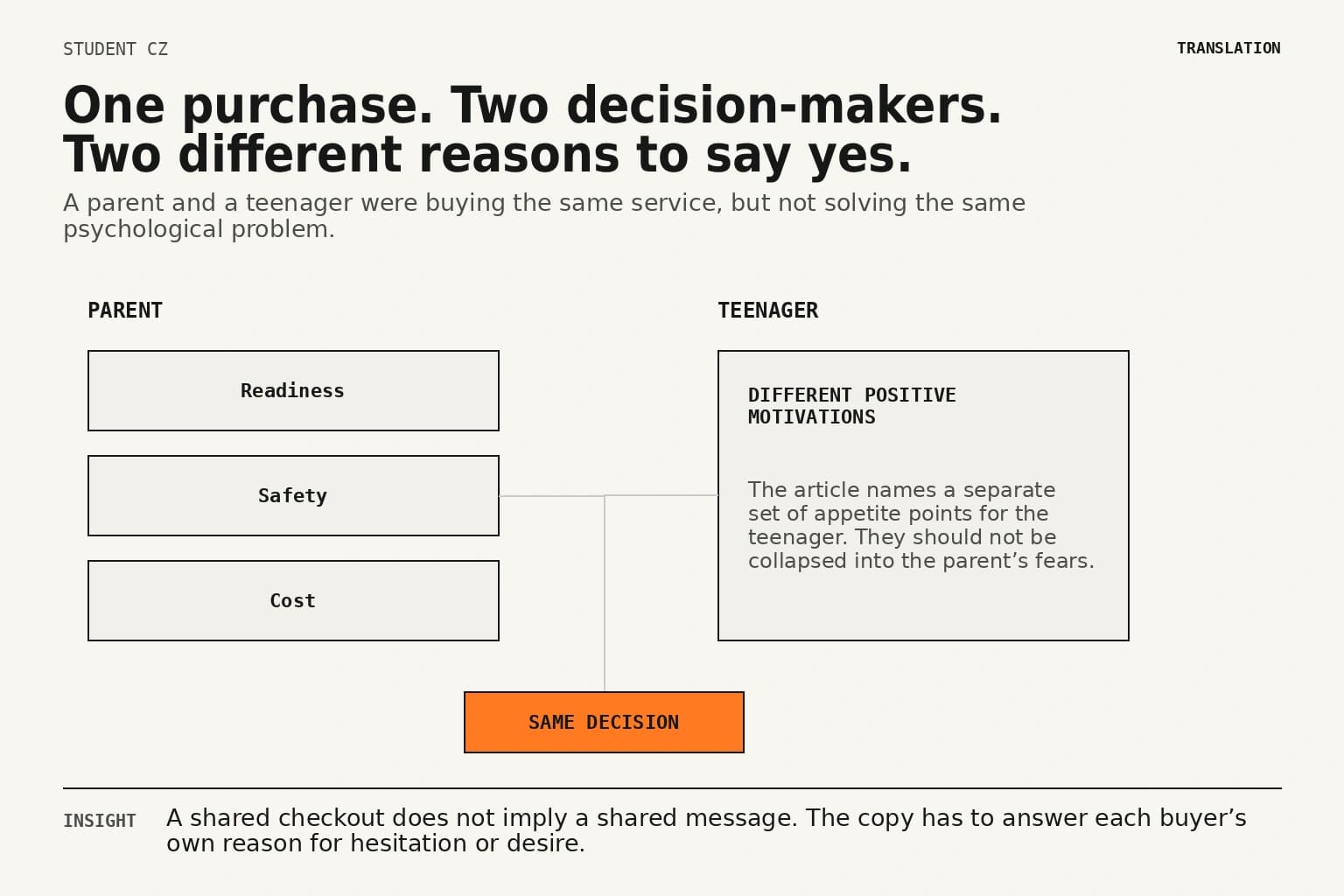
Parent interviews surfaced something the course pitch never touched: what a parent says they want and what a parent is actually afraid of are two different lists. Underneath "I want my child to learn Czech" sat three specific fears — that the child wouldn't know enough to get in, that they'd end up alone in a country whose language they didn't speak, and that the money would be spent and lost. Every promise on the page ended up written against exactly one of those fears instead of gesturing at all three at once: a full refund if the student wasn't admitted answered the money fear, native-speaker teachers who helped with cultural adaptation answered the loneliness fear, and the stated fact that 94% of course graduates went on to state-funded places at a Czech university answered the readiness fear. One line ran underneath all three — no entrance-exam requirement from the student's home country — because it removed the single largest procedural obstacle the whole audience shared.
- 3
- segments researched, two funnels builtParents, future students, and Russian speakers already in Prague
- ~$24
- tripwire price point10 to 15 video Czech Basics course
- 4
- roadmap stages, each costed twiceRealistic and idealistic staffing per stage
- ~$690 → $6,300
- monthly marketing budget across the roadmap
Same purchase, same moment, two people bringing two different sets of words to it.
The teenager sitting next to the parent in that same decision was reading a completely different page. Their fear was narrower — that the programme itself would be too hard — and everything else was appetite: other students from other countries, a language to actually use, a European degree, a city to walk through between lessons. Same purchase, same moment, two people bringing two different sets of words to it.
What the parent actually wanted before any of that, though, wasn't a course. It was an answer to a question they had no one else to ask: is my child suited to this, and which university should they even be aiming at? That question became the entry point itself — a free career-orientation consultation, offered before anything else, that assessed a student's strengths and pointed them at a specific university rather than a general promise. The consultation became the first interaction because it answered the question parents brought before they'd compared a single course.
From there the path went in small, specific steps rather than one big ask: a roughly $24 short video course next, cheap enough to be a decision nobody had to deliberate over, then a real first lesson built as an assessment rather than a sales demo — a methodologist checking level and goals before assigning a teacher and a programme, so the family's first paid experience was diagnostic, not promotional.
A second, separate path went to a different audience entirely: Russian speakers already living in Prague, eighteen to thirty-five, who weren't choosing a university at all. Their problem was arrival — no friends, no reliable answers about visas or banks, no circle. That path started with a Telegram community where specialists answered questions, moving toward paid events, then the language school, then the parts of living in a foreign city that are genuinely hard: paperwork, legal questions, and the slang nobody teaches in a textbook. Same company, same city, and often the same person again a year and a half later — just arriving through a completely different door.
If your product serves two people making one decision together — a parent and a teenager, a buyer and a user, an owner and an employee who'll actually work with what gets bought — write down what each of them is afraid of separately, in their own words, not as one shared customer persona. Then check your current messaging against both lists: if the same paragraph is meant to answer both people, it's worth testing whether it actually answers the specific fear either one of them brought into the decision.
The full engagement record
Student CZ — case study