
Sales and marketing · Education, media and political campaigns
Political campaigns don't get a cheap way to test a consultant. This one built one for $6.70.
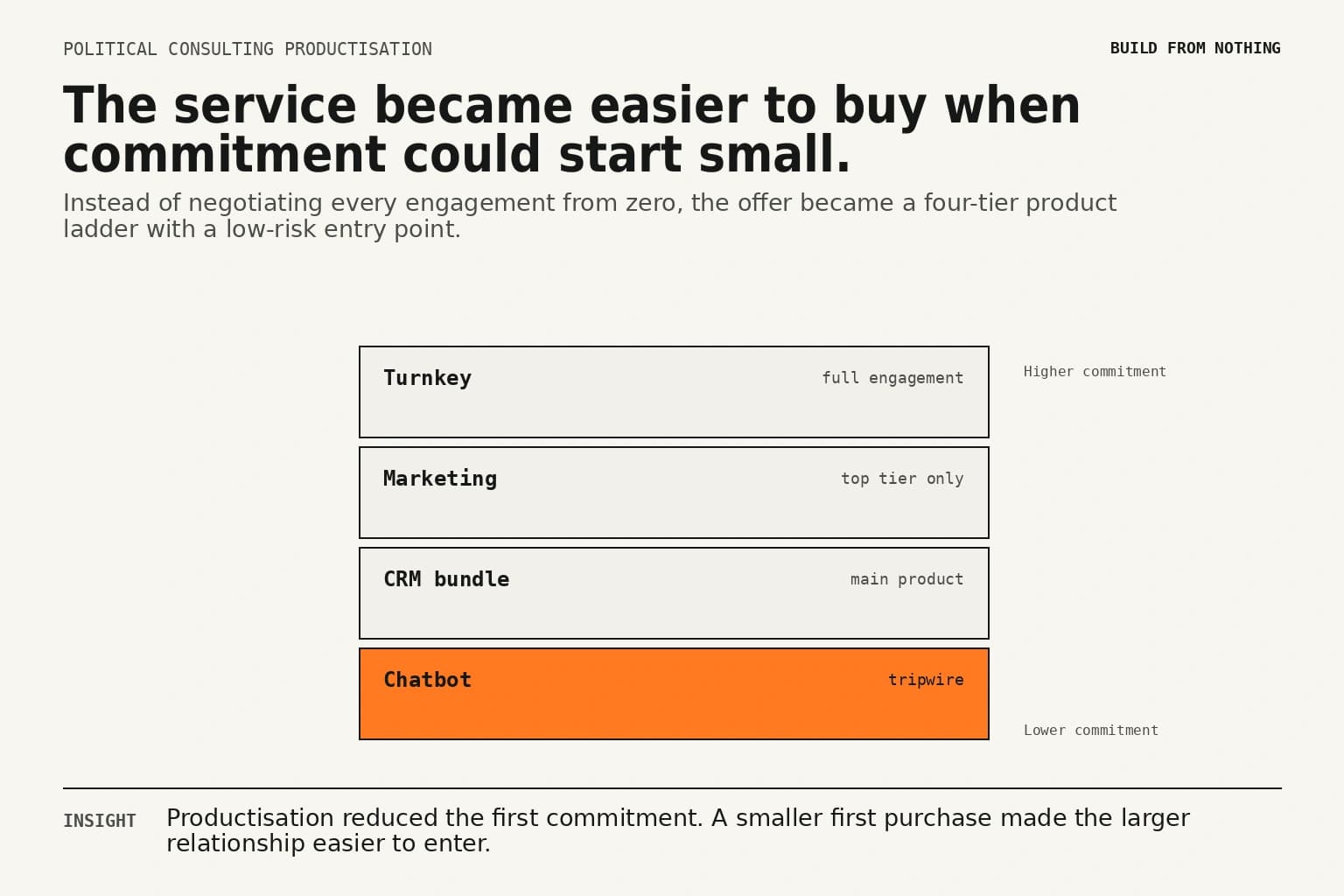
Political consulting is usually sold as a bespoke engagement negotiated from scratch every time. This packaged it into four tiers, with field software underneath instead of slides.
Political consulting is usually sold as a full campaign contract, negotiated from scratch, priced from scratch, delivered from scratch. There's no smaller version to buy first, which means there's no way for a candidate deciding whether to trust an outside consultant to find out cheaply. And the audience makes the problem worse than it would be anywhere else: it isn't a mass market, there are only so many campaigns running in any cycle, and they all start at the same time.
The actual bottleneck wasn't demand for the services. Campaigns needed what a political consultancy does. It was that asking someone to sign a full campaign contract as their first transaction with a stranger is asking for a large commitment on faith, with nothing smaller in between to test the relationship on first.
There was a second problem sitting underneath the first one: what to actually demonstrate. A deck of slides doesn't show a campaign that a consultant can operate in the field. Software that logs whether a canvasser genuinely showed up to their assigned territory does — a different kind of proof, and the only kind that matters to someone running an operation.
How it was built
- 01 / The gap
No smaller version to buy first — a candidate had to sign a full campaign contract as their first transaction with a stranger.
- 02 / The ladder built
Four tiers: a roughly $6.70 chatbot proving the problem was solvable, a CRM bundle, marketing reserved for the top tier, turnkey delivery costed in named stages.
- 03 / What it enabled
A campaign with no budget could run the same canvassing workflow on paper-simple tools instead of the premium CRM.
- 4
- product tiers, ladderedTripwire chatbot, CRM bundle, marketing, turnkey
- ~$6.70
- frontend event priceOffline events as the acquisition channel
- 38
- days of costed delivery10 for packaging, 14 for strategy, 14 for preparation
- 3
- chatbots specifiedCanvasser control, supporter, fair elections
It doesn't need to make money on its own. It needs to prove, cheaply and fast, that the rest of what you're selling actually works.
The fix was a product line instead of a bespoke pitch, laddered into four tiers. The cheapest was a chatbot priced to be an easy yes — its only job was to prove the underlying problem was solvable, not to close a sale. Rather than collecting a contact for later follow-up, it collected a grievance and published both the problem and the process of resolving it, so the advertising spend behind it paid for a visible public record instead of an impression count. Above that sat a CRM bundle pairing supporter management with election monitoring as the actual main product, with the marketing service reserved for the top tier specifically so it couldn't be bought on its own and become the whole relationship. Turnkey delivery was costed in named stages — ten days to package the offering, fourteen for planning, fourteen for preparation — so a buyer could see exactly what thirty-eight days of work actually contained before agreeing to any of it. New relationships started through offline events priced at roughly $6.70, because a narrow, senior audience doesn't convert from a feed the way a consumer audience would.
A canvasser registers with a role and a GPS-tagged territory, checks in at the workplace, logs supporters with a supports, against, or undecided tag, and reports territory problems by type. On election day the same canvasser checks in at the polling station. All of it flows into a CRM on the premium tier — or into a shared spreadsheet on the cheapest one. A campaign with no budget could run the exact same workflow on paper-simple tools, which is what let the cheap tier function as a real product instead of a demo nobody could actually use.
If your business sells something that currently gets negotiated from scratch every time — a large contract, a bespoke engagement, a relationship that starts on trust nobody can verify yet — find the smallest true piece of what you do that a stranger could buy in a week and judge for themselves. It doesn't need to make money on its own. It needs to prove, cheaply and fast, that the rest of what you're selling actually works.
The full engagement record
Confidential, political consulting practice — case study