
Team and contractors · Education, media and political campaigns
Seven campaigns wanted more visibility. None of them could say what made someone actually vote.
The 2020 Ukrainian local elections. Field work still decides these races, but digital turned out to be the part you can actually predict and control.
Seven candidates came into Ukraine's 2020 local elections wanting a digital presence. Before building anything, I looked at what field campaigns already knew and couldn't measure well: door-knocking can move votes, but connecting one specific conversation to one specific vote afterward is close to impossible. Digital contributes a smaller share of the outcome — roughly 20 to 25% by the working estimate — and it's the only share a campaign can actually see and adjust while the race is still running.
That's not a case for replacing the field work. It's a case for building the one part of the campaign you can measure well enough to improve it mid-race.
The bigger finding wasn't about channels. It was about what actually performed with voters. Campaign messages built around a specific, visible result outperformed messages built around a promise — "vote for me and I will" — and did better with repetition than with a single strong version shown once. That pointed at something narrower than a general awareness campaign: show what's already been done, or name one specific local problem with an answer attached. Roads, schools, traffic, a building site — not invented, and ideally with a real answer already behind it.
One digital structure got built and adapted across all seven campaigns instead of seven separate builds from scratch — YouTube, Facebook, Instagram, messengers, and PR, with five videos cut per campaign for five audience segments: sport and lifestyle, patriotic, family values, digitalisation, and the core issue film. Every channel carried the same underlying message regardless of segment: you have a problem, this candidate has a solution. Field data and CRM records got layered onto geotargeting, so the digital audience and the door-knocking teams were working the same actual territory instead of two separate maps of the same district.
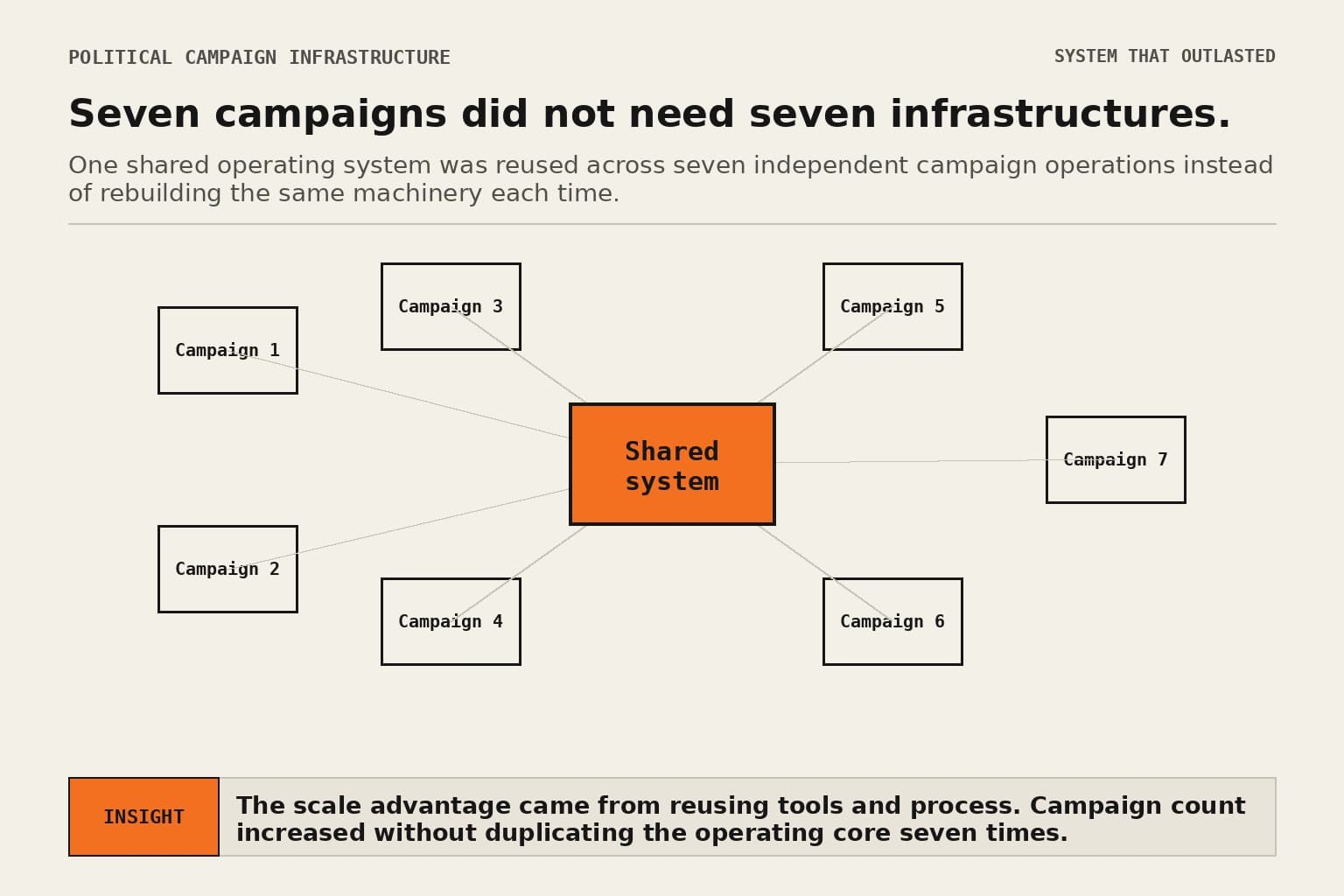
- Built one funnel across YouTube, Facebook, Instagram, messengers and PR, then adapted the components per campaign instead of rebuilding each time
- Cut five videos per campaign for five audience segments: sport and lifestyle, patriotic, family values, digitalisation, and the main issue film
- Ran one message on every channel: you have a problem, this candidate has a solution
- Overlaid field data and the CRM onto geotargeting, so the digital audience and the door-knocking teams worked the same territory
- 6 of 7
- candidates elected
- 20–25%
- of the result attributable to digitalThe controllable and predictable share
- 5
- videos per campaignOne per audience segment
- 4
- stage micro-targeting loopPlus social, closed back on itself
Six of the seven candidates won their races. The two shapes that worked were different from each other: incumbents ran on what had already been done, which works only when a challenger has no record to point to instead. Challengers ran on one named local problem with a stated solution. The shared structure underneath both was identical — local, using language and issues specific to that district, with an answer ready — and five segment-specific videos let that same claim land differently for a cyclist and a parent without changing what was actually being said.
There's a harder observation sitting inside this result, worth stating plainly rather than only counting the wins: the same tools that make a local campaign cheaper and easier to run well also lower the barrier to entry for candidates with different levels of preparation. That's a real cost of the same approach that won six of seven races, not a separate issue from it.
If you're running any campaign — a candidate, a product, a cause — asking for a bigger audience before you can say what you actually need someone to see and how many times they need to see it means building reach for a message that isn't ready yet. Work out the second part first.
The full engagement record
Confidential, seven local election candidates — case study