
Operations · E-commerce and retail
Samsung Ukraine had four official social pages. I laid three months of posts from all four side by side, and the same phone showed up on two of them and nowhere on the other two.
A three-month audit of Samsung Ukraine’s social channels. The finding was not that engagement was low. It was that each channel was behaving like a different company.
Samsung Ukraine ran four official channels — two Facebook pages, one VK community, and Instagram — with 430,516 followers between them. Nobody had been comparing them on the same basis, which is how four channels belonging to one company quietly turn into four different companies.
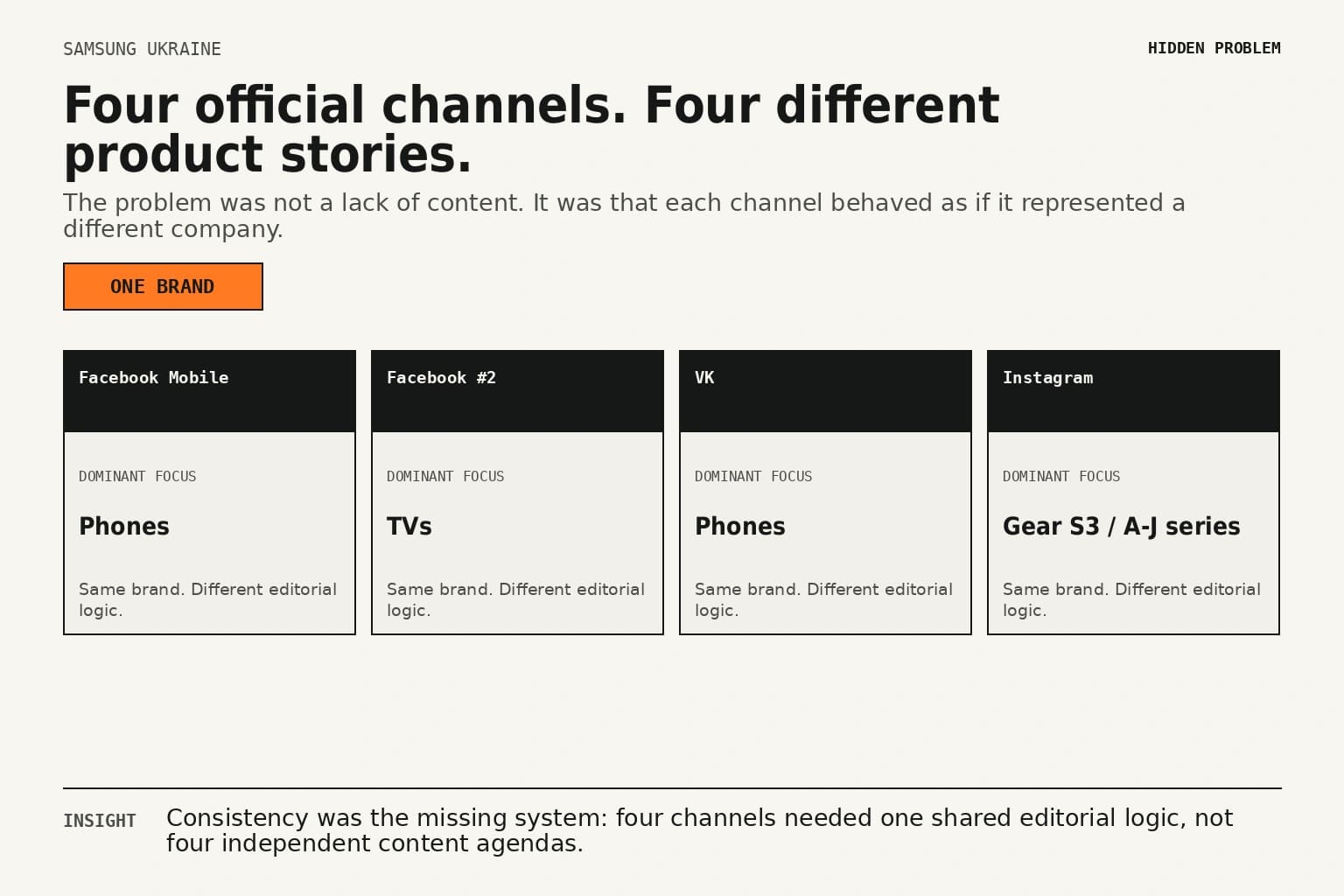
Laying out 321 posts from a single three-month window across all four made the split visible immediately. Samsung Mobile Ukraine and the VK community both led with phones, with the S7 Edge showing up in roughly half of everything either channel posted. The second Facebook page led with televisions, ran photos only, and showed no phones or accessories at all in the entire window — a Samsung page that, for three months, wasn't about phones. Instagram was the only one of the four showing the Gear S3 after it had gone on sale, and the only one showing the A and J series phones at all. Four channels, four different product priorities, one brand.
- 430,516
- followers audited across four channels
- 321
- publications analysed1 September to 30 November 2016
- 72%
- of the audience sat on two Facebook pages
- 7.7 vs 0.04
- reactions per follower, Instagram against FacebookThe two channels rank in opposite order depending on the metric
The follower counts told one story and the reaction data told a different one. Facebook Mobile carried the most followers, comments, and shares. Instagram had the fewest followers and the fewest comments, and by far the highest reaction rate per follower — 7.7 reactions per follower against 0.04 on Facebook. VK had fewer followers than Facebook and a more active audience relative to its size. Read only by reactions per follower, Instagram looked like the strongest channel Samsung had. Read by actual comment and share volume, it was the smallest conversation of the four.
Contests were pulled out and counted separately from genuine interactive posts before any of those comparisons were trusted, because a contest inflates whatever number it touches and would have made every channel that ran one look artificially alive. Once that was controlled for, tracking which specific products appeared on which channel was what surfaced the television page and the missing Gear S3 coverage — a comparison the existing channel-by-channel reporting had never produced.
What came out the other side was one comparable picture instead of four separate ones: reach sat on Facebook, activity per follower sat on VK, and reactions sat on Instagram. A single content approach applied evenly across all four would have been the right call for exactly one of them and wrong for the other three.
If your business runs more than one channel, page, or location doing what's supposed to be the same job, pull a fixed window of output from each of them and put it in one place — not the follower count, the actual posts. If you can look at that pile and tell which one came from which team without checking, you don't have one operation running in several places. You have several operations that happen to share a logo.
The full engagement record
Samsung Ukraine — case study