
DELTA is ahead of NATO's command systems because it was built inside a war, and that is the one thing no peacetime program can buy
Ukraine's DELTA battlefield system does in one ecosystem what the US Army spreads across several programs, and NATO armies are still trying to field. This piece compares DELTA with the Western record, from the US Army's CPCE to Britain's Morpheus and Germany's D-LBO, explains why a system built in war outpaces them, why security is a strength rather than a weakness, and why the US Army can only adopt something like it from the top.
DELTA is the battlefield system NATO armies are now studying, and the reason is not its code. Since Russia launched its full-scale invasion of Ukraine in February 2022, Ukraine has run its war on DELTA, a shared picture of the battlefield used by more than 200,000 people across its forces and the hub of the wider stack I map in Ukraine's battlefield software. In May 2026 the US Army's own secretary, Dan Driscoll, told the Senate Armed Services Committee that DELTA can integrate every drone, sensor and shooting platform into one network, an integration he said the US military had yet to reach. In August 2026 an officer writing for West Point's Modern War Institute argued that the Army should license and field DELTA now.
My argument is that DELTA is ahead because it was built inside a war, and that no peacetime program can buy that. NATO's command systems were designed for a different war, and they are bought the way armies buy tanks: a requirement, a contract, years of testing, fielding. DELTA was built the other way, by people who saw the problem first, with users who would die if it failed and an enemy who changed tactics every few months. Its builders say that no country not fighting a full-scale war on its own territory, the United States included, could build something this adaptive. I agree, and the Western record shows why.
DELTA and the Western systems side by side
| System | Owner | Started | Where it stands |
|---|---|---|---|
| DELTA | Ukraine's Ministry of Defence | Volunteers, mid-2010s; in combat since February 2022 | More than 200,000 users; ordered into use at every level in August 2025; NATO interoperability tested at CWIX |
| CPCE (Command Post Computing Environment) | US Army | Fielding from 2019 | Increment 1 found "not operationally suitable" by the Pentagon's test office (FY2022 report) |
| NGC2 (Next Generation Command and Control) | US Army | Prototype award July 2025 | About $3.3 billion in requested funding through FY2026; fielding objective 11 divisions and four corps by FY2032 (GAO, August 2026) |
| Maven Smart System | Pentagon; NATO bought it in March 2025 | 2017 | The closest US analogue for data fusion and AI targeting, with a different architecture (Modern War Institute) |
| AFATDS | US Army and Marine Corps artillery | Initial fielding 1995 | Being modernized from a monolithic legacy design |
| Morpheus / LETacCIS | UK Ministry of Defence | Late 2010s | About £766 million to £828 million spent on Morpheus before it was paused; the wider LETacCIS program rated red for delivery confidence in February 2025 |
| D-LBO | German Bundeswehr | Contracts from the early 2020s | A leaked ministry report in 2026 rated it unfit after about €1.75 billion to €2 billion; readiness pushed toward the 2030s |
Why could only a war build DELTA?
Because the feedback a war gives cannot be simulated. DELTA began with a doctrinal problem its builders saw in 2014: a small Soviet-style army fighting a big Soviet-style army loses, so Ukraine had to win asymmetrically, with units that see more and coordinate faster than the enemy. They took the American idea of network-centric warfare and built it themselves, through years of bureaucracy, and the full-scale invasion put it into use across the army; a 2025 order made it standard at every level. Since then, each release has been tested by soldiers who stopped using whatever failed them and by a Russian army that adapted its drones, jamming and tactics every few months.
The users say the same in their own words. Artem Bielienkov, chief of staff of a Ukrainian drone unit, described to Ukrainska Pravda in 2024 how his team combined a neighbor's observations, counter-battery radar data and its own reconnaissance in DELTA to find and destroy a Russian heavy mortar, and why: to spread information and decide very quickly. Ukraine's own critics keep the system honest. Some units have called it slow and centralized, Intelligence Online reported in 2025, and a reserve artillery colonel argued in 2026 that it displays more than it analyzes. Those complaints arrive within months and shape the next release, which is the loop a program of record does not have.
A peacetime program has neither. Its users are on exercises, where a failure costs a bad review, and its threat is a scenario written years before. A Ukrainian defense ministry developer, Lt. Col. Yelyzaveta Boiko, put it plainly in April 2025: many NATO countries began building their command systems in the 1990s, still maintain them at great cost in money and people, and lack modules for what Ukraine now needs, because no one has fought a war this technologically advanced on their own territory. DELTA's builders found NATO's procedures and security protocols too slow for this war, kept NATO's data standards as a frame and built everything else to the tempo of the front.
What does the Western record show?
That the problem is the method, not the people. Three of the largest recent Western programs show the same pattern:
- The US Army's CPCE, its command-post computing environment, was found by the Pentagon's test office in its FY2022 report to be effective for a basic common picture but not operationally suitable, because of reliability, training and usability. Staffs could not share plans across cells and servers, and when it failed they went back to paper maps.
- Britain's Morpheus, the next generation of its tactical communications and information systems, cost between about £766 million and £828 million, by the figures reported to Parliament, before it was paused. A government review in February 2025 rated the wider LETacCIS program red for delivery confidence, and it stayed red at the end of that financial year, while the army keeps its old Bowman system going with incremental updates.
- Germany's D-LBO, the digitization of land operations, had reportedly spent roughly €1.75 billion to €2 billion by 2026, according to a leaked defense ministry report first reported by Die Welt. That report found the basic system unfit for operational testing or even training, after a field test was cancelled in May 2025 and another aborted in November. First units had been due to use it in 2026; that slipped toward the 2030s.
These are not failures of talent. They are what happens when a system is specified years ahead, built by a prime contractor and tested by the people who wrote the requirement. Ukraine ran that experiment too, with its state-ordered system Dzvin, and got the same result, which I describe in Dzvin. DELTA is what the other path produced.
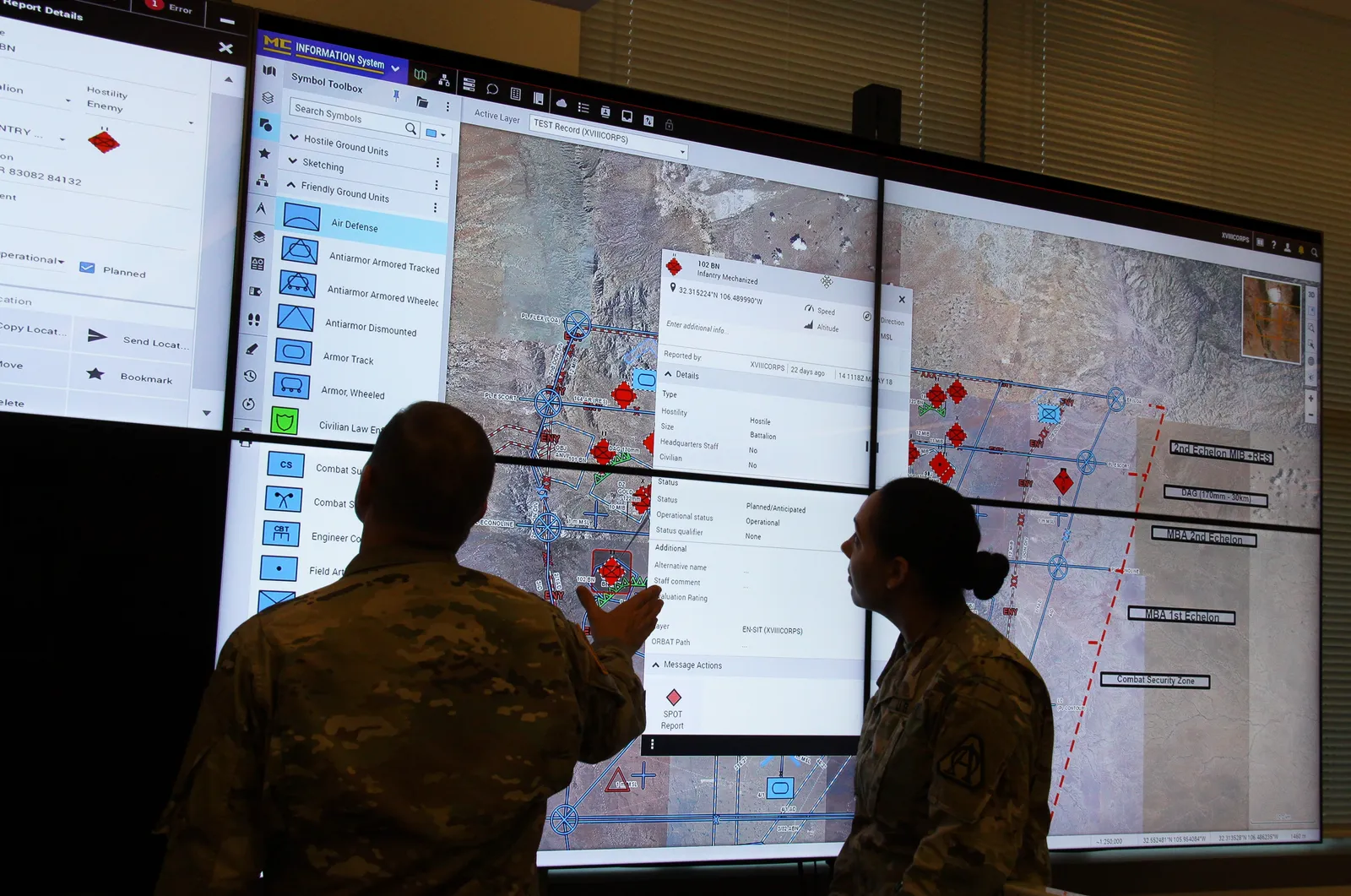
The US Army's newer program shows the other way is possible. NGC2, built with Anduril, Palantir and others, moved from a $99.6 million prototype award in July 2025 to monthly testing with the 4th Infantry Division and contracts to scale it in October 2026. It moves fast because the Army's leadership pushes it. Even so, the Government Accountability Office (GAO) reported in August 2026 that full fielding across 11 divisions and four corps is a goal for FY2032, a decade after DELTA first went into combat.
Isn't DELTA too risky for NATO to use?
The record makes a strong case for it. The usual objection is that DELTA runs in the cloud, partly on servers abroad and over civilian networks and Starlink, with access for hundreds of thousands of users, risks NATO's classified networks were designed to avoid. Ukraine took those risks deliberately: it passed a law to allow the cloud, and its government authorized DELTA's cloud components outside the country in February 2023. Russia has attacked the system from the start, with phishing and malware aimed at its users, and the attacks never let up. The defense held: independent assessments in July 2024 and March 2026, the second after DELTA passed 200,000 users, found no deviations against more than 160 requirements.
The Western alternative has its own cost. The Modern War Institute's author described how US classified enclaves can exclude the very users who need the data because they lack the terminal, the account or the clearance, so crews bridge systems with voice calls, screenshots and retyped coordinates. Security that keeps your own soldiers out of the picture is a vulnerability of a different kind. DELTA's answer, tiered access, device management and constant auditing on an open architecture, is the one that has held under real attack, including for its video and AI modules, which I describe in Vezha and Avengers.
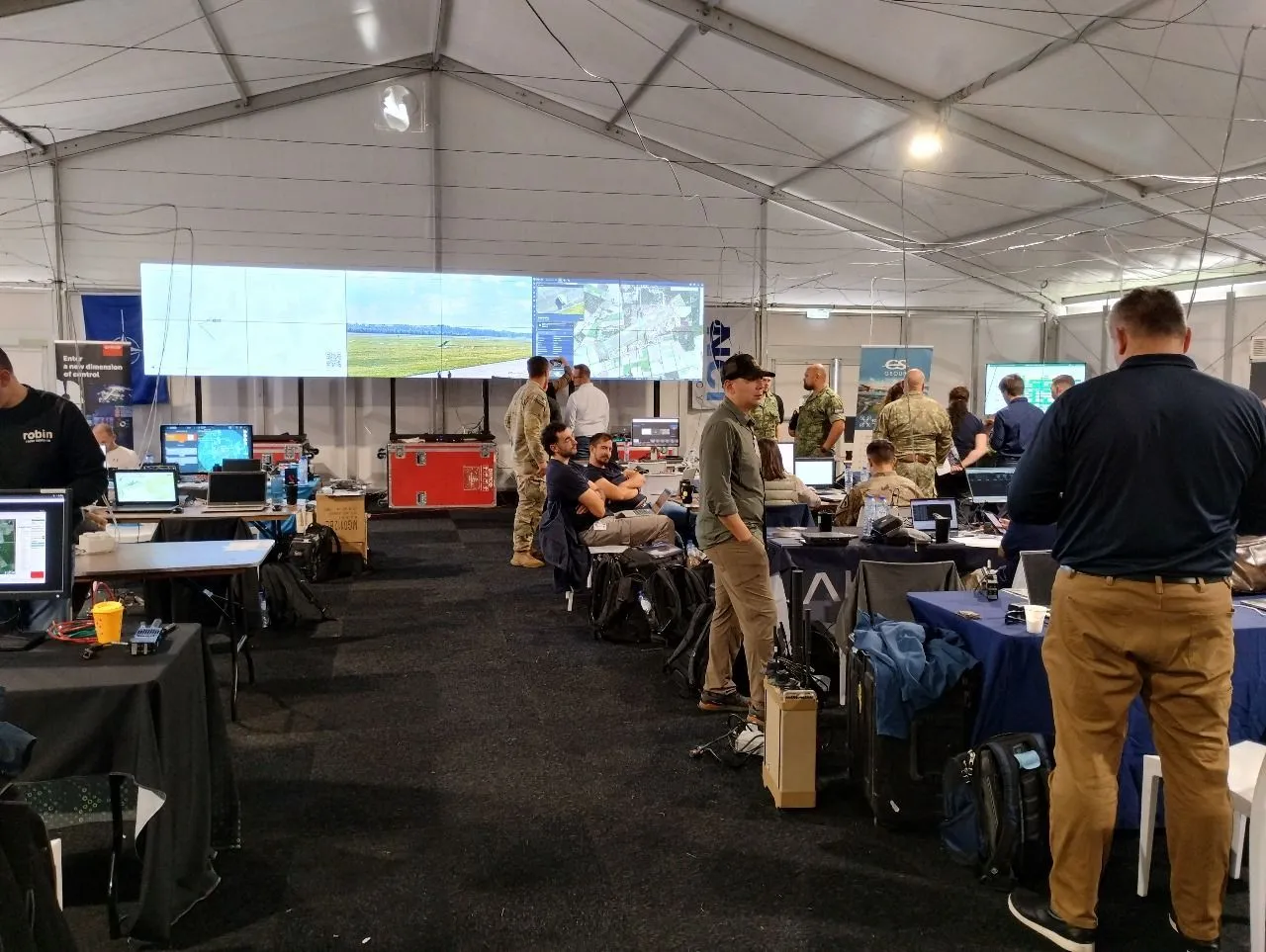
DELTA also already speaks NATO's language. At NATO's CWIX interoperability exercise in 2024 it exchanged data in five standards across 13 areas, against one standard in one area in 2019, and it linked to Poland's TOPAZ artillery fire-control system. At a US Army training center in Germany, a Ukrainian platoon-sized drone unit stopped a US armored brigade, the Modern War Institute reported, crediting shared data layers, direct horizontal communication and delegated authority among the reasons.
Why can't the US Army adopt it from below?
Because good software has rarely entered the US Army from below. Its own history shows the pattern:
- Palantir and DCGS-A. Palantir's court filings say field units asked for its software over the Army's own intelligence system, DCGS-A, from 2011, and were refused. It took a lawsuit: in October 2016 the Court of Federal Claims ruled that the Army had broken federal law by not considering commercial products, the appeals court affirmed in 2018, and only in March 2019 did Palantir win a major Army contract for that system.
- Maven. The Pentagon's AI targeting program began with a memo from Deputy Secretary of Defense Robert Work in April 2017, a decision at the top, not a request from units.
- NGC2. The Army's newest command system is moving at speed because the Army's secretary and chief of staff made it a priority.
- ATAK. The tactical app every soldier now knows started at the Air Force Research Laboratory around 2010 and spread through special operations units long before it became a formal standard, which I describe in ATAK.
The conclusion is the one that matters for anyone who wants DELTA, or something like it, in American hands: a founder or a unit cannot bring it into a huge army from below. It takes a decision at the level of the Secretary. The Modern War Institute's case for licensing DELTA is a case addressed to that level, and Driscoll's testimony shows the Army's leadership has seen the gap.
Can NATO simply buy DELTA?
It can license the system, on terms not yet public, and the software is the smaller part. A NATO country formally asked to buy DELTA in April 2025, and Ukraine has been preparing licensing models. A licence would likely give an army the architecture, the modules and the data standards. What made DELTA work, a team that ships every week, a culture that treats soldiers as users and an enemy that punishes every delay, does not come in a licence. An army that licenses DELTA and then runs it as a program of record, with annual requirements and a prime contractor, will get a copy of last year's DELTA.
The smart purchase is the method together with the code: Ukrainian engineers working inside the buyer's forces, a release cycle measured in weeks, and data from the buyer's own exercises fed back into it. That is harder to approve than a contract, and it is the only version that would carry over what makes DELTA better.
Where does this lead?
I expect three things.
- A first NATO licence of DELTA. One member will license it, probably on NATO's eastern flank, where the threat is close enough to justify the risk of a new way of working.
- NGC2 becomes DELTA-like. The US Army will not buy DELTA, but NGC2's data layer and release pace will converge on what DELTA showed, under pressure from its own leadership.
- Ukraine's engineers become an export. The scarcest thing in this market is people who have built command software under fire. Allied armies will hire them, partner with them and pay for them.
Signals worth watching: a named NATO buyer for DELTA, NGC2's fielding pace against its FY2032 goal, and D-LBO's and Morpheus's next delivery assessments.
What will the market need next?
- Integration between DELTA and allied systems. Gateways, data translation and support that connect DELTA to TAK, Maven, NGC2 and national systems, built in partnership with the Ukrainian team.
- Secure cloud hosting for allied battlefield data. Every army that copies the model needs a cloud it trusts, abroad or at home, with the auditing DELTA proved.
- Exercise design that tests like a war. Exercises that measure detection-to-strike time, manual data transfers and performance under jamming, the measures the Modern War Institute recommended, sold to armies preparing for the kind of war Ukraine is fighting.
- Ukrainian engineering teams for hire. Services that place Ukrainian command-software engineers with allied forces and Western defense companies.
What it means for a defense founder
- Sell to the top, prove at the front. In a large army a system moves when its leadership decides. A founder needs a combat record, which Ukraine can provide, and a route to the people who decide, which a field demonstration alone will not provide.
- Integrate with DELTA, not against it. A product that feeds DELTA's picture and speaks NATO's standards is sellable on both sides. One that competes with DELTA in Ukraine has a much harder road.
- Your process is part of the product. Buyers who have watched CPCE, Morpheus and D-LBO now ask how fast you ship and how you hear from users. Show them, with dates and numbers.
Sources (19)
- Military Times, Ukraine's battlefield integration surpasses US military's, Army secretary says, 13 May 2026
- Modern War Institute, James L. Andreasen, Borrow what works: the case for Army adoption of Ukraine's combat-tested horizontal kill web architecture, 14 August 2026
- Ukrainska Pravda, Rustem Khalilov, how DELTA works at the front, 28 August 2024
- Intelligence Online, Ukraine military's data fusion system facing user backlash, 21 July 2025
- UNITED24 Media, Ukraine's DELTA combat system may be exported to a NATO ally, defense official says, April 2025
- DOT&E, FY2022 annual report (CPCE)
- GAO, GAO-26-108019, Army Next Generation Command and Control, 20 August 2026
- US Army, Army announces Next Generation Command and Control prototype award, 18 July 2025
- Anduril, Anduril continues to scale Next Generation Command and Control across the Army, 5 October 2026
- UK Parliament, written question on Morpheus expenditure, 11 December 2024
- UK Defence Journal, Army comms programme hit red rating after Morpheus pause, 2025
- Heise, Bundeswehr digital radio fails practical test
- Brussels Signal, German army spent €2 billion on non-functional radio system, says internal report, April 2026
- US Army, Army seeks industry input on approach to modernizing digital fires products (AFATDS), 2023
- NATO NCIA, NATO acquires AI-enabled warfighting system, 14 April 2025
- Defense News, Judge rules in favor of Palantir in lawsuit against US Army, 31 October 2016
- Defense News, Palantir, who successfully sued the Army, just won a major Army contract, 29 March 2019
- NATO Allied Command Transformation, Ukraine's DELTA system at CWIX24, 12 July 2024
- Ministry of Defence of Ukraine, Independent assessment confirms DELTA remains compliant with all cybersecurity standards after scaling, 9 March 2026