
Vezha and Avengers turned Ukraine's drone video into data, and the data, not the AI, is now the asset everyone wants
Vezha is the platform inside DELTA that streams video from thousands of Ukrainian drones and cameras to every unit that needs it; Avengers is the AI that watches those streams and flags Russian equipment for a person to confirm. A combat battalion built the first, the defense ministry's innovation center the second, and together they produced a dataset of millions of annotated frames that Ukraine now lends to companies and allies. Here is how they work and what they mean for the market.
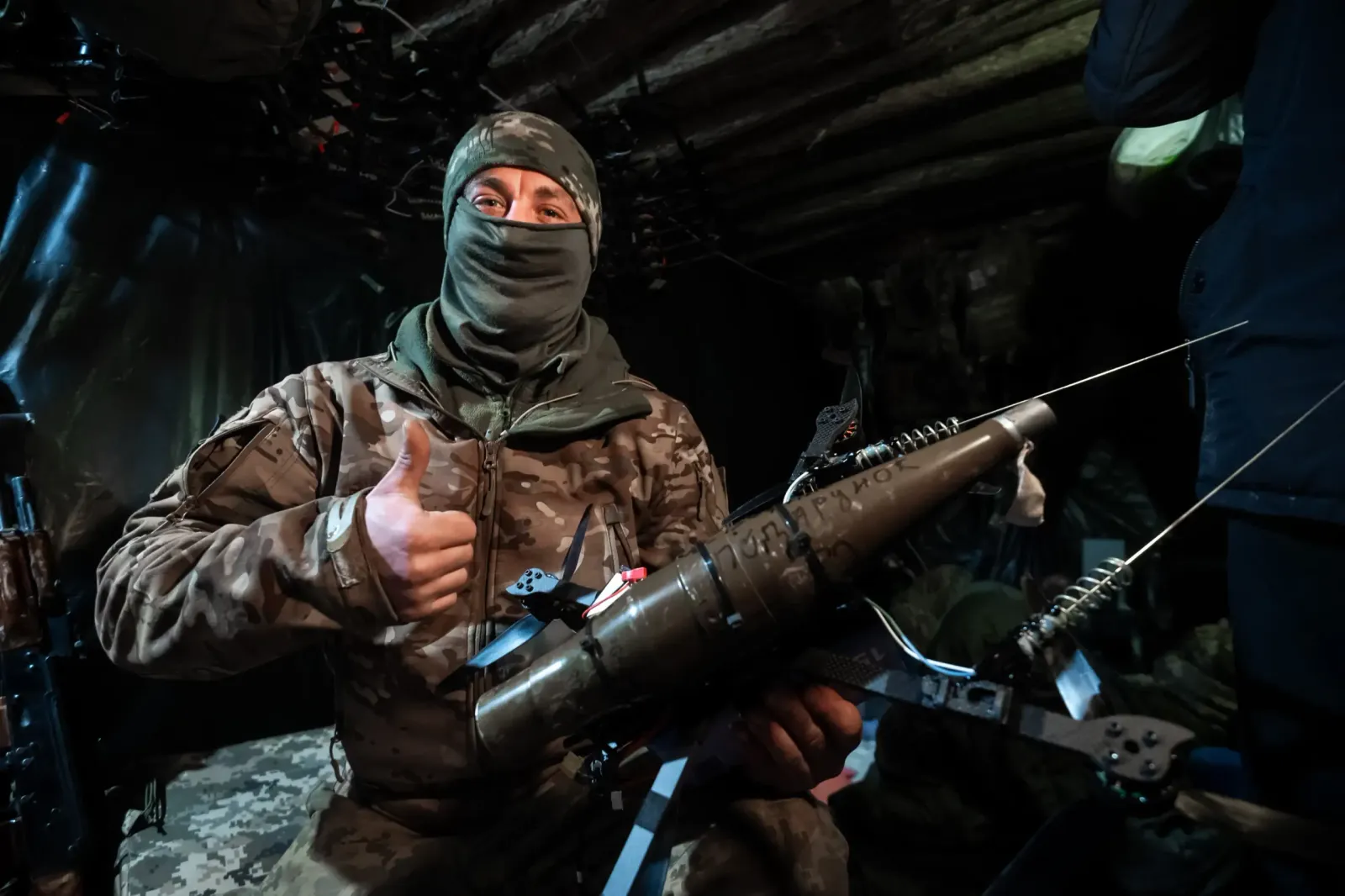
Vezha and Avengers are how Ukraine watches the war it fights. Since Russia's full-scale invasion of Ukraine in February 2022, drones have become the army's eyes: thousands of them fly every day, each sending video to the crew that flies it. For a long time that video stayed with the crew. Vezha, Ukrainian for "tower," puts the feeds in one place inside DELTA, the army's shared battlefield system, so an artillery battery, a headquarters and a neighboring unit can watch and mark the same footage. Avengers is the AI that watches it with them and flags the Russian equipment in it.
My argument is that the most valuable thing these two built is neither the streaming nor the AI. It is the record. Every stream that passes through Vezha and every detection a person confirms in Avengers becomes labeled data from a real war, and in 2026 Ukraine began lending that data to its companies and its allies. The software can be copied. Millions of frames of a modern war, annotated by the people who fought it, cannot.
Vezha and Avengers in numbers
| Vezha | Live video from drones and fixed cameras, shared across units, with joint analysis and voice; part of DELTA since October 2024 |
|---|---|
| Built by | The 411th Separate Battalion "Yastruby" (Hawks), with the Tube and Raven streaming teams and the ministry's Technology Solutions Scaling Center |
| Vezha scale | Footage from hundreds of drones analyzed for more than 4,000 targets a day when it joined DELTA (ministry, October 2024); more than 75,000 video streams a day across DELTA by July 2026 (UNITED24 Media) |
| Avengers | AI platform of the defense ministry's Innovation Center that detects enemy vehicles and equipment in video |
| Avengers scale | About 12,000 detections a week (ministry, September 2024); 70% of enemy vehicles in processed video identified, about 2.2 seconds per item (Modern War Institute, citing the ministry) |
| Avengers Labs | About 5 million annotated frames, mostly from DELTA, opened to Ukrainian defense companies in August 2026; the UK joined as the first foreign partner in October 2026 |
| Security | Both included in an independent assessment of DELTA against more than 160 requirements in March 2026, with no deviations found |
Who built Vezha, and why does that matter?
A combat battalion, for itself. Vezha began with the 411th Separate Battalion, known as Yastruby, which needed its crews and commanders to see the same drone video at the same time. It grew into a joint effort with independent streaming teams, Tube and Raven, and the ministry's Technology Solutions Scaling Center, which built a streaming core designed for field conditions. In October 2024 the ministry folded it into DELTA and made it available to everyone using the system.
The reason it mattered was dependence. Before it, units often passed drone video through commercial streaming and messaging services, which could be blocked, could fail, or could hand data to a company abroad. The ministry framed Vezha explicitly as the end of that reliance. Owning the video pipeline is what made the next step possible, because a country that does not own its footage cannot build anything on it.
In practice, an operator can watch dozens of feeds at once and pick the ones relevant to a mission. An officer writing for West Point's Modern War Institute in August 2026 described a dashboard with thirty live feeds visible and more available. Vezha is also linked to Mission Control, DELTA's drone-mission module, partly to keep crews from interfering with each other's frequencies.
What does Avengers do, and what does it not do?
It does the watching nobody has time for. No team can look at tens of thousands of streams. Avengers scans them automatically and flags Russian vehicles and equipment, including camouflaged ones, and the ministry says it can tell decoys from real targets. By the ministry's account it identifies 70% of enemy vehicles visible in the video it processes, in about 2.2 seconds per item.
What it does not do is decide. A person reviews each flag before it goes on the shared map, a point the Modern War Institute's author stressed. That is not a weakness to be engineered away. A wrong detection that sends a strike to the wrong place costs more than a missed one, and the human step is what lets commanders trust the system enough to act on it.
How did the video become an asset?
By being labeled at scale. Every detection a person confirms or rejects teaches the model, and every frame tied to a confirmed result becomes training data. In August 2026 the ministry opened Avengers Labs: about five million annotated battlefield frames, mostly from DELTA, available to eligible Ukrainian defense companies to train their own detection models, under security rules rather than as open data. In October 2026 the United Kingdom became its first international partner, with data anonymized and delayed so that it does not expose current operations. By then more than 30 Ukrainian companies were training models on it and three products built that way were in use at the front, the ministry reported.
This is the point most outsiders miss. Western companies selling AI to armies usually have to find, buy or simulate their training data. Ukraine's state has the largest set of real, labeled combat video in the world and can decide who trains on it. That turns the ministry from a buyer of AI into the owner of the input every AI vendor needs. It is the same dynamic I describe for Palantir in Ukraine, seen from the other side.
What do independent observers say?
That the AI is useful and that the data has to keep moving. CSIS, the Washington think tank, described Avengers in 2024 as the part of DELTA meant to cut the manual watching of surveillance footage and point analysts to what matters. Its 2025 study added the harder lesson: early recognition models trained largely on footage from fixed cameras became less useful as the fighting shifted to drone video, with new angles, resolutions and object sizes, and the models and infrastructure had to be rebuilt around the new data. The Modern War Institute's author stressed the human step, a person classifying each alert before it reaches the shared map. Both points support the same conclusion: the advantage is a steady flow of fresh, labeled combat data and the people checking it.
Where do Vezha and Avengers go next?
I expect three things.
- AI moves onto the drone. CSIS reported in 2024 that the plan for Avengers included running on board, so the drone itself flags targets when the link to the stream is jammed. Detection at the edge will matter more as jamming spreads.
- The dataset becomes a diplomatic asset. The UK partnership is the first. Allies that want models trained on a real war will trade for access, and Ukraine will set the terms.
- More of the shared picture comes from AI. As streams multiply, a growing share of what appears on DELTA's map, and of the targets handed to fire-coordination systems such as GIS Arta, will be machine-flagged and human-confirmed rather than reported by a person.
Signals worth watching: more foreign partners in Avengers Labs, a published accuracy or false-alarm figure, and AI detection running on drones in service.
What will the market need next?
- Models trained on Avengers Labs data. Target recognition, damage assessment and decoy detection for specific platforms and seasons, sold back to Ukraine's forces and, with the ministry's agreement, to allies.
- Edge AI hardware. Small, cheap processors that run detection on a drone or a ground camera when the link drops.
- Video infrastructure for allies. Streaming, storage and access control for armies that still pass drone video through commercial services, built on the lesson Vezha learned.
- Annotation and validation services. The labeled frames are the asset. Teams that label, check and curate battlefield data to a standard a model can trust have steady demand.
What Vezha and Avengers mean for a defense founder
- Own the data path, or someone else will. Vezha's first achievement was ending dependence on outside streaming services. Products that keep the customer's data inside the customer's control are easier to buy.
- Put the human in the loop on purpose. Avengers is trusted because a person confirms each flag. Design your AI so a commander can see who checked what, and sell that.
- The data is the moat. Ukraine's advantage is labeled combat video at a scale nobody else has. If you build AI for defense, plan how you will get access to that kind of data, and treat a partnership with its owner as worth more than a better model. I go through how to judge such products in evaluating a defense data product.
Sources (9)
- Ministry of Defence of Ukraine, The battlefield video analysis platform Vezha is now accessible within DELTA, 14 October 2024
- Ministry of Defence of Ukraine, 12,000 enemy targets are detected by the Ukrainian military weekly, 23 September 2024
- Ministry of Defence of Ukraine, Ukrainian defense companies to train their own AI models on the Avengers Labs platform, August 2026
- Ministry of Defence of Ukraine, The UK becomes the first international partner to join Avengers Labs, October 2026
- Ministry of Defence of Ukraine, Independent assessment confirms DELTA remains compliant with all cybersecurity standards after scaling, 9 March 2026
- Modern War Institute, James L. Andreasen, Borrow what works, 14 August 2026
- CSIS, Kateryna Bondar, Does Ukraine already have functional CJADC2 technology?, 11 December 2024
- CSIS, Kateryna Bondar, Ukraine's future vision and current capabilities for waging AI-enabled autonomous warfare, June 2025
- UNITED24 Media, A surgeon in Kyiv can save a soldier on Ukraine's frontline, 20 October 2026
Where this comes up on the site
- Ukraine built its battlefield software as layers for every state of the network, not as one system, and that is why it keeps working under fire
- DELTA, Ukraine's battlefield system, is less a map than a ledger, and the ledger now decides what gets bought
- DELTA is ahead of NATO's command systems because it was built inside a war, and that is the one thing no peacetime program can buy