
Ukraine built its battlefield software as layers for every state of the network, not as one system, and that is why it keeps working under fire
Ukraine fights Russia's invasion with more than a dozen military software systems, from DELTA's shared battlefield picture to Kropyva on the gunner's tablet and ComBat Vision on a radio mesh with no internet. This map explains what each system does, which ones compare and which are different ideas, how they connect, and what the whole stack means for any company that wants to sell into it.
Ukraine's battlefield software has had more combat testing than almost any military software in the world, and it is not one system. Since Russia's full-scale invasion of Ukraine in February 2022, and for eight years before it in the east, Ukraine's forces have built and adopted more than a dozen digital tools: some by volunteers, some by companies, some by combat units and some by the state. An American reader meeting names like DELTA, Kropyva and GIS Arta usually asks which one is "Ukraine's system." The answer is that they are layers, each built for a different job and a different state of the network.
My argument is that this layering is the design, not the mess it looks like from outside. A system that depends on one network loses the picture when that network fails. Ukraine's stack has a layer for a good connection, a layer for a bad one and a layer for no internet at all, and a soldier moves between them as the fight changes. Almost all of it began with people who saw a doctrinal problem: a small Soviet-style army loses to a big one, so the only way to win was asymmetric, with units that see more and coordinate faster.
The map: which system does what
| System | Layer | What it does | Built by |
|---|---|---|---|
| DELTA | Command, shared picture | Battlefield map, drone missions, video and strike records for the whole army, in the cloud | Volunteers of Aerorozvidka, now the defense ministry |
| Vezha and Avengers | Video and AI inside DELTA | Streams drone video to every unit; AI flags Russian equipment for a person to confirm | A combat battalion; the ministry's Innovation Center |
| Kropyva | Fires, on the tablet | Offline maps, positions and ballistic calculations for artillery crews | Volunteers of Army SOS, KB Logika |
| GIS Arta | Fires, coordination | Assigns each target to the best-placed gun, like a ride-hailing app | Civilian geospatial specialists, from 2014 |
| ARMOR | Fires, other weapons | Indirect-fire calculations for tanks, mortars, guns and machine guns | Ukrainian developers, from 2015 |
| ComBat Vision | Command, no network | Tactical navigator on a radio mesh with no server or internet; friendly-fire prevention, ground robots | A company with special-forces roots, from 2012 |
| Virazh and Sky Map | Air defense | The Air Force's air picture; a command system fusing acoustic sensors and radar for drone hunters | A small Air Force team; Sky Fortress |
| ePPO | Air defense, citizens | Civilians report missiles and drones from their phones, verified through the state app Diia | Odesa volunteers, Tekhnari |
| Griselda | Intelligence | Turns messages, intercepts and sensor data into verified intelligence for the other systems | A volunteer team that became a company |
| Dzvin | Command, state-ordered | Automated command system for higher headquarters, contracted in 2016 | A private contractor for the ministry |
| Army+, Reserve+, DOT-Chain, Brave1 Market | Back office | Soldiers' reports, the reserve register, personnel, logistics and unit-chosen procurement | The defense ministry and its agencies |
Two American systems sit inside this picture too: ATAK, the US tactical app Ukraine's special forces and intelligence units use, and Palantir, whose software Ukraine's state uses for targeting, data and AI.
Which systems compare, and which are different ideas?
Most of them do not compete. They answer different questions:
- Where is everything? That is DELTA's question, for the whole army, and ComBat Vision's for a unit on the move with no connection. They compare, and they are designed for opposite network conditions.
- How do I hit it? Kropyva, GIS Arta and ARMOR all serve fires, and they compare most closely. Kropyva is the artillery crew's own tablet. GIS Arta coordinates many dispersed guns as one. ARMOR makes tanks, mortars and other weapons fire like artillery. A brigade can run all three.
- What is in the sky? Virazh, Sky Map and ePPO each build part of the air picture, from radars, from microphones on poles and from people's phones.
- What does it mean? Vezha, Avengers and Griselda do not show a battlefield. They process video and text into something the other systems can show.
- Who serves, who has what, who buys? The back office is a different category altogether, and it is where combat records now decide procurement.
Dzvin is the exception, because it was meant to compete. The state ordered it in 2016 as the command system for higher headquarters, months after volunteers had shown it a prototype of what became DELTA. Audits found it siloed and incompatible with NATO standards, and DELTA, built the other way, became the system the army actually uses.
How do the systems connect?
Through files, links and standards, more than through one database. DELTA is the hub: it exchanges data with Kropyva, takes in Vezha's video and Avengers' detections, receives Griselda's intelligence and links to the American ATAK. ComBat Vision opens the map and elevation formats of DELTA, Kropyva and ATAK, so a unit can switch tools when the network changes without losing the picture. Griselda feeds Kropyva, ARMOR and GIS Arta as well as DELTA. Sky Fortress's sensors feed Virazh. DELTA's app store distributes several of the others, including ComBat Vision's military version.
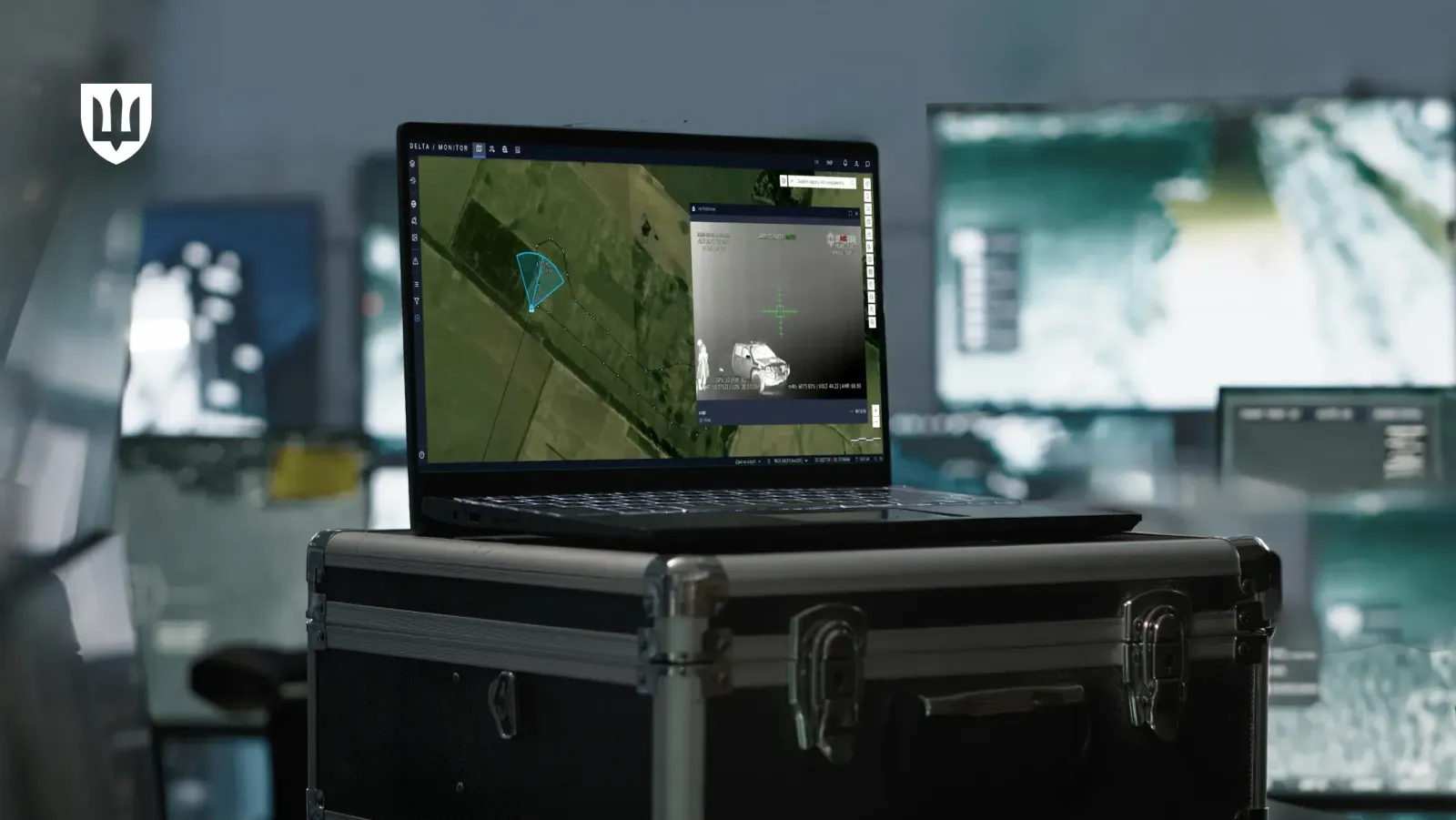
Toward NATO, DELTA is the gateway. At NATO's CWIX interoperability exercise in 2024 it exchanged data using five allied standards across 13 areas, against one standard in one area in 2019, and it linked to Poland's TOPAZ artillery fire-control system. None of these systems carries a published NATO Stock Number, the catalogue code NATO's codification system assigns to items of supply. Their status is set by Ukraine's own decisions: Dzvin was adopted into service in 2022; DELTA was authorized in 2023 and ordered into use at every level in 2025.
Why does this stack keep working under fire?
For three reasons, each one visible in the individual systems.
- A layer for every network. DELTA needs a connection and gets one through Starlink and the cloud. Kropyva and GIS Arta were built to work offline from the start. ComBat Vision needs no server at all. When jamming or strikes take one layer down, another carries on.
- Built by users, changed weekly. GIS Arta shipped eight versions in its first year from soldiers' error reports. Kropyva, by its developers' account, has updated once or twice a week for twelve years. DELTA's team shipped more than 30 releases in 2022 alone. The people whose lives depend on a tool are the people who shape it.
- Security that held. Russia has attacked these systems from the start, through phishing, malware and tampered copies of artillery apps. The systems kept running, and independent assessments in 2024 and 2026 found DELTA compliant with every requirement they tested, ComBat Vision issues its keys by QR code so that soldiers never know them, and ePPO checks every reporter's identity through the state app Diia.
The soldiers who use these tools say the same, with their complaints. Gunners describe Kropyva as easy to learn and credit it with Ukraine's artillery accuracy; a drone-unit officer describes finding and destroying a Russian mortar through DELTA by pooling several units' data. The criticism is mostly about the joins: a reserve artillery colonel calls the field a "zoo" of programs without a common data standard, and some units find DELTA slow and centralized. Those complaints are why the integration work never stops.
The cost is the other side of the same coin. Many of these tools were built by small teams outside the budget. Virazh, used by most of the Air Force's air-defense personnel, is still not formally codified. Kropyva receives no budget money. The state that relies on them has been slow to fund them, and in Ukraine a state that merely did not stand in the way already counted as help.
Where does the stack go next?
I expect three things.
- Fewer, deeper integrations. The tools will stay separate, but more of their data will flow through DELTA's hub and live links will replace file exchange.
- AI moves into every layer. From Avengers' detections to Griselda's text processing, machine triage will do more of the first pass, with people confirming.
- Exports begin. Sky Map already protects a US base, and a NATO country has asked to buy DELTA. The first formal export licences will follow.
Signals worth watching: a named foreign buyer for DELTA, formal funding for Kropyva and Virazh, and live API links between ComBat Vision and DELTA.
What will the market need next?
- Integration with the stack. Any product sold to Ukraine's forces, a drone, a sensor, a radio or a ground robot, needs to deliver its data into DELTA and the tools around it. Adapters, software kits and support for that are a service every foreign maker needs.
- Hardware the software depends on. Data-capable radios, rugged tablets, mesh relays and power for soldiers: the tools work, and the kit to carry them is short.
- Funding models for volunteer-built tools. Systems the army relies on but the budget does not fund need investors, grants or service contracts to stay alive and secure.
- Allied versions. NATO armies want what this stack shows, layered resilience and fast iteration, and companies that bring Ukrainian teams and methods to them will win the work.
What the stack means for a defense founder
- Find your layer. Decide which question your product answers and which state of the network it must survive. A product that only works on a good connection serves one layer of this war.
- Feed the hub. In Ukraine, a product whose results do not reach DELTA is far less visible to the units choosing what to buy next, as I describe in Ukraine's digital back office.
- Build with users, ship often. Every system on this map that succeeded was shaped by the soldiers using it, release by release. That method is the part to copy.
Sources (12)
- CSIS, Kateryna Bondar, Does Ukraine already have functional CJADC2 technology?, 11 December 2024
- CSS ETH Zürich, Stefan Soesanto, The Ukrainian way of digital warfighting, July 2024
- Ukraine's Arms Monitor, Combat software in the service of the Armed Forces of Ukraine, 21 June 2025
- Ukrainska Pravda, DELTA in the top three most popular combat systems in Ukraine, 9 October 2024
- Ukrainska Pravda, how DELTA and Kropyva work at the front, 28 August 2024
- Texty.org.ua, Artillery after 2022: what the war showed, 22 May 2026
- NATO Allied Command Transformation, Ukraine's DELTA system at CWIX24, 12 July 2024
- Militarnyi, Ukrainian DELTA system successfully integrated with the Polish TOPAZ, 1 July 2024
- Modern War Institute, James L. Andreasen, Borrow what works, 14 August 2026
- Reuters, US turns to Ukrainian counter-drone tech after Iran attacks, 22 April 2026
- Militarnyi, A NATO country wants to purchase the Ukrainian Delta system, April 2025
- Ministry of Defence of Ukraine, The DELTA combat system has been deployed across all levels of the Defence Forces, 6 August 2025