
GIS Arta makes a few scattered guns fight like a big battery, which is how Ukraine answered an enemy with far more artillery
GIS Arta is a Ukrainian command-and-control system for artillery, nicknamed "Uber for artillery" because it assigns each target to the gun best placed to hit it. Civilian geospatial specialists built its first version for a brigade in three months in 2014, and Ukraine's armed forces have used it ever since. Here is how it works, why it suits a smaller army, and what it means for the market.
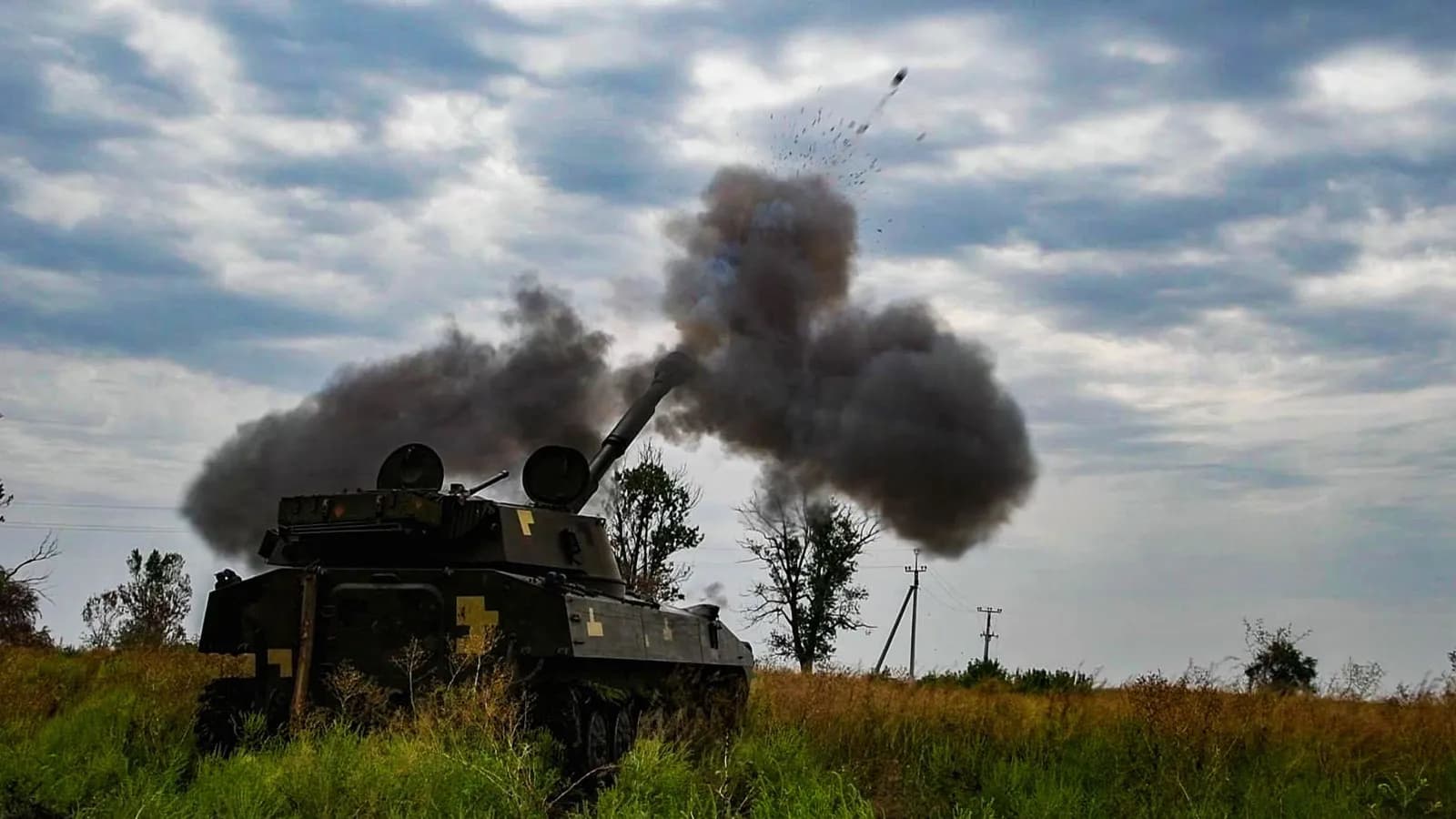
GIS Arta is the system that let Ukraine's artillery fight as a network instead of as batteries. Since Russia's war against Ukraine began in 2014, and with far greater force since the full-scale invasion of February 2022, Ukraine has faced an enemy with many more guns and shells. On some parts of the front Russian artillery outnumbered Ukraine's by about twenty to one, a New America analysis noted in 2023. A small army cannot win that count. It can make each of its guns count for more, and that is what GIS Arta does.
My argument is that GIS Arta's real invention is dispersion, not speed. A traditional battery keeps its guns together so its commander can control them, and a cluster of guns is the easiest target on a battlefield watched by drones. GIS Arta lets guns stand far apart and still fire as one, because the coordination moved from the battery commander's voice into software. The speed people quote is a consequence of that.
GIS Arta in numbers
| What it is | Automated command-and-control system for artillery; the developers' own term is an automated troop-command system |
|---|---|
| Started | Spring 2014; first version delivered to the 72nd Brigade on 30 May 2014, about three months after work began (NV, 2016) |
| Built by | Civilian geospatial specialists from the companies Geo-Soft, Breeze Software and PrimeWay Ukraine, working as volunteers (Ukrainska Pravda, 2015) |
| Updates | Eight versions in the first year, driven by soldiers' error reports (Ukrainska Pravda, 2015) |
| Speed | From target to fire mission in as little as 30 to 45 seconds (New America, 2023) |
| Inputs | Drones, forward observers on phones, counter-battery radars, satellite imagery |
| Status | Used by Ukraine's armed forces since 2014, most widely in artillery units (developer) |
How does an "Uber for artillery" work?
Like a ride-hailing app, which is where the nickname came from in 2022 press coverage. Guns, howitzers and mortar teams join the network and mark themselves available. A target arrives from a drone, a forward observer's phone, a counter-battery radar or a satellite image. The system weighs the target's type, its range from each available unit and the unit's position, and assigns the fire mission, the way a ride app matches a rider with the nearest free driver. It also matches the weapon to the target: a mortar team for soldiers in the open, a howitzer for a vehicle. A commander selecting a target on a touchscreen sees every battery within range light up, and several guns in different places can be given the same target at once.
That last point is the one an outsider misses. Concentrating fire used to require concentrating guns. GIS Arta lets guns spread out across kilometers, each hidden and moving, and still put their shells on one target together. After firing, a battery can move to a new position within minutes rather than hours, because the system keeps track of where it is.
Who built it, and how?
Civilians with the right skills and a narrow request. In spring 2014, an officer from the 72nd Mechanized Brigade of Ukraine's army asked civilian specialists in geographic software for something simple: military maps on a laptop that worked without the internet. They already knew satellite imagery, aerial photography and mapping software, and combined what they had into a prototype. When officers saw it, they recognized what it could do for artillery, and the request grew from maps into fire control.
The project ran as a volunteer effort supported by three companies, with the cooperation of the government and the General Staff rather than a state contract. Soldiers reported errors as they found them, and the team shipped eight versions in the first year. The first version reached the 72nd Brigade on 30 May 2014, about three months after work began. In a 2015 exercise the developers described, a task that took up to 20 minutes the traditional way took about 30 seconds with the software, their own figure rather than an independent trial.
Working offline was a starting requirement: the first request was for maps that worked with no internet at all. GIS Arta now also runs over military radios, mobile networks and Starlink satellite internet when they are available, New America reported in 2023.
Its history is often confused with ArtOS, a separate ballistic-calculator app that an artillery officer, Yaroslav Sherstyuk, wrote in 2013 and that some Western accounts treat as GIS Arta's ancestor. The founders' own 2014 and 2015 accounts describe a different team and a different starting point. It is also distinct from Kropyva, the artillery crew's tablet app built by the volunteers of Army SOS.
Why does it suit a smaller army?
Because it turns the enemy's advantage in numbers into a disadvantage in targets. An army with many guns can afford to mass them and accept losses. An army with few must keep every gun alive, and the way to do that is to spread them out, hide them and move them often. Without software, spread-out guns fire as separate units and lose the effect of mass. With GIS Arta they keep it.
The same logic runs through all of Ukraine's battlefield software, and it is the doctrinal bet behind DELTA: a smaller force that sees more and coordinates faster can offset the numbers. GIS Arta made that bet for artillery in 2014, years before the rest of the stack.
What are its limits?
The ones every networked system has. GIS Arta is only as good as the targets fed into it and the links between its users, and every phone or tablet on the network is an entry point an enemy will try. New America stressed in 2023 that it must be secured and updated continuously, and Ukraine's IT community does both. The deeper limit is ammunition: a network can make each shell count, but it cannot make shells. That is also why Ukraine pairs plain shells with drones overhead rather than relying on guided rounds such as Excalibur, which faltered under Russian jamming. In a war where Ukraine has rationed artillery shells for long stretches, a system that wastes fewer of them is part of the answer, and the other part is the factories.
What do users say about it?
That it works and that it is a target. Erik Kramer, a retired US Army lieutenant colonel interviewed by Columbia University researchers in March 2023, called GIS Arta well-known, well-liked and well-received. The same interview reported Russian attempts at spoofing and occasional compromised passwords despite daily changes, and the researchers noted that target requests had limited formal verification and fire requests no priority system, so cross-checking fell to commanders. Those are 2023 observations. They describe the price of a tool popular enough for Russia to attack and the next problems for its team to solve, which is why its developers keep shipping from the front's error reports.
Where does GIS Arta go next?
I expect three things.
- More drones as spotters, fewer people. As drone reconnaissance grows, more targets will arrive automatically, and GIS Arta's job shifts from coordinating observers to triaging a flood of detections.
- Drones as shooters in the same network. Strike drones are already the other half of Ukraine's fire. Assigning a target to a gun or a drone, whichever is better placed and cheaper, is the logical extension of the ride-hailing model.
- Export of the idea. NATO armies facing a larger enemy on their eastern flank have the same problem of dispersed guns. The concept of assigning missions to the best-placed shooter travels even where the software does not.
Signals worth watching: GIS Arta's integration with DELTA's target modules, drones added as assignable shooters, and any allied army testing the system.
What will the market need next?
- Shooter-assignment software for allies. Armies that must disperse their guns to survive need the coordination GIS Arta provides, integrated with their own fire-control systems and NATO data standards.
- Secure, rugged devices for every gun crew. A network of dispersed guns needs a reliable terminal at each one, working under jamming and in the cold.
- Counter-battery and drone data feeds. The faster targets arrive, the more the system is worth. Sensors that feed it directly, without a person retyping coordinates, are the next bottleneck.
- Training for networked fires. Crews and commanders used to battery-level control need to learn to work as nodes in a network.
What GIS Arta means for a defense founder
- Start with the narrowest real request. GIS Arta began as maps that worked without the internet. The fire-control system grew from that request once soldiers saw what the prototype could do. A specification written in advance would have missed it.
- Ship often, from the front's error reports. Eight versions in a year, each driven by what broke for soldiers, is the development loop that made it trusted.
- Sell the multiplier. For a buyer outnumbered by the enemy, what a product does to the value of weapons already owned matters more than any single specification. That is the same cost logic I describe in cost-exchange ratio.
Sources (6)
- GIS Arta, official site
- Ukrainska Pravda Life, interview with the creators of GIS Arta, 2 June 2015
- NV, The science of winning, 15 July 2016
- New America, David Zikusoka, How Ukraine's "Uber for artillery" is leading the software war against Russia, 25 May 2023
- Columbia SIPA, Commercialized combat: analyzing wartime applications of non-military technologies in the war in Ukraine, April 2023
- CSS ETH Zürich, Stefan Soesanto, The Ukrainian way of digital warfighting, July 2024
Where this comes up on the site
- Ukraine built its battlefield software as layers for every state of the network, not as one system, and that is why it keeps working under fire
- Kropyva has kept Ukraine's artillery data fast and correct on an offline tablet for twelve years, and that is why crews still trust it
- ARMOR turns the barrels a Ukrainian brigade already has into artillery, which matters more than a new gun when shells are short