
Ukraine spreads drone production across small sites to survive. Nobody has published what that costs, but one American number hints at it.
Small, scattered, hard-to-hit workshops make a good story. The economics of giving up a consolidated plant are well understood, and a comparable US program shows roughly what scale is worth, even though nobody has priced the Ukrainian trade-off directly.
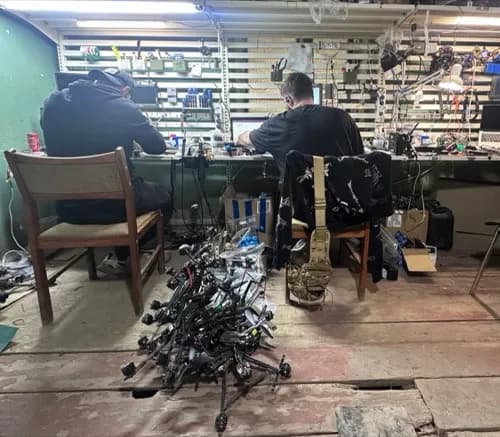
Small, hidden, distributed workshops that keep building drones no matter how many missiles land: it is a good story, and it is true. Ukraine’s manufacturing is deliberately scattered, and it is also a competitive fact with a price tag. As far as I can find, nobody has published that price tag. I want to work out what can honestly be said about it, then show the one number I did find that puts a rough shape on it, from the other side of the ocean.
Why Ukrainian production is deliberately small and scattered
Public reporting is consistent on this. Georgetown Security Studies Review reported in May 2025 that some Ukrainian drone manufacturers were decentralizing production across multiple sites specifically to reduce vulnerability to strikes, sabotage and industrial espionage. The Modern War Institute at West Point reported in August 2026 on underground Ukrainian manufacturing and logistics sites, describing centralized infrastructure as vulnerable on a transparent battlefield and distributed, concealed infrastructure as more resilient. A September 2026 report citing Latvia’s defense minister described the same practice directly: arms makers split manufacturing across sites and sometimes move production, so no single strike has a disproportionate effect on output. Ukraine’s Ministry of Defence is reported to be formalizing this: relocating and duplicating critical capacity and building underground facilities.
None of this is a guess about intent. It is a stated, reported strategy, and the strikes that justify it are not hypothetical: Reuters reported strikes on Ukrainian defense-linked facilities and logistics hubs in September 2026 alone.
What giving up a consolidated plant actually costs, in theory
This part has a real, textbook answer, and it does not depend on anything happening in Ukraine. Manufacturing economics has settled terms for it: economies of scale, minimum efficient scale, fixed-cost dilution, multi-site coordination cost. Splitting the same output across many small sites means duplicating what a single plant would only pay for once: management, quality systems and certification, equipment and tooling, and the purchasing leverage that comes from buying components in one large batch instead of several small ones. Add the cost of moving materials and people between sites, and coordinating engineering changes across all of them. A 1963 study in the Journal of Political Economy found substantial scale economies at the plant level across many industries; more recent work on production fragmentation finds the same pressure holds unless better coordination technology offsets it. McKinsey’s own manufacturing-network research treats this as a real trade-off businesses make consciously: concentrate for scale, or disperse for resilience, flexibility or proximity, and pay for whichever one you choose.
Is there a number for what Ukraine’s dispersal costs?
No, not one I could find. The sources above establish the strategy and its stated reason clearly. None of them, and nothing else I found in a search for it, puts a percentage or a dollar figure on the resulting unit-cost or productivity penalty for Ukrainian drone or defense production. Anyone who quotes one is quoting a guess dressed as a fact. What can be said honestly is the direction: standard economics says dispersal has a real operating cost, and Ukrainian manufacturers are reported to be paying it in exchange for staying in business after the next strike, which for them is the only trade worth making.
Where a comparable number does exist
The US Department of War’s Drone Dominance program is not a Ukraine-comparison exercise, and I want to be precise about what it does and does not show. Executive Order 14307, signed 6 June 2025, directs the US to scale domestic drone production and prioritize US-manufactured systems; nothing in the order or in the Department’s own program materials mandates or favors centralized, single-site manufacturing over a distributed one. Drone Dominance is a multi-vendor, phased procurement: 25 companies were invited into the first "Gauntlet," and the Department’s own stated targets show what happens to unit price as volume grows under normal, non-wartime conditions: an initial phase of 12 vendors producing 30,000 drones at a targeted $5,000 each, moving to a later phase of 5 vendors producing 150,000 drones at a targeted $2,300 each, on the way to roughly 340,000 units over two years, funded at around $1 billion.
That is not a study of dispersal cost. It is a government’s own stated price curve for scaling production under no comparable threat to the factory floor, and it shows a unit price falling by more than half as volume climbs. It is the closest public number I found to putting a rough shape on what scale is worth in this exact category of manufacturing, even though it answers a related question, not the same one.
What this means for a US manufacturer or a buyer comparing sources
A domestic US manufacturer competing in the same category is not making Ukraine’s trade at all. There is no comparable strike risk forcing a choice between one efficient plant and several smaller, safer ones, so a US producer can chase the same economies of scale Drone Dominance’s own numbers point to, without paying for resilience it does not currently need. That is a real, structural cost advantage available to a company on US soil, separate from any difference in labor cost, technology or subsidy. For a buyer or investor comparing a Ukrainian-origin supplier against a domestic one, the honest question is not just "who is cheaper today," it is "who is paying for a form of insurance the other one does not need," which changes how a price difference should be read. Where this advantage matters most is the defensive side: cheap interceptors built by the thousand, which I argue the US needs more than its own copy of Russia’s cheap cruise missile in the US does not need its own Banderol.
For the Ukrainian side of the same comparison, this is not a criticism. A manufacturer under strike risk that refused to disperse and lost its only plant would not have a cost advantage either, it would have no output. I go through the operational questions I would ask about any manufacturer’s real capacity, wherever it is located, in what breaks first between prototype and series production, and the wider set of institutions a Ukrainian deal runs through in Ukraine’s defense industry in 2026. For the US-specific routes a buyer or investor actually has into this market, see three real routes into the US market. Why volume, not the first working unit, is where most defense-tech companies stall is in why one to a thousand is the hard part.
Does Ukraine’s dispersed production actually cost more?
Standard manufacturing economics says it should, through lost scale economies, duplicated fixed costs and added coordination cost. No public source I found puts a number on it for Ukrainian defense production specifically, so treat any percentage you see quoted as an assumption, not a fact.
Does the US government’s Drone Dominance program prove US manufacturing is cheaper?
Not directly. It shows the US government’s own targeted unit price falling as volume rises, under conditions with no comparable strike risk to the factory. That is a real, sourced number about the value of scale in this category, not a documented comparison against Ukrainian costs.
What will the market need next?
Dispersal creates demand a single plant never has. Ukrainian makers need quality systems that work the same way across many small sites, with the same documents, inspections and traceability in each; production software that plans and tracks parts across workshops; and logistics that move components between sites without turning the routes into targets. These are products a Western company can sell into Ukraine.
The know-how will travel the other way as well. European defense plants already plan for sabotage; Estonia blamed Russian services for an arson attack on a ground-robot maker in September 2026. As that risk grows, European and American manufacturers will want the distributed model, and the engineers who have actually run it under missile strikes are Ukrainian. Advising on distributed, hardened production is a service Ukrainian companies can export long after the war.
Signals worth watching: Western investment in distributed or hardened defense manufacturing, insurers pricing sabotage and strike risk for European defense plants, and Ukrainian makers licensing their production model to partners.
Where I could be wrong
I am comparing a well-documented strategy with an unrelated government program’s price targets, not two versions of the same study. If a real, audited cost comparison of dispersed versus consolidated defense manufacturing in Ukraine is published, it should replace the reasoning here, not sit alongside it as a second opinion.
Sources (11)
- Georgetown Security Studies Review, "A First Point View: Examining Ukraine’s Drone Industry," 15 May 2025
- Modern War Institute at West Point, "Digging Below the Death Zone: The Underground War in Ukraine," 12 August 2026
- Business Insider, on Latvia’s defense minister and dispersed Ukrainian arms production, 27 September 2026
- Militarnyi, on Ukraine’s plan to relocate and build underground defense plants, 26 September 2026
- Reuters, on strikes reported against Ukrainian military-linked facilities, 24 September 2026
- Leonard Weiss, "Economies of Scale in Industrial Plants," Journal of Political Economy, 1963
- Fort, Pierce and Schott, "Technology and Production Fragmentation," NBER Working Paper No. 22550, 2016
- McKinsey, "Is your manufacturing network an anchor or a sail?", 2022
- The White House, Executive Order 14307, "Unleashing American Drone Dominance," 6 June 2025
- US Department of War, "War Department Announces Vendors Invited to Compete in Phase I of the Drone Dominance Program," 3 February 2026
- US Department of War, "War Department Asks Industry to Make More Than 300K Drones Quickly, Cheaply"