
Ukraine's answer to the jet Shahed is held up by one part, and it is not the drone. It is the engine.
Ukraine has high-speed interceptors that can catch Russia's jet-powered drones. What it does not have is enough engines to build them by the thousand. The war's next air-defense contest is a supply chain for one component.
Russia now launches jet-powered versions of the Shahed attack drone at Ukrainian cities, flying two to three times faster than the original. The usual reading is that Ukraine needs a better interceptor. It already has the designs. On 2 October 2026 Zelensky told the Financial Times that five high-speed interceptor types are in testing, one of them expected at about 400 units by the end of October. What is holding them back is a single part: an interceptor drone engine shortage. "Engines are a key element; we do import them in large quantities," he said. "There are domestically produced engines as well, but there aren't enough of them." The contest against jet Shahed drones is now an engine supply chain, and that is a production problem before it is a design one.
The assumption: the answer is a faster drone
The logic looks straightforward. Russia moved from the propeller-driven Geran-2 at about 185 km/h to jet-powered Geran versions reported at 300 to 600 km/h. Ukraine's cheap answer to the first generation, interceptor drones at a few thousand dollars, runs on electric motors and tops out around 280 to 300 km/h: Wild Hornets lists 280 km/h for STING, SkyFall over 300 km/h for P1-SUN. So build a faster interceptor.
The numbers show why it matters. Zelensky said on 28 September that only 57% of jet-powered Shahed-type drones were being shot down, "much less than necessary." Russia launched about 500 drones in one day around the start of October, half of them jet-powered, and 900 jet-powered Shaheds in the week before 4 October. The detail on the Russian side is in the Shahed drone, from an Iranian design to a production line.
Why that is the wrong place to look
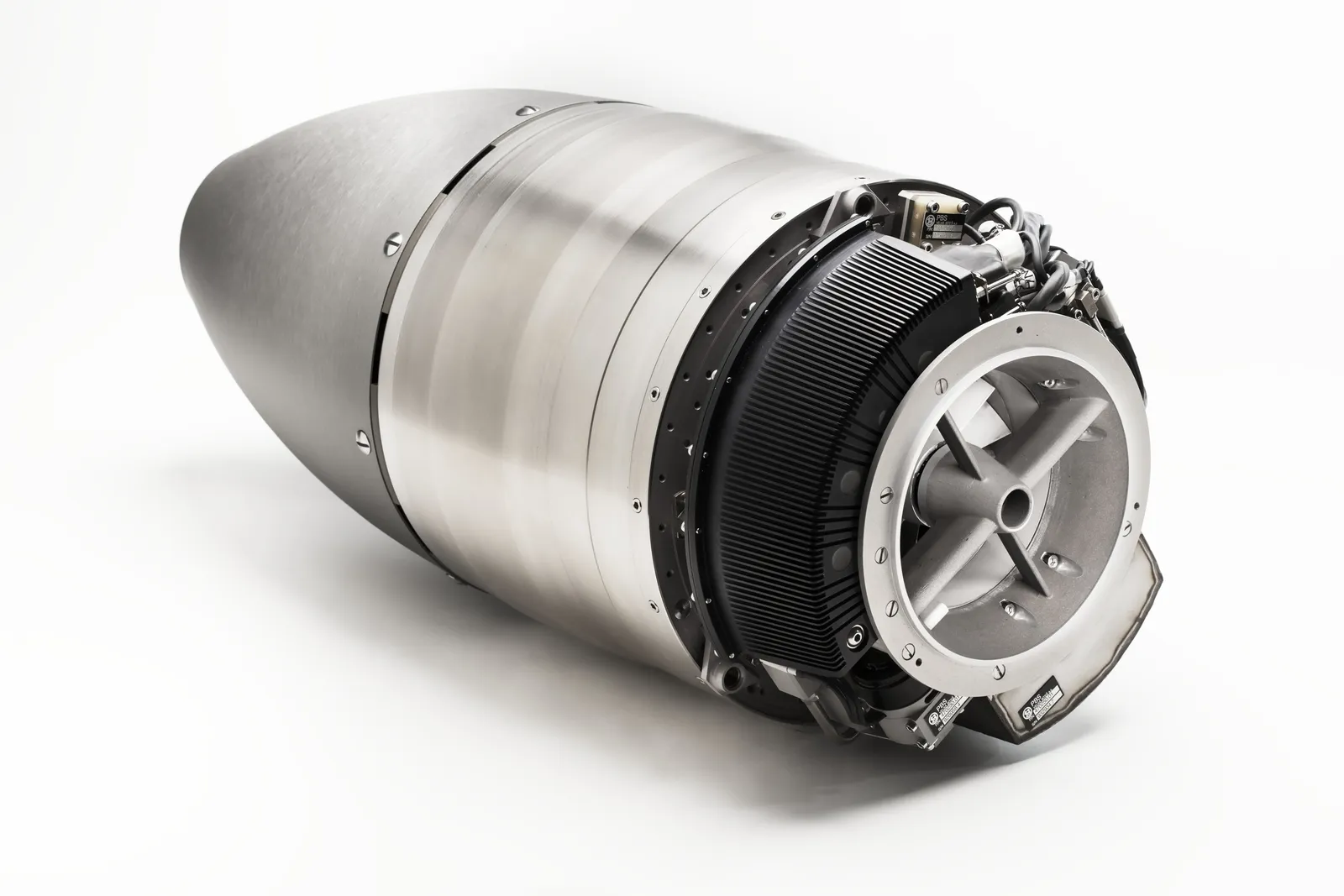
Because the design exists and the part does not. Catching a target at 500 km/h and more needs a propulsion system with continuous high thrust in a small airframe, which in practice means a small turbojet or a much more powerful electric drive. Small turbojets are a specialist product made by a handful of companies in volumes measured in thousands, not millions. Reuters reported in April 2026 that Ukraine relies on three European makers for mini jet engines: the Czech PBS Group, Germany's JetCat and the Netherlands-based Destinus. PBS lists its TJ100 at up to 1,250 N of thrust for 17.6 kg, has built its 2,000th unit and states an annualized capacity of 5,000 engines a year, for all its customers worldwide. At the hobby end, Taiwan's KingTech sells model turbines from about $1,900 to $2,000. That is a respectable industry. It is not a supply that can absorb a war's demand for interceptors, cruise missiles and jet drones at the same time.
Ukraine knows how to build jet engines; Motor Sich and Ivchenko-Progress have done it for decades. What it has lacked is a conveyor for the small ones. The moves are visible but early:
| Who | What | Status |
|---|---|---|
| Ivchenko-Progress with Poland's PZL Defence | memorandum to design and build small powerplants for cruise missiles and drones | signed 25 June 2026; capacity and dates not public |
| Fire Point | its own turbojet for the FP-5 Flamingo missile | in testing; mass production planned after testing ends in 2026 |
| Luch, with a Czech-Ukrainian engine | the Palianytsia jet drone-missile on the AI-PBS-350 | in serial production since late 2024 |
| Motor-G | electric motors for FPV, bomber and fixed-wing drones | 80% localized in October 2026, about 90% expected in 2027 |
The last line is the useful contrast. Electric motors for slow drones are already being localized at scale; the rest of the drone supply chain still leans on China, where nearly 97% of Ukrainian drone producers name it as a primary source and 89% of drone-related imports by value came from in the first half of 2024, as reported by FDD from a Ukrainian supply-chain study. The fast end, where the jet Shahed lives, is not localized at all.
The jet interceptors themselves are arriving. A Ukrainian-German jet-powered interceptor called SPYS was reported at about 600 km/h with a 300 g payload, with the first 50 units sent for combat evaluation in July 2026. Each of them needs an engine from the same short list.
Who else is buying the same engines?
Everyone in the same class. Russia's Banderol cruise missile flies on a Chinese hobby-market turbojet of about 82 kgf, bought for about $16,000 apiece, as its bill of materials shows. Ukrainian interceptors, Ukrainian and Russian jet drones and the cheap cruise missiles both sides and the US are now buying by the thousand all draw on a small-engine market that was built for target drones and radio-controlled jets. Demand has jumped by an order of magnitude; the factories have not.
That is also why money alone does not close the gap. Germany's €1.3 billion package of 4 October includes funding for new interceptors against jet Shaheds, and separate German funding will pay for tens of thousands of Quantum Systems interceptors built in Ukraine. Neither announcement says where the engines come from. Financing an interceptor without securing its engine buys a queue.
Does a faster drone still matter?
Speed is real. An electric interceptor at 280 km/h cannot chase a target at 500, and some of the jet threat will need missiles, fighters and guns in the right place, as I set out in why a cheap cruise missile is hard to stop. Better designs also widen the choice of engines. But a design that can only be built with an engine nobody can supply in volume is a prototype, however well it flies.
What will the market need next?
The engine shortage is the clearest product gap in the war in Ukraine right now. Small turbojets in the 50 to 120 kgf class are wanted by interceptor makers, by cruise-missile programmes on both sides of the Atlantic and by jet-drone builders, and PBS, one of the three European makers Ukraine relies on, states a capacity of 5,000 a year for all its customers worldwide. A new line in Europe or Ukraine, even at modest volume, has buyers waiting.
Around the engine sit smaller markets. Engine controllers, fuel systems and starters are made by even fewer companies. Testing services that qualify an engine with an airframe before a volume order save a buyer months. And a hobby engine at about $2,000 that someone can make reliable at volume would take a large share of the cheap end.
Signals worth watching: new small-turbojet plants announced in Europe, Ukraine or the US, the price of engines in interceptor contracts, and Ukrainian jet interceptors reaching units in numbers.
What it means for anyone building in this space
- The production rate is set by the engine, not the airframe. Whatever the line can assemble, output is set by the part with the longest lead time and the fewest suppliers, the rule I apply in what breaks first between prototype and series production. Count engines, not airframes. Russia faces the same limit on its jet drones; China supplied about 3,000 engines against a need about six times larger, by RBC-Ukraine's sources, which I go through in the Geran-5 K5. How I would choose and second-source an engine is in engine selection for small aircraft and drones.
- Qualify the engine before the volume order, and qualify two. Vibration, temperature, fuel and reliability have to be tested with the engine, its controller, the airframe and the production process as one system before a buyer asks for thousands; finding out at volume turns a product back into a prototype. A second engine source, tested and documented, is worth more to a buyer than a few more km/h.
- Small turbojets are the opening. A European or Ukrainian line for engines in the 50 to 120 kgf class has buyers in three markets at once, interceptors, cruise missiles and jet drones, all of them short of the same part. It is the clearest case of the one to a thousand problem in the war in Ukraine: the prototype is solved; volume is not.
- Do not expect the hobby market to scale. A jet engine is not a piston engine. The small turbojets in today's interceptors and cheap missiles are model-aircraft engines bought up wherever they can be found, and making jet engines well at volume is hard. Demand will stay far above supply for years, which is the opening in point 3 and the risk in this one.
- Price the intercept including the engine. A jet interceptor costs more than an electric one, and the arithmetic in cost-exchange ratio still favors it against a Western missile. It stops favoring it the day the engine doubles in price because everyone wants the same one.
Sources (15)
- The Kyiv Independent, Ukraine aims to produce up to 400 interceptor drones as Russian jet-powered drone use grows, 2 October 2026
- Interfax-Ukraine, Zelensky on engines for interceptors, October 2026
- The Kyiv Independent, Germany announces $1.46 billion in aid for Ukraine, including interceptor drones, 4 October 2026
- Militarnyi, Germany to fund tens of thousands of Quantum Systems interceptor drones for Ukraine, October 2026
- PBS, TJ100 turbojet
- PBS, the 2,000th TJ100 engine produced
- Militarnyi, Ukraine and Poland to cooperate on engines for missiles and UAVs, 26 June 2026
- UNN, why Ukraine needs its own jet engines for missiles and drones
- Defence Ukraine, Ukraine's missile industry in 2026
- Militarnyi, Motor-G reached 80% localization of drone motors, October 2026
- Wild Hornets, STING interceptor
- Reuters, Ukraine's attack drone fleet faces mini jet engine supply crunch, 7 April 2026
- FDD, China is a key factor in Ukraine's surging drone industry, 10 October 2025
- KingTech Turbines, product catalogue
- Pickdrones, Germany–Ukraine interceptor drone deal 2026
Where this comes up on the site
- Anduril's Barracuda sells aim points rather than explosive, and its real product is a cruise missile any partner can assemble
- Palianytsia is the weapon the SSU credits with dropping the Kerch Bridge span, and its limit is the Czech-Ukrainian engine rather than the warhead
- The MICH 2000 is a $48,000 Chinese drone copied in Ukraine, and one unit of the SSU flies all of them