
From 20 to 2,000 drones a month: what changes at each stage of a drone manufacturing ramp-up
An order for thousands arrives before the factory for thousands exists. Here is the drone manufacturing ramp-up in three stages, what each one demands in people, parts, testing and cash, and the test that tells you a stage is finished.
A drone manufacturing ramp-up usually starts with a phone call: a buyer wants thousands, and the company builds twenty a month. Ukraine, which fights Russia’s invasion largely with drones, produced about 4 million of them in 2025 and set a target above 7 million for 2026, so the orders are real; the factories that can meet them mostly are not, yet. Skydio says it builds more than 1,000 drones a month in California. Neros reported about 1,500 Archer FPV drones a month in July 2025 and about 2,500 by November. Neither got there by hiring more people to do what the first twenty took.
I have worked on this problem from inside a Czech aircraft manufacturer and an aviation supplier with its own 8,000 m² plant in Prague, and the pattern is the same for a $500 FPV drone and a $100,000 aircraft. Each tenfold step changes who builds the product, what limits output and where the money goes. These thresholds are my working model, not an industry standard; a $20,000 reconnaissance drone reaches them later than a $500 FPV. Below are the three stages, with a test for each that tells you it is done.
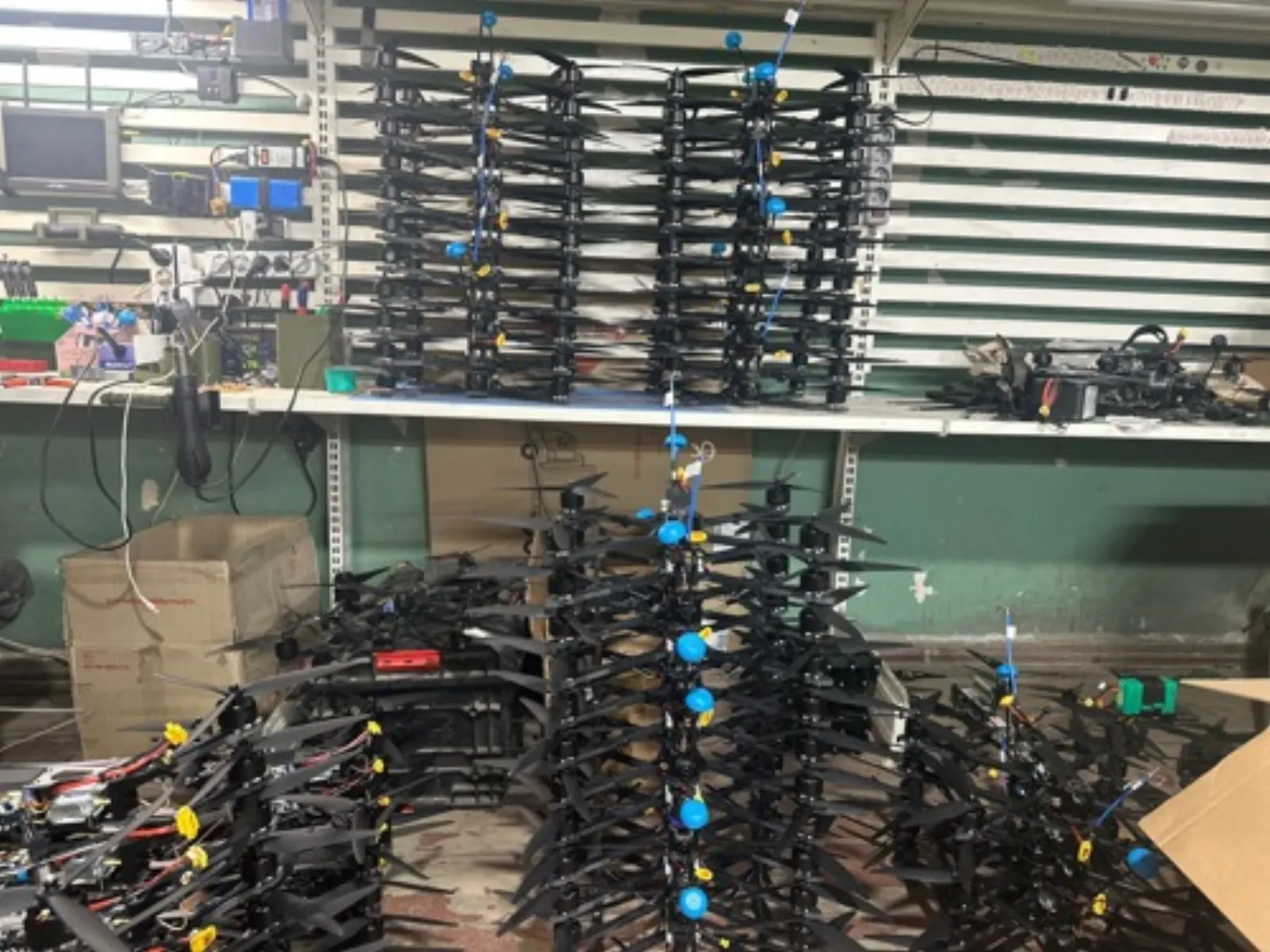
Stage 1: 20 a month, engineers build
At this volume the people who designed the drone also assemble, tune and fly it. Every unit is slightly different, and that is fine, because the engineer knows why.
What has to happen before you leave this stage:
- Freeze a build standard. One configuration, with a version number, that does not change between Monday and Friday. Design changes go into the next version, on a date.
- Write the bill of materials with lead times and a second source for every critical part. Motors, flight controllers, cameras, video transmitters and batteries are where the delays come from. In Ukraine, by one industry survey reported by Militarnyi in December 2025, about 85% of frames and housings are made locally, 50–70% of communication and control parts, and no more than 25% of flight stacks, motors and thermal cameras. The rest comes from abroad, mostly from China. Single makers move faster than the average: Motor-G reported 80% localization of its drone motors in December 2025.
- Write the test procedure. What is checked, in what order, with what pass mark.
Done when a technician who did not design the drone can build and test one from your documents, and it flies as well as the engineers' units.
Stage 2: 200 a month, a line builds
Now assemblers build and engineers fix problems. Output is limited by purchasing lead times, not by engineering.
- Split the work into stations. Frame and motors, electronics, wiring, final assembly, test. Each station has a time; the slowest one sets your output.
- Inspect incoming parts. At 200 a month a bad batch of motors stops the line for a week. Check samples before they reach the bench.
- Measure first-pass yield and labour hours per unit. How many drones pass final test without rework, and how many hours each one takes, including test. Nobody publishes these numbers, which is exactly why a buyer or investor asks for yours.
- Order parts against forecast, not against orders. If motors take ten weeks to arrive and the customer wants delivery in six, you buy before the contract. This is the step that turns a production problem into a cash problem.
- Keep records a military buyer can audit. Which version is in which serial number, inspection results, every non-conformance and how it was closed. A buyer will ask for them before the second order.
Done when you know your yield and hours per unit for three consecutive months and can say what output you would reach by adding one more station or shift.
Stage 3: 2,000 a month, a system builds
At about 100 drones per working day, assuming 20 working days a month, nothing works by memory. Two examples set the bar. Skydio says an X10 can be built in nine minutes, and that each X10D passes 550 assembly and test checkpoints before delivery. Ukraine's makers mostly took the opposite route and spread production across many small sites to survive strikes; what that costs is the subject of Ukraine's dispersed drone factories.
- Contract the suppliers, not just the parts. Volume agreements with fixed lead times, second sources qualified and actually ordering from both. One imported part can cap a whole program, as the engine does for jet interceptors.
- Standardise test, then automate it, before you speed up assembly. Flashing firmware, calibrating sensors and checking links take longer than putting parts together. Assembly in minutes means nothing if acceptance takes an hour.
- Keep stock, work orders, serial numbers and test results in one system. At this volume a spreadsheet loses a pallet of motors.
- Plan the people. Hiring, training and keeping assemblers becomes the slowest thing to change.
Done when you can deliver the same number of drones every week for a quarter, and tell a buyer the date of a delivery three months out.
How much does each stage cost in people and cash?
Here is the arithmetic I run with a client. It is an illustration, not a benchmark: put your own numbers in.
| 20 a month | 200 a month | 2,000 a month | |
|---|---|---|---|
| Drones per working day | about 1 | about 10 | about 100 |
| Labour at 3 hours per drone, assembly and test | about 60 hours a month | about 600 hours, 4 people | about 6,000 hours, 35–40 people on one shift |
| Parts paid ahead at a $1,000 bill of materials and three months of lead time | about $60,000 | about $600,000 | about $6 million |
The last line is the one that stops companies. At 2,000 a month with three months of lead time on key parts, roughly 6,000 drones' worth of components are on order or on the shelf before the first of them is paid for. Supplier credit, deposits and milestone payments from the buyer change the number, but the gap between paying for parts and being paid for drones does not go away. Most founders model the price per drone and forget it.
Should you build capacity before you have the orders?
No, build it against orders and a forecast you can defend. Neros's chief executive said the expansion depended on finding buyers; in July 2025 it was delivering a six-month contract for 6,000 drones for Ukraine from the International Drone Coalition, and two-thirds of its 1,500 a month went to Ukraine. Stark, as reported in October 2025, said it could not yet produce the 12,000 drones under discussion. One company had the orders before the line, the other the conversation before the line.
The price you will be asked for falls as volume rises. The Pentagon's Drone Dominance plan expects average prices to fall from $5,000 to $2,300 a drone as orders grow from 30,000 to 150,000 across its phases. Plan the cost curve before you quote, not after. Who signs those orders, and in what order, is in defense tech go-to-market.
What will the market need next?
Each stage has its own buyers' list. At 20 a month a company needs engineering documentation that a stranger can build from. At 200 it needs fixtures, test benches and a way to measure yield; at 2,000 it needs production planning software, supplier development and quality staff. Makers of tooling and test equipment for small drone lines, and planning software sized for them, sell into a market growing as fast as the orders.
The scarcest input is people. Production engineers, technicians and quality staff are harder to find than the money for a plant, and companies that recruit, train or lend them to drone makers will have more demand than they can fill.
And money for capacity before orders is its own product. Lenders who finance a line against a signed framework, or against Ukraine's demand of about 4 million drones in 2025 and a target above 7 million in 2026, take a risk venture funds do not want to carry.
Signals worth watching: drone makers' published monthly output, hiring of production and quality staff in defense startups, and financing secured against production contracts rather than equity.
What breaks if you skip a stage?
- Skipping stage 1 puts undocumented knowledge on a line. Output depends on which engineer is in the building.
- Skipping stage 2 means you never learn your yield. At 2,000 a month a 10% rework rate is 200 drones a month going round twice.
- Hiring last leaves the line without the production engineers and quality staff it needs. In my experience they, and suppliers that can deliver at volume, are the real limit at stage 3, not the money for the plant.
- Starting stage 3 on hope turns a supplier delay into a missed delivery to a military customer, which is remembered longer than the price.
The problems that appear between the prototype and the series are in what breaks first in series production and why one to a thousand is the hard part. On the factory side, Aviatex is what an aviation plant with 43 people and capacity for 150 drones a year looked like before its demand became forecastable.
Sources (9)
- Ministry of Defence of Ukraine, combat experience and technological adaptability (4 million drones in 2025, 7 million target), April 2026
- Skydio, Skydio delivers first systems for Army SRR Tranche 2 (1,000+ a month, nine minutes), May 2025
- Skydio, US Army $52 million order for X10D (550 checkpoints), March 2026
- Defense News, made-in-America drone maker Neros awaits its big Pentagon break, 3 July 2025
- Tectonic Defense, Neros snags major Marine Corps contract for FPVs, November 2025
- Militarnyi, how dependence on components affects Ukrainian defense tech, December 2025
- Militarnyi, Motor-G reached 80% localization of drone motors, December 2025
- US Department of War, moving out fast on Drone Dominance, February 2026
- Tectonic Defense, Stark and Helsing win big in Germany