
ComBat Vision runs a battle with no server and no internet, and what holds it back is the radio on the soldier's chest, not the code
ComBat Vision is a Ukrainian battlefield navigator that shows every connected friendly soldier, drone and ground robot on one map without a server, without the internet and without Starlink, using the unit's own radios as the network. It began with Ukraine's special forces in 2012. Here is how it works, why it matters for raids and counteroffensives, why the radio kit is the real limit, and what that means for the market.
ComBat Vision is the Ukrainian battlefield navigator built for the moment the network dies. Russia's full-scale invasion of Ukraine, under way since February 2022, has produced one of the most jammed front lines in the world. Most of Ukraine's battlefield software leans on a connection: DELTA, the army's shared battlefield picture, runs in the cloud and reaches the front over Starlink terminals. ComBat Vision assumes there is no connection at all. Its developers describe it as serverless: no central node, no internet, nothing but the unit's radios joined into one network.
My argument is that ComBat Vision shows two things the rest of the stack hides. The first is that Ukraine does not run one battlefield system but layers, each built for a different state of the network, and this is the layer for none. The second is that once the software works without a network, the hard problem moves into the soldier's kit. The code exists; the radio, cable, headset and tablet that a soldier needs to carry it often do not.
ComBat Vision in numbers
| What it is | Tactical navigator (KomBat 4) for soldiers, drone crews and ground-robot operators |
|---|---|
| Network | No server, no internet: devices link to tactical radios that form a closed mesh |
| Slowest link it works on | High-frequency radio at 1 kilobit per second, by the company's description |
| Origin | First version in 2012; used across Ukraine's Special Operations Forces and other special units from 2015 to 2018 |
| Rebuilt | Rewritten from scratch in 2022 with a 3D engine and augmented reality |
| Designation | ComBat Vision 4.0, Battlefield Reconnaissance and Coordination System; messaging built on NATO's STANAG 4677 approach, by the developer's account |
| Distribution | Free trial open to anyone; the military version through DELTA's app store for military devices |
| Robots | Integrated with ground robots from the Ukrainian makers Ratel and Tencore in January 2026 |
Why build a battle map with no server?
Because a server is a single point of failure, and so is the link to it. A unit on a raid behind the line, a landing party or a counterattack that moves faster than its support cannot count on Starlink or a mobile network, and under Russian jamming it often cannot count on GPS either. A system that needs a central server stops showing anything the moment the link drops, exactly when a commander most needs to know where the unit's people are.
ComBat Vision removes the center. Tablets, phones and drone controllers connect by cable, Bluetooth or Wi-Fi to the unit's tactical radios, and the radios carry the data between devices. Every device holds the part of the picture it is allowed to see, and none of them is the one node an enemy has to hit. That is also a security property: there is no central server to hack and no headquarters node whose loss blinds the unit, though a local network can still split when radios drop out.
The company is frank about where it does not fit. In static, positional defense, where units sit in the same trenches for months with cables and stable links, the advantage shrinks. Its home is the dynamic fight: raids, counteroffensives and landings behind enemy lines, such as the liberation of the southern city of Kherson in November 2022 or Ukraine's incursion into Russia's Kursk region in August 2024.
Where did the idea come from?
From a fight against a bigger side. In 2012 Yevhen Maksymenko, ComBat Vision's founder, ran a military-patriotic club that staged field exercises. In one of them his team faced a much larger opposing group, and they tried automated coordination and shared information to hold their own. His conclusion became the product: a smaller force that sees the whole fight and coordinates faster can offset the numbers. It is the same doctrinal bet DELTA's builders made after 2014, reached from the bottom of the army rather than its staff.
The design assumption followed from the field: no infrastructure network, no internet, real-time coordination anyway. Ukraine's special operations forces were the first serious users, because their missions needed independent coordination and they had the equipment to run it. Between 2015 and 2018 earlier versions were used in combat and, by Maksymenko's count, deployed in 83 units of various sizes. After the full-scale invasion the team judged the old generation inadequate for the new war and spent about a year building version 4, on combat experience and NATO standards, including the STANAG 4677 approach to low-bandwidth messaging that lets it run on links as slow as one kilobit per second.
How does it stop friendly fire?
By answering the question every commander asks on the radio, "who is that?", before it is asked. A commander who sees movement in a tree line looks at the tablet and sees that it is the unit's own group Bravo. Each connected soldier and friendly drone is on the map in real time, so the decision to fire does not wait on a voice check that may not come through under jamming.
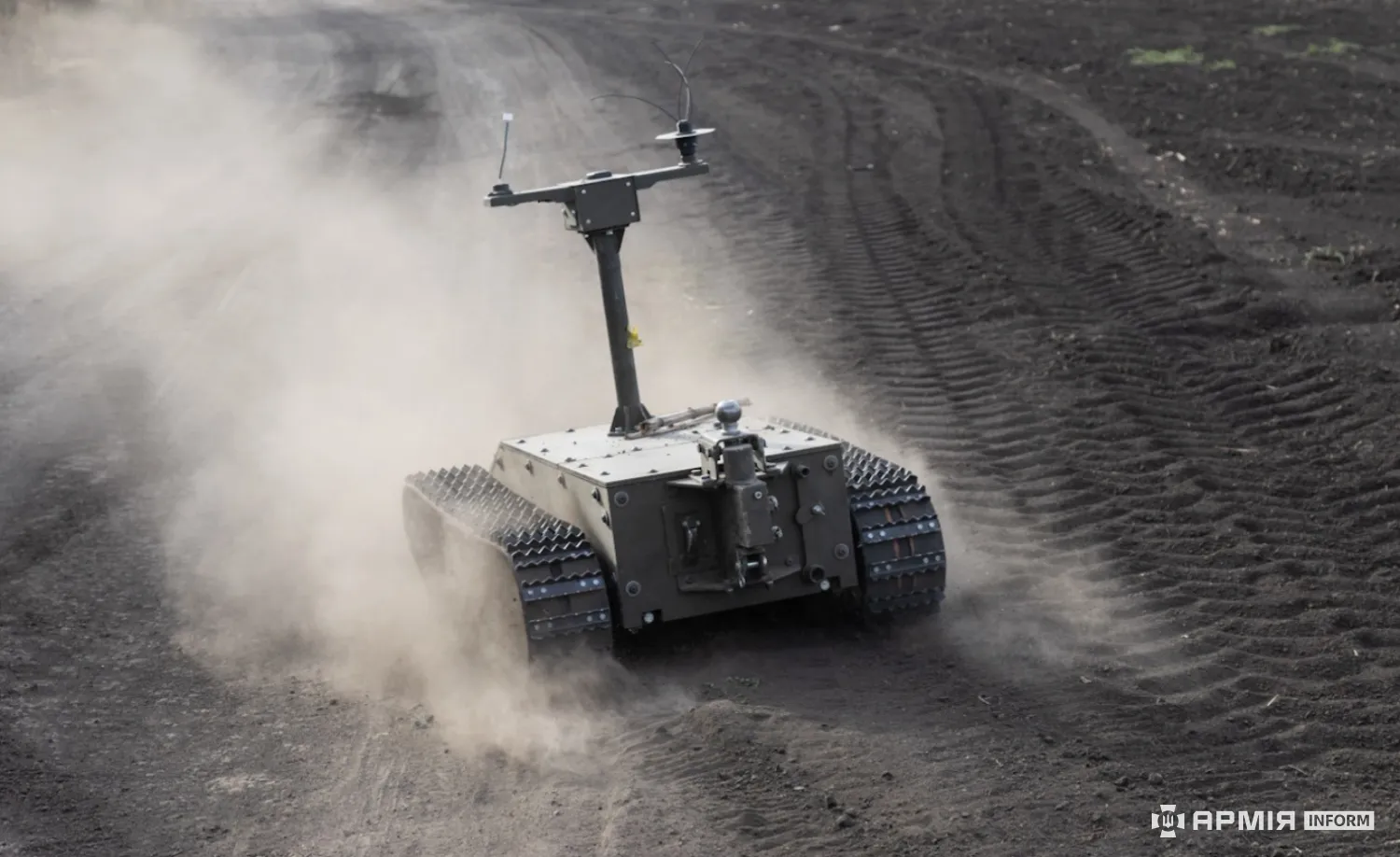
The same map now runs ground robots. A commander sets way-points for an unmanned ground vehicle, watches its camera and sees enemy jamming zones drawn as three-dimensional cylinders to route around. If a robot loses a wheel, its last coordinates stay on the map. ComBat Vision's team calls the next step an Uber for the military: a soldier says what ammunition is needed and where, a vehicle is found, and the soldier watches where it is, when it will arrive and whether it got there. Ground robots now carry a growing share of the delivery and evacuation at the front, a market I go through in Ukraine's ground robots and what Ukraine's ground-robot rules ask of a maker.
Why is the radio kit the real bottleneck?
Because software without a data radio is a picture of last hour. This is the point an outsider usually misses, and it is the most useful one in this story. The main problem now, by the company's own account, is the lack of a standard communications kit for infantry. An ordinary civilian voice radio cannot carry the data. A soldier needs a tactical radio that can, the right headset, a push-to-talk button and a tablet, joined by cable, because Wi-Fi gives a position away to enemy direction-finding.
Range is the second limit. In forest, by the company's account, its ground radio links reach about two or three kilometers. To stretch the network past fifteen kilometers, the company is adding relays on fixed-wing drones and teaching an air drone to track a ground robot optically, so it can guide it when GPS is jammed. Ukrainian radio makers are closing part of the gap: Himera, a Kyiv company, integrated its radios with ComBat Vision so they can carry tactical data to tablets and phones, and its radios also work with DELTA, Kropyva and the American ATAK.
The third limit is people. The team's warning is plain: you cannot arrive at a unit, hand out tablets, explain which button does what and expect the soldiers to know what to do next. A tool for maneuver has to be trained into the way a unit fights, before the fight.
How can a network with no server be secure?
By never letting the soldier know the key. A system without a center has no single vault to protect, so ComBat Vision stacks four locks instead:
- a password on each device, set by device management;
- local encryption of the data with private keys;
- session keys for the channel, using the 256-bit AES encryption standard, loaded only by scanning a QR code before the mission, so the user never sees or knows the channel's password;
- the hardware encryption of the military radios themselves.
The third lock is the one that matters when a tablet is captured. A soldier who never knew the password cannot give it away; a captured device still has to be cut out of the network.
Where does it fit next to DELTA and Kropyva?
At the edge of the network. DELTA holds the shared picture of the whole army in the cloud. Kropyva lives on the artillery crew's tablet and works offline. ComBat Vision connects the people moving between them when nothing else connects. It already exchanges map files with DELTA and Kropyva, and its developers say it is the only system that opens every map and elevation format used by DELTA, Kropyva, the Ukrainian Ukrop app and ATAK. A live link through an API is in progress.
That file-based integration sounds primitive, and in a war it is often the integration that works. When every system can read every other system's maps, a unit can switch tools when the link changes without losing the picture, and no single program has to own the whole stack.
What do outside observers say about it?
That it belongs in the core of Ukraine's tactical software. CSIS listed it in 2023 among the home-grown applications that support Ukraine's battlefield awareness and coordination, and the Johns Hopkins Applied Physics Laboratory included it in its January 2025 overview of Ukrainian military technology as a system for recording and classifying positions and movements. Published testimony from the soldiers who use it is scarce, which fits a tool whose first users were special-operations units that rarely give interviews. The test that matters will be the next large offensive, when the question of who sees whom with no network becomes urgent again.
Where does ComBat Vision go next?
I expect three things.
- Ground-robot logistics becomes its main job. The map that shows soldiers will increasingly dispatch and track the robots that supply them, and that is where most of the daily traffic will come from.
- Relays become standard equipment. Drones carrying mesh relays will be issued with units that maneuver, because two or three kilometers of forest range is not enough for a raid.
- Demand arrives late. The team puts it bluntly: while no counteroffensive is planned, the system does not show its value, and when one is planned everyone will again ask why coordination is so poor and where the communications are. You prepare skis in summer. Buyers who wait for the offensive will be buying in a hurry.
Signals worth watching: an online API link between ComBat Vision and DELTA, a standard infantry communications kit ordered at brigade scale, and mesh relays appearing on Ukraine's drone marketplace.
What will the market need next?
- Data-capable tactical radios at infantry scale. One radio for every soldier who carries a tablet, with mesh networking and encryption built in, where today a platoon may share a few. Ukrainian makers such as Himera have started; the volume a maneuvering army needs is far larger.
- The complete kit, not the parts. Headset, push-to-talk, cables, tablet, power and mounting, sold and supported as one standard set, so a unit does not assemble it from donations. The buyer is the brigade and often the unit itself: under Ukraine's combat-points program, units earn credits for verified results and spend them on equipment from makers listed on the Brave1 marketplace.
- Airborne relays. Small drones and tethered systems that extend a mesh beyond ground range and survive jamming.
- Training as a product. Courses and drills that build the tool into how a unit raids and counterattacks, sold before the offensive rather than during it.
- Allied interest in the same problem. NATO armies plan for networks that are denied, disrupted or limited. A system that has already run real operations without a server is evidence they do not have, and its integration with allied radios is a service someone will sell.
What ComBat Vision means for a defense founder
- Design for the network you will not have. Ask what your product shows when the link drops. If the answer is nothing, it fails at the moment that matters most.
- The bottleneck may be next to your product. ComBat Vision's code works; the radios, cables and training around it limit it. A founder who sells the missing kit can be worth more to a unit than one more app.
- Sell maneuver tools in the quiet months. Demand for coordination software peaks at the start of an offensive, and the time to be trained and deployed is before. That is the same planning problem I describe for production in why one to a thousand is the hard part.
Sources (9)
- DOU, ComBat Vision opened free access to the KomBat 4 tactical navigator, August 2025
- dev.ua, ComBat Vision opened free access to KomBat 4: who it is for and on what terms, August 2025
- Militarnyi, Combat Vision integrates its situational awareness system into Ratel and Tencore ground robots, January 2026
- Militarnyi, Ukrainian Himera radios integrated into the ATAK situational awareness system
- Mezha, Himera: how Ukrainians built radios that compete with Motorola
- Defense Express, The battlefield in real time: what ComBat Vision's tactical control system can do
- CSIS, Seth G. Jones and others, Ukrainian innovation in a war of attrition, 27 February 2023
- Johns Hopkins APL, Wizard warfare: Ukrainian technological developments overview, January 2025
- CSS ETH Zürich, Stefan Soesanto, The Ukrainian way of digital warfighting, July 2024