
Ukraine's procurement agency now buys ground robots by specification, not by brand. What that and the US Army's S-MET ask of a logistics UGV
In August 2026 Ukraine's procurement agency switched to buying ground robots by tactical and technical characteristics, in classes, with no supplier allowed more than half of a class. The US Army is buying its own cargo robot on a different clock. Here is what both documents say, and what a maker has to prove to win either.
UGV procurement in Ukraine changed with that sentence: its procurement agency, DOT, now defines what a robot must do and lets verified makers with a codified product compete for it, instead of contracting named models. For a company building logistics or evacuation robots, the guide DOT published for manufacturers is the clearest public statement of what Ukraine's buyer wants. The numbers behind that market are in Ukraine's ground robots, decoded.
What the Ukrainian guide says
- Two things are bought. Robots that carry cargo at tactical depth over difficult terrain, "equipped with resilient command-and-control capabilities as well as video and telemetry transmission"; and robots built to strike designated targets once, at the enemy's tactical depth.
- Classes, not models. Robots are grouped into classes by minimum operational range and payload. Each class has four to five lots.
- No one wins it all. A single participant may win no more than 50% of the volume in a class.
- Codification is the ticket. To take part, a company must have at least one codified product in the class.
- Verification once. Makers already verified by DOT receive requests for quotation directly; others write to the agency, are checked, and then receive the specifications, document list and instructions.
- Closed bidding. The procurement runs in a secure environment to protect information about participants.
What the guide leaves out, and where to find it
The guide does not publish the class thresholds; those go to verified makers. It does not set a price cap in public. What it does not need to say is what the units already measure. By the ministry's account every ground-robot mission in 2026 has been recorded in DELTA, Ukraine's combat data system, and verified missions earn units points they spend on equipment. Evacuating one wounded soldier earns 70 to 120 points, depending on difficulty. Through the Brave1 Market under that points program, units had ordered nearly UAH 1.9 billion of ground robots by August 2026.
The ministry's monthly mission counts show how fast demand is moving: 7,511 in January, 9,072 in March, 14,059 in May, 16,664 in June and 19,969 in July 2026, more than 100,000 by 20 August. More than 22,000 robots had been contracted since the start of 2026 by 20 July, nearly twice the whole of 2025.
What the US Army asks of its cargo robot
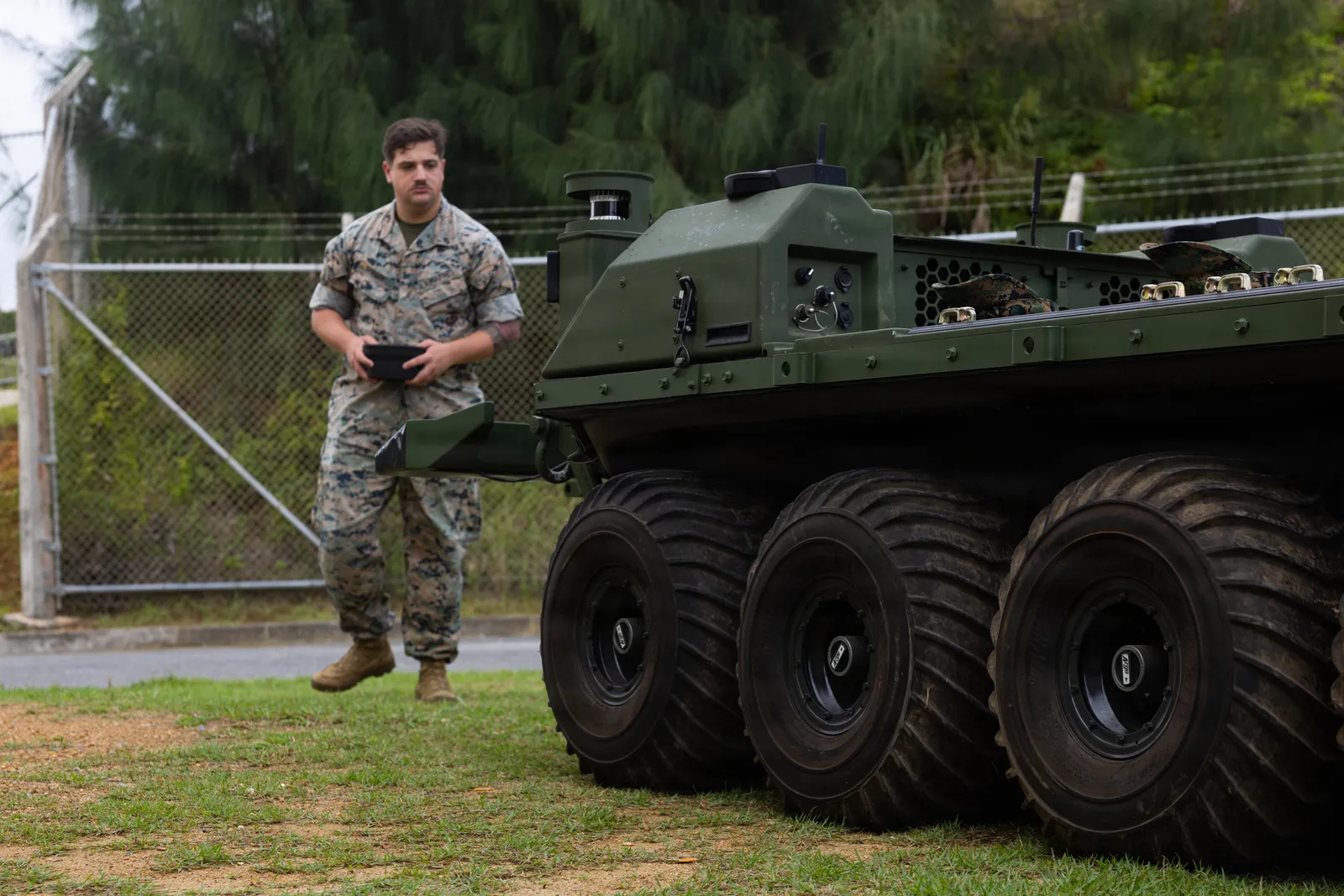
The US Army's Small Multipurpose Equipment Transport, S-MET, is the closest American equivalent. Increment I is an eight-wheeled, radio-controlled platform that carries 1,000 lb. For Increment II the Army awarded two prototype contracts in September 2024, to American Rheinmetall Vehicles and HDT Expeditionary Systems, together worth $22 million for eight prototypes each. Increment II should double the payload to 2,000 lb and add what soldiers asked for:
- more exportable power for drones and radios;
- a quieter signature;
- a wireless mesh network for dismounted troops;
- higher reliability;
- charging from any power grid in the world;
- a modular, open architecture.
A production contract for up to 2,195 systems is slated for late fiscal 2027, if testing succeeds.
Why do the two buyers ask for different things?
They fight different wars. Ukraine contracted more than 22,000 robots in seven months, many of which will be lost, from many Ukrainian makers, and caps each supplier at half a class, which, as I read it, keeps any one plant from becoming a single point of failure. The US Army buys about two thousand larger robots over years, to lighten an infantry load, and asks for power, silence and reliability. A Ukrainian cargo robot such as Air3F's Varkhan, codified in September 2026, carries up to 300 kg for up to 37 km at 20 km/h, uses a secure analogue radio channel and supports Starlink and LTE. Rheinmetall's Mission Master SP, which the US Marine Corps ordered in September 2026 (12 vehicles and five amphibious kits for $7.28 million, including equipment), is built for a different customer and a different budget.
What will the market need next?
The two buyers create two different markets. Ukraine contracted more than 22,000 robots in seven months of 2026 and caps each supplier at half a class, so it buys from many makers at once; that rewards small plants with codified products and fast repair, and it leaves room for component suppliers who sell to all of them: drivetrains, batteries, relay radios and remote-control kits. The US Army buys about two thousand larger robots over years, with a production decision in late fiscal 2027; that rewards a few makers with power, silence and long-term support.
The bridge between them is a product in its own right. A ground robot proven in Ukraine against Russian drones and mines, then adapted to the US requirement and built in the US, would carry evidence no US rival has. Makers that plan the adaptation and the US production partner now will be ready when the Army's decision comes.
Signals worth watching: Ukraine's monthly robot contracting volumes, the codified classes and how many makers fill each, and the shortlist for the US Army's next cargo robot.
What does a UGV maker have to prove?
- Codification in the class you bid for. Without a codified product you cannot enter Ukraine's tender. Plan codification before the tender, not after.
- Range and payload at the class minimum, with margin. The class sets a floor. Prove it loaded, on bad ground, with the batteries you will ship.
- The link and the autonomy. "Resilient command and control" with video and telemetry is the first line of the requirement. Show which bands you use, what happens under jamming and when the link drops, and how much the robot drives itself: remote control, waypoints, or a safe return on its own. Agree how each of these will be proven before the trial; the method is in a verification matrix, worked end to end.
- Mission records. Units log every mission in DELTA. A maker who can show how many missions its robots completed, and how many came back, has evidence no brochure matches.
- Volume you can deliver with half the class. With a 50% cap even the best bid wins at most half a class; size the plant for a share and price for it. The production side is in from 20 to 2,000 a month.
- Evacuation, done properly. A robot that can carry a stretcher is not yet a casualty-evacuation robot. Restraint, vibration and protection of the casualty are what a medic will ask about.
For a European or American maker, the route into this market runs through testing with Ukrainian units and a Ukrainian or joint production partner; the joint ventures already doing it are in German-Ukrainian defense joint ventures, and the testing route is in how to get a drone tested in Ukraine.
Sources (7)
- Defence Procurement Agency DOT, procurement of UGVs on tactical and technical characteristics: step-by-step guide for manufacturers, 22 August 2026
- Ministry of Defence of Ukraine, UGVs have performed over 100,000 frontline missions since the start of the year, August 2026
- Ministry of Defence of Ukraine, over 22,000 UGVs contracted since the start of 2026, July 2026
- Ministry of Defence of Ukraine, DELTA expands mission reporting for ground robotic systems, January 2026
- US Army, Small Multipurpose Equipment Transport Increment II contract awards, 24 September 2024
- Ukrainska Pravda, Varkhan ground robot approved for military use, 24 September 2026
- Rheinmetall, American Rheinmetall supplies Mission Master to the US Marine Corps, 10 September 2026
Where this comes up on the site
- Ukraine digitized its army's paperwork and purchasing the way it digitized the battlefield, and now the front line decides what gets bought
- ComBat Vision runs a battle with no server and no internet, and what holds it back is the radio on the soldier's chest, not the code
- DELTA, Ukraine's battlefield system, is less a map than a ledger, and the ledger now decides what gets bought