
Ukraine's ground robots by the numbers: 22,000 contracted, nearly 20,000 missions a month, and $77.6 million of European venture money
Ukraine buys more unmanned ground vehicles than any army, and most of them carry ammunition, water and wounded soldiers, not guns. European investors put 60 times more into aerial drones. Here is which figure answers which question, and what the gap means for a company building ground robots.
Unmanned ground vehicles in Ukraine went from a few experiments to a procurement line in two years, because Russian drones made the last miles to the front too dangerous for people. An unmanned ground vehicle, or UGV, is a remotely driven robot on wheels or tracks; in Ukraine most of them are electric cargo platforms the size of a garden tractor. By the count of UNITED24, Ukraine’s official fundraising platform, Ukraine received about 2,000 of them in 2024 and about 15,000 in 2025. In the first half of 2026 its ground robots ran more than 66,000 missions. In the same year, European venture investors put $77.6 million into ground robotics and $4.7 billion into aerial drones. The figures quoted about this market measure different things, and the wrong one in a deck or a market model costs credibility in the first meeting. Below is which number to use for which question, what the robots do, and why the money has not followed the demand yet.
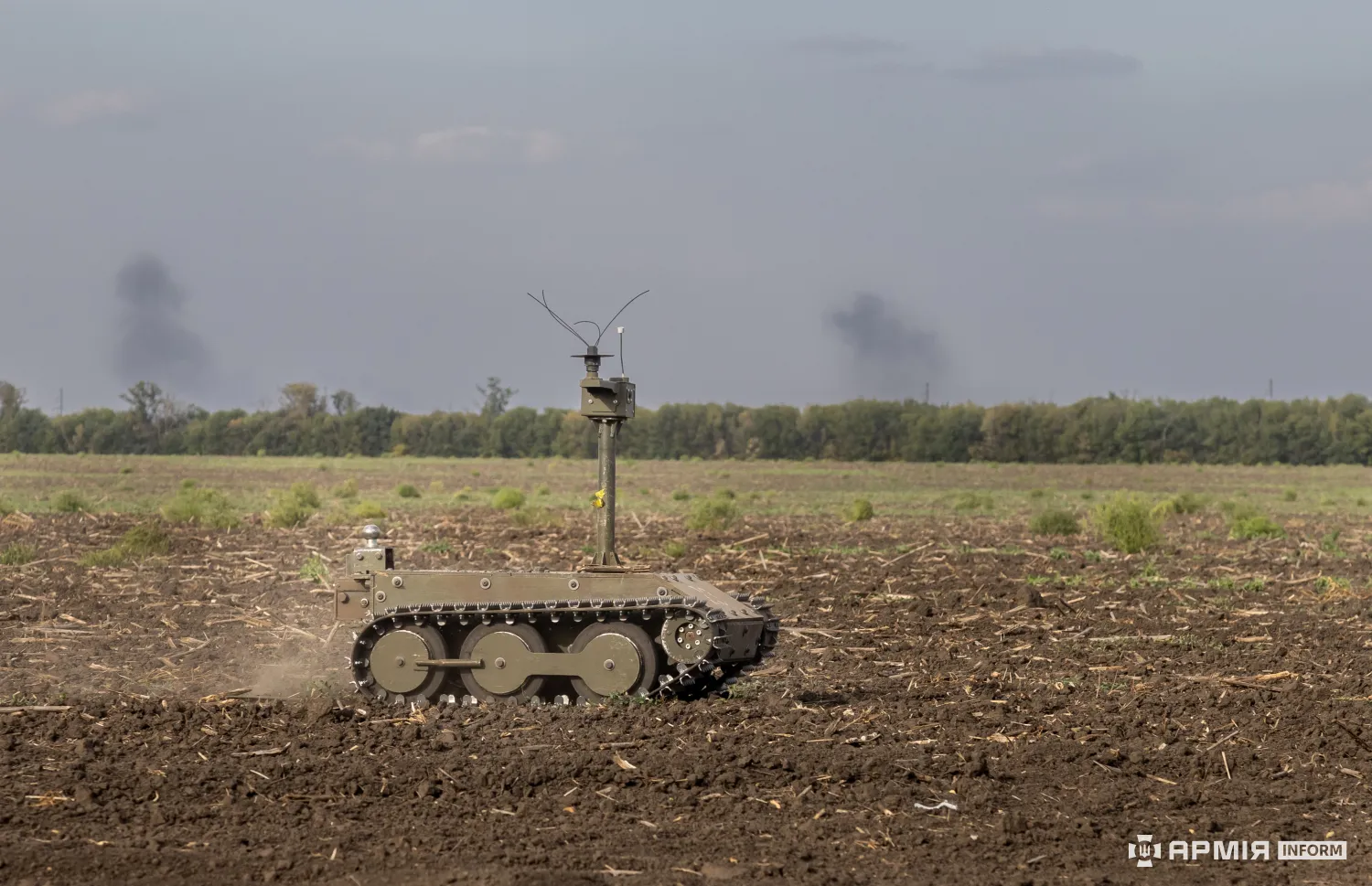
The figures, and what each one counts
| Figure | What it counts | Source and date | Use it for |
|---|---|---|---|
| About 2,000 (2024), about 15,000 (2025) | ground robots received by Ukraine's forces | UNITED24 Media, July 2026 | the delivery curve |
| 25,000 in the first half of 2026 | a contracting target, "twice as many as Ukraine procured throughout all of 2025" | Defence Minister Mykhailo Fedorov, April 2026 | the size of the state's intent |
| More than 22,000 | robots contracted for delivery in 2026 | Defence Procurement Agency, as reported in July 2026 | the demand a maker can actually bid for |
| 19 contracts, UAH 11 billion (about $250 million) | signed contracts with manufacturers by April 2026 | UNITED24 Media, May 2026 | money committed, not vehicles delivered |
| 50,000 a year | President Zelensky's ambition | July 2026 | direction, not a forecast |
| 2,900 → 7,511 → 9,072 → 16,664 → 19,969 | missions in November 2025, January, March, June and July 2026 | Ministry of Defence of Ukraine | how fast use is spreading |
| More than 66,000 | missions in January–June 2026 | UNITED24 Media, July 2026 | the demand for the work itself |
| 181,000 | drones, ground robots and electronic-warfare systems delivered through digital procurement since January 2026 | Fedorov, April 2026 | nothing about ground robots alone |
| Nearly 30 | new UGV models codified in January–June 2025 | Ministry of Defence of Ukraine | the number of competitors with a route to the buyer |
| $77.6 million vs $4.7 billion | European venture funding for ground robotics vs aerial drones, 2026 to September | Dealroom, via Defense News, October 2026 | the capital gap |
Two of these collide. Fedorov's "twice as many as all of 2025" puts 2025 procurement near 12,500; UNITED24 counts about 15,000 received. My reading is that the first is what the ministry contracted and the second is everything that arrived, through every channel. If you size the state market, use the lower one.
Which number answers which question?
- "How big is the market?" The 22,000 contracted for 2026 and the UAH 11 billion signed. Not the 50,000 ambition and not the 25,000 target.
- "Is the demand real?" Missions. 19,969 in July 2026 is a count of times a unit chose a robot over sending a soldier, and it grew almost sevenfold in eight months.
- "How crowded is it?" The codification count. Nearly 30 new models in six months means a buyer with choices and prices set by Ukrainian makers.
- "Will investors pay for this?" The Dealroom split, read with care: it is venture money into European startups, not spending by armies, and it leaves out Ukrainian makers almost entirely.
What do the robots actually do?
They carry. In Ukraine's 3rd Assault Brigade about 19 of every 20 tasks given to ground robots are logistics or evacuation, and combat is about 2%. The brigade's monthly robotic deliveries rose from 30 tonnes in January 2025 to 300 tonnes a year later, and it reports that all evacuations of wounded and fallen soldiers are now done by robots. The 21st Unmanned Systems Regiment moves up to 90% of its deliveries this way. Fedorov's stated goal is for all frontline logistics to be done by robotic systems.
The reason is the last few kilometres. Aerial drones watch the roads behind the line, so any vehicle or person moving supplies forward is a target. A robot that carries 300 kg is cheaper to lose than a truck and its crew, and it can split one delivery into several small loads on different routes.
The products show the same priority:
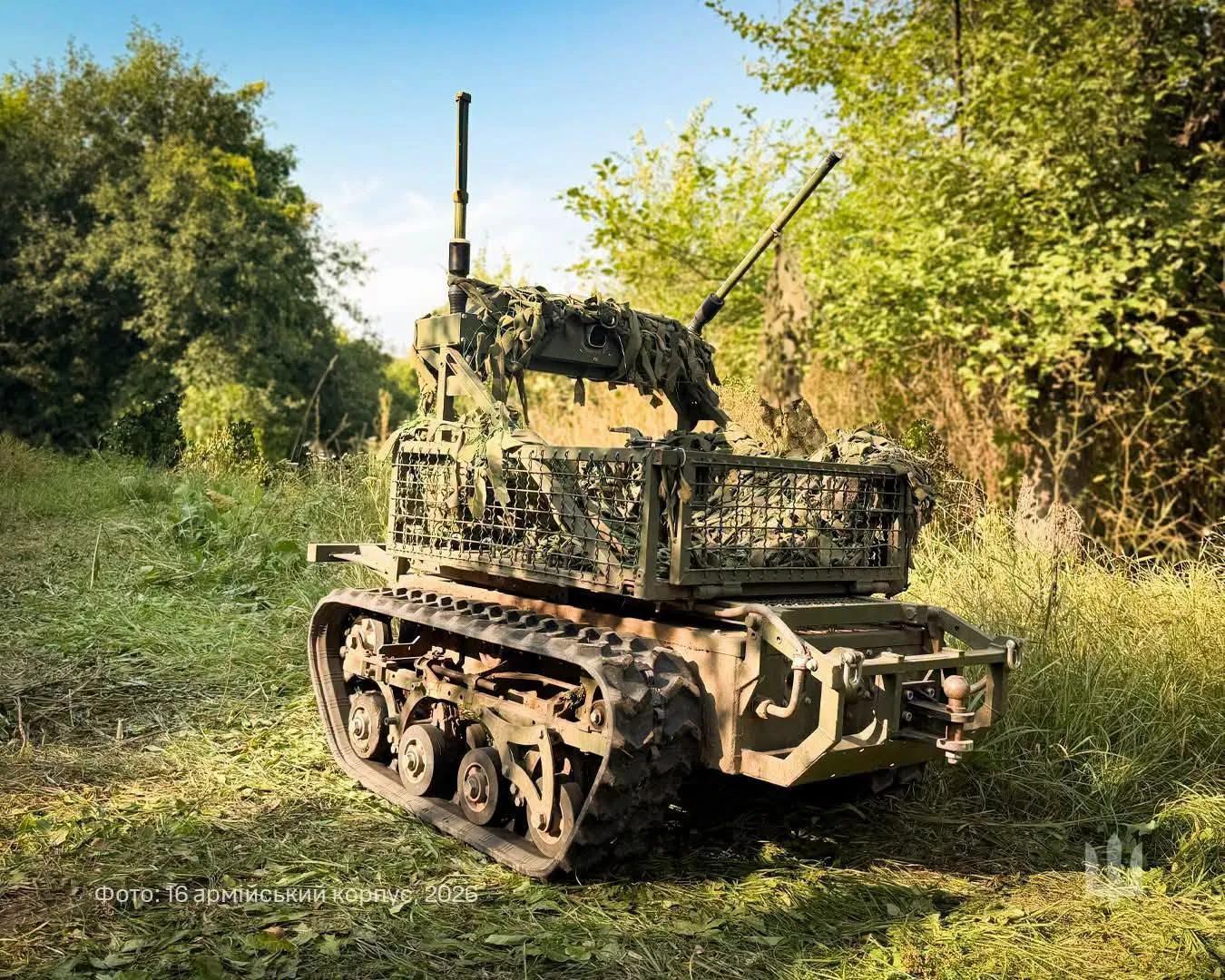
- TerMIT 2.0 (Tencore): 570 kg unarmoured, 398 kg payload, up to 40 km range, 15 km/h on roads, four 73 Ah batteries; modules lay up to 20 TM-62 anti-tank mines or 100 m of barbed wire. The earlier TerMIT was reported at 300 kg payload for about $13,000.
- Bizon-L: a logistics robot codified in April 2026 for 300 kg over 50 km, cleared for Ukraine's forces and allies under NATO cataloguing rules.
- Droid TW 12.7 (DevDroid): an armed platform with an M2 Browning heavy machine gun, 7 km/h, a 5 km tactical radius.
- KRAMPUS: a strike robot carrying RPV-16 thermobaric launchers, approved in May 2025.
The armed ones get the headlines; Khartiia's all-robot assault near Hlyboke in December 2024 and a Russian position taken by robots and drones alone in April 2026 are the cases everyone cites. The money is in the mule.
Why does Europe fund the drone and not the robot?
Venture money goes where a euro buys the most output soonest, and on that test a ground robot loses to an aerial drone for four reasons.
- It is a vehicle. A ground robot is a chassis, a drivetrain, batteries and often armour. Building it looks like automotive production, with tooling, heavy parts and freight, not like assembling electronics around a small airframe. The capital per unit of output is higher and the margins are thinner when the buyer pays in the tens of thousands of dollars.
- The ground fights back. Mud, craters, wire and slopes change the range, and the radio link decides how far a robot can go more than its battery does. Earlier TerMITs used a 915 MHz link or a relay carried by a drone overhead. The range on the spec sheet is driving range, not control range under jamming.
- One buyer sets the price. Ukraine buys most of the world's ground robots, from Ukrainian makers, at Ukrainian prices. Western armies are behind: the US Army reconsidered its Robotic Combat Vehicle program in 2025 rather than pay, as the Congressional Research Service reported, "almost $3 million per copy". A buyer at $13,000 and a buyer at $3 million are two different markets, and neither looks like a venture market yet. The Pentagon's fiscal 2026 request put $210 million into autonomous ground vehicles against $9.4 billion for aerial ones, a gap its planned Autonomous Warfare Command will inherit.
- Fewer second markets. An aerial drone company can also sell to mapping, inspection and agriculture. A frontline cargo robot has fewer civil buyers, and the ones it has, in mining, farming and logistics yards, buy to different specifications. Investors pay for that second market as much as for the first.
Maritime robotics sits in between, with $796 million raised by European startups in the same period; why navies and investors fund it differently is in maritime drones after the Black Sea. None of this is permanent, and the signs of change are in Germany. ARX Robotics raised a €31 million Series A in 2025, with the NATO Innovation Fund among its investors, extended by €11 million to €42 million. On 4 October 2026, in Kyiv, with Chancellor Merz and President Zelensky present, ARX and the Ukrainian maker Roboneers signed an expanded partnership around ARX Industries, a joint company for serial production in Ukraine and Germany. Quantum Tencore Industries, Quantum Systems' joint venture with TerMIT's maker, is building 2,000 TerMITs in Germany for Ukraine over 12 months on a German Ministry of Defence contract, one of several German-Ukrainian defense joint ventures. ARX and the engine maker DEUTZ delivered the first Gereon robots built at DEUTZ's Ulm plant to Ukraine's forces after a 12-week production ramp-up. Milrem's THeMIS, from Estonia, has more than 150 vehicles due for Ukraine with Dutch funding, and in September 2026 Estonia blamed Russian intelligence services for an arson attack on a Milrem building in Tallinn. A European robot maker now needs site security in its plan as well as a supply chain.
What a ground-robot company should be able to show
The market is for mass, not for perfection. Ten thousand small robots do more than one large one with lidars, and a robot that a brigade can buy by the thousand at around $25,000 each will find buyers faster than any prototype. The same machines also have a life after the war: rescue missions in places people cannot reach, firefighting, logistics on difficult ground. A robot that has worked at the front can be turned into a good civilian product; it takes creativity, and few makers are thinking about it yet.
The investor gap is an opening for a company that presents itself as a production business. These are the numbers I would want on the first page, in this order:
- Missions and tonnes. How many missions your robots ran last month, with which units, and how much they carried. Mission data is what this buyer counts: every mission is logged in DELTA, the army's battlefield data system, and verified missions earn the unit points to spend on more robots.
- Cost per delivery. Unit price, plus repairs, batteries and the operator's time, divided by missions before loss. A $13,000 robot that survives 40 runs is cheaper per run than a $40,000 one that survives 60, and the buyer does this sum. Say how fast a damaged robot is back in service and where the spare parts sit: a unit is buying availability.
- Units a month, and where. The plant, the batteries and motors you depend on, and their lead times; one imported part can cap a whole program, as the engine does for jet interceptors. Contracts arrive faster than production lines; the stage-by-stage plan is in from 20 to 2,000 a month, and the reasons are in why one to a thousand is the hard part and what breaks first in series production.
- The link and the autonomy. What happens when the radio is jammed, whether a relay drone is part of the kit, and how much the robot drives itself: remote control only, waypoints, or a safe behaviour when the link drops.
- The route to the buyer. Codification in Ukraine, which since August 2026 is the entry ticket to tenders where robots are bought by class and specification (see how Ukraine and the US Army buy ground robots), cataloguing under NATO rules (a STANAG is a standard, not a certificate), and which of the three buyer roles in defense tech go-to-market you already have.
- Where it was tested. Robots tested by a brigade behind the line answer the questions an investor cannot; the route is in how to get a drone tested in Ukraine, and it works the same way for ground systems.
What will the market need next?
The gap between how many robots Ukraine uses and how little Europe invests in them is the market. European venture investors put $77.6 million into ground robotics in 2026 against $4.7 billion into aerial drones, while Ukraine, under Russia's full-scale invasion, sends its robots on tens of thousands of supply and evacuation missions. I expect the investors who missed the drone rounds to arrive here, and the companies they back to be the ones that can show missions, cost per delivery and units a month.
Around the robot sit parts and services with even less competition: batteries and motors made outside China, relay radios that keep a robot driving when the link is jammed, and repair and spares kept close to the units, because a brigade buys availability, not machines. The demand is for mass: robots a brigade can buy by the thousand at around $25,000 each, not a few large ones with lidars.
The same machines have a market after the war. Rescue in places people cannot reach, firefighting and logistics on rough ground are civilian jobs for robots built and proven at the front line in Ukraine.
Signals worth watching: the first large European ground-robotics round, Ukrainian procurement volumes by robot class, and civilian rescue or firefighting tenders for ground robots.
Five ways these numbers get misused
- Adding the target and the contracts. The 25,000 target and the 22,000 contracted are two views of the same demand, not 47,000 robots.
- Calling 181,000 a robot count. It mixes aerial drones, ground robots and electronic-warfare systems.
- Reading missions as vehicles. 66,000 missions were run by a much smaller fleet; one robot can run dozens before it is lost.
- Mixing TerMIT versions. The earlier model's $13,000 price and the newer model's 398 kg payload belong to different machines.
- Taking $77.6 million as the size of the market. It is what European venture investors put in, which is why it sits next to the European defense funding numbers as the smallest line, while Ukraine's state contracts for the same robots had reached about $250 million by April.
Sources (23)
- Defense News, Ukraine to field 25,000 ground robots in push to replace soldiers for frontline logistics, 24 April 2026
- UNITED24 Media, Ukraine's ground robots surpass 16,000 battlefield missions in a single month, July 2026
- UNITED24 Media, how Ukraine builds its ground robots for the kill zone, May 2026
- Ministry of Defence of Ukraine, over 9,000 frontline missions in March, April 2026
- Ministry of Defence of Ukraine, a new UGV codified (June missions), July 2026
- Defence Blog, Ukraine ramps up robot use to keep soldiers off the front line, July 2026
- Ministry of Defence of Ukraine, nearly thirty ground robotic systems approved since the beginning of the year, July 2025
- Ministry of Defence of Ukraine, units to be reinforced with thermobaric-launcher robots (KRAMPUS), May 2025
- War on the Rocks, Ukraine's ground robots and the economics of survival, September 2026
- Tencore, TerMIT product page
- The New Voice of Ukraine, what Ukraine's TerMIT robot brings to the front line, August 2025
- Army Recognition, Ukraine uses ground robots and drones to capture Russian positions, October 2026
- Forbes, Ukraine's first all-robot assault force, December 2024
- Defense News, European defense startups to raise record $10.5 billion in 2026, Dealroom forecasts, 5 October 2026
- YPOG, ARX Robotics €31 million Series A, April 2025
- ARX Robotics, Series A extended by €11 million, October 2025
- European Security & Defence, ARX Robotics and Roboneers, 5 October 2026
- Defence Industry Europe, ARX Robotics and DEUTZ deliver Gereon systems for Ukraine in 12 weeks, October 2026
- Defense News, Estonia blames Russia in arson attack on military robotics firm Milrem, 29 September 2026
- Congressional Research Service, the Army's Robotic Combat Vehicle program, IF11876
- European Security & Defence, Quantum Systems and Tencore to co-produce 2,000 TerMIT UGVs, June 2026
- US Department of Defense, background briefing on the FY2026 defense budget (autonomy line), June 2025
- Ministry of Defence of Ukraine, UGVs have performed over 100,000 frontline missions since the start of the year (monthly counts), August 2026
Where this comes up on the site
- Ukraine's procurement agency now buys ground robots by specification, not by brand. What that and the US Army's S-MET ask of a logistics UGV
- ComBat Vision runs a battle with no server and no internet, and what holds it back is the radio on the soldier's chest, not the code
- German-Ukrainian defense joint ventures: who builds what, where, and who pays