
Skydio in Ukraine: a trusted drone is not a survivable drone, and the US market only certified the first
Skydio is America's best-known drone maker, on the Pentagon's Blue UAS list and in the US Army's reconnaissance programme. Its drones sent to Ukraine struggled under Russian jamming, the Wall Street Journal reported in 2024. Here is what happened, what Skydio changed, and the gap it exposed between trusted and survivable.
Skydio is the best-known American drone maker: founded in 2014, headquartered in San Mateo, California, with its factory in Hayward, and built on autonomy software that lets a drone fly itself around obstacles. Its X10D is on the Pentagon's Blue UAS list of drones cleared for US military purchase, and the US Army is buying it for its Short Range Reconnaissance programme, part of a market US law cleared by restricting DJI, the Chinese maker of most of the world's civilian drones. It sent hundreds of drones to Ukraine for its war against Russia's invasion. In April 2024 the Wall Street Journal reported that they were going off course and being lost under Russian electronic warfare. Anduril's first Ghost drones in Ukraine ran into the same jamming, as I describe in Anduril.
My argument is that Skydio exposed a gap the US drone market had not priced: a trusted drone is not the same as a survivable one. The Blue UAS list certifies where a drone's parts come from and that its software is secure. It does not certify that the drone keeps flying when an enemy jams its radio and its satellite navigation. The list certified the paperwork, not the flight. The US market rewarded the first; the war in Ukraine tested the second. Skydio's recovery since shows what closing that gap takes.
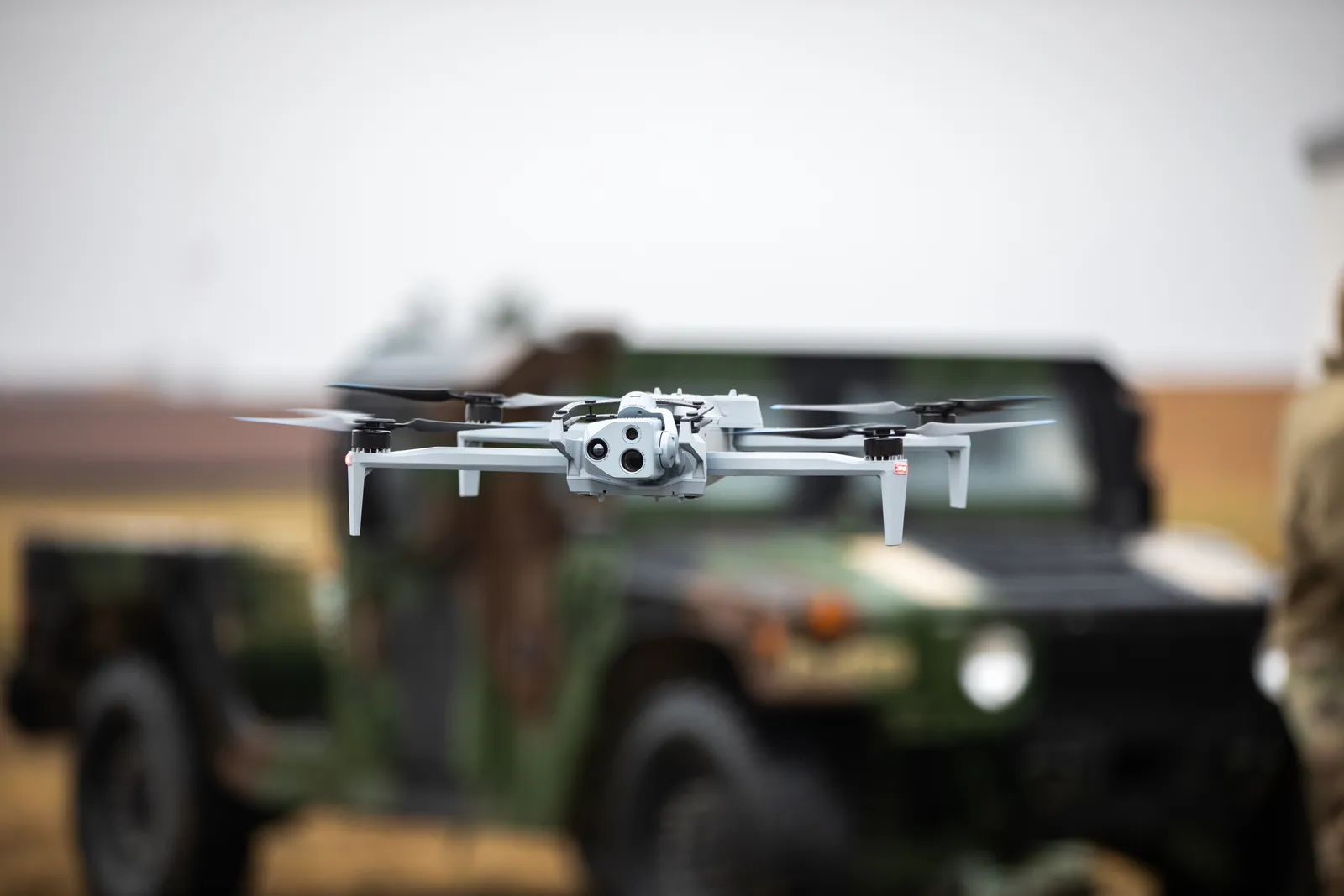
Skydio in numbers
| Founded | 2014; headquarters San Mateo, factory in Hayward, California |
|---|---|
| Military drones | X2D and X10D, both on the Blue UAS list (X10D added in May 2024) |
| US Army | Short Range Reconnaissance programme; a $52 million-plus order for over 2,500 X10Ds announced in March 2026 |
| Funding | Series F in April 2026 at a $4.4 billion valuation |
| China | sanctioned by China in October 2024, which cut its battery supply, one of the few parts it still sourced there |
What happened in Ukraine?
The drones met an environment their designers had not expected. The Wall Street Journal reported in April 2024 that Skydio drones sent to Ukraine were going off course and being lost to Russian jamming, part of a wider finding that American small drones were expensive, hard to repair and vulnerable to electronic warfare. Ukrainian units came to rely more on drones built at home, which they could change themselves.
Why did a trusted drone struggle?
Because what the US market checked was not what the war tested. A drone earns its place on the Blue UAS list by its supply chain and cybersecurity: no Chinese flight controllers or radios, no data leaking to the wrong server. Those are real requirements, and they matter for a military buyer. But a Ukrainian unit asks a different first question: will it keep flying when the radio link and GPS are jammed, and can we fix it in a dugout? A drone can pass the first test perfectly and fail the second.
There is a second, less obvious gap. Skydio's strength was autonomy built for the civilian world: flying itself around trees and buildings. Ukraine needed a different kind of autonomy: flying on when the link drops, navigating without satellites, and keeping the operator's position hidden from the enemy who is hunting the radio signal. The same word, autonomy, meant two different products.
What did Skydio change?
It went to where the problem was. In July 2024 Skydio announced an external radio that lets operators put distance between themselves and the transmitter, so that the enemy locating the signal does not find the crew, and said it was already testing it in Ukraine. It has since kept growing: the US Army's order for over 2,500 X10Ds in March 2026, and a Series F in April 2026 at a $4.4 billion valuation. China's sanctions in October 2024 showed the other supply-chain risk, a battery still sourced from the country the list is meant to keep out.
Where does this lead?
I expect three things.
- Lists add survivability. Military buyers will start asking for proof of performance under jamming alongside supply-chain compliance, and the companies that can show both will take the orders.
- Testing in Ukraine becomes a requirement. A Western drone that has not flown under Russian electronic warfare will be treated as untested, the route in how to get a drone tested in Ukraine.
- The last Chinese parts go. Batteries, motors and magnets are the remaining dependencies. The FCC's December 2025 rule on foreign drone components adds pressure to move them.
Signals worth watching: Army deliveries of the X10D, any published Ukrainian assessment of Skydio's newer drones, and US battery and motor production for drones.
What will the market need next?
The gap between trusted and survivable is a market. Buyers will want both a clean supply chain and proof that a drone keeps flying under jamming, so test services that produce that proof, and components that pass both checks, sell to every maker on the list. Batteries and motors made outside China are the scarcest of those parts, as Skydio learned when China's sanctions cut its battery supply.
The radio Skydio built for Ukraine points to a product category of its own: equipment that separates the operator from the transmitter, so the enemy locating the signal does not find the crew. Every army flying drones against an opponent that hunts emitters will buy it.
Signals worth watching: US battery and motor plants for small drones, buyers asking for jamming test data alongside the Blue UAS listing, and orders for remote radios and relays for drone crews.
What Skydio means for a defense founder
- Compliance is the entry ticket, survival is the sale. Get the supply chain clean, then prove the drone works when it is jammed. A buyer needs both.
- Find out which autonomy the buyer means. Civilian autonomy and battlefield autonomy are different products; build for the one your buyer fights with.
- Go where the hardest user is. Skydio's recovery started when it tested in Ukraine. The questions an investor should ask about combat claims are in how I would evaluate a defense tech startup, and the pattern across Western weapons is in why Western weapons stumbled in Ukraine.
Sources (8)
- Skydio, raises $230 million Series E (company, factory), 27 February 2023
- Defense Innovation Unit, updates to the Blue UAS list (X10D), 30 May 2024
- The Wall Street Journal, How American drones failed to turn the tide in Ukraine, 10 April 2024
- Skydio, upgraded suite of wireless and connectivity capabilities (external radio tested in Ukraine), July 2024
- Skydio, China's sanctions on Skydio, October 2024
- US Army, Army awards Skydio contract for Tranche 2 Short Range Reconnaissance systems, 16 December 2025
- Skydio, US Army $52 million order for Skydio X10D, March 2026
- Skydio, Series F, April 2026
Where this comes up on the site
- The Blue UAS list is turning the US drone market into a protected industry. How a drone gets on it, and what that buys.
- From 20 to 2,000 drones a month: what changes at each stage of a drone manufacturing ramp-up
- The Defense Innovation Unit sells a startup a prototype, and the prize is the production deal that can follow without a new competition