
Choosing an engine for a small aircraft or a large drone: write the requirement before you open the catalogue
The engine is usually the most expensive bought-in part of a small aircraft or a large drone, and the one with the longest lead time. Here are the options side by side, with real prices, and the method I used at a Czech aircraft maker to cut the engine bill by more than 80%.
Small aircraft and UAV engine selection usually starts in the wrong place: a catalogue of aviation engines and an argument about which one is best. In four years at Distar CZ, a Czech maker of composite aircraft and unmanned platforms, the engine was the part where that habit cost the most. Every aircraft flew on a bought-in aviation engine at up to €26,000, burning up to 18 litres an hour, with six to seven months from order to delivery, so next year's engines had to be ordered in June. The way out was not a better choice from the same list. It was writing down what the engine had to do and then looking outside the list.
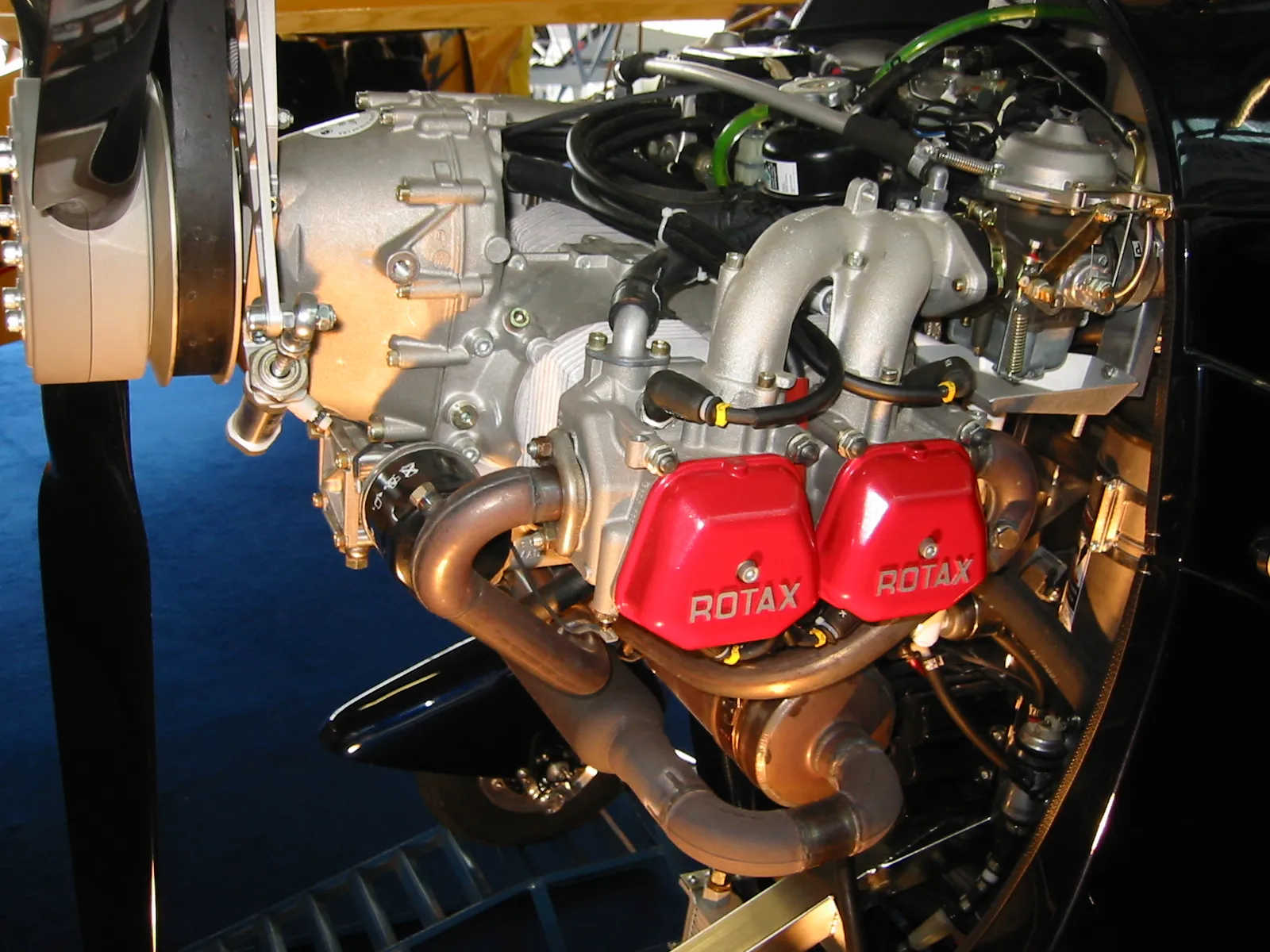
The options, side by side
| Certified aviation piston | Car-engine conversion | Heavy-fuel two-stroke | Small turbojet | |
|---|---|---|---|---|
| Examples | Rotax 912 UL (80 hp), 912 ULS / iS (100 hp), 914 UL (115 hp), 915 iS (141 hp), 916 iS (160 hp, 85.8 kg) | Škoda 1.0 TSI and 1.2 TSI conversions | Hirth 4202, a 15 hp class engine for drones that runs on Jet A-1 | PBS TJ100 from the Czech Republic: 1,100–1,250 N thrust, 17.6 kg |
| Price | US retail: 912 UL $21,940, 912 iS Sport $32,098, 914 UL $37,571, 915 iS $53,971 and 916 iS $59,305 with Rotax Care | under €4,000 fitted, in the Distar case | on request | on request |
| What you get | certification paperwork, a service network, known overhaul intervals | mass-production volume, parts everywhere, low fuel burn | the fuel many military operators prefer for logistics | speed; the class of engine used in target drones, fast UAVs and small missiles |
| What you give up | price, and lead time when demand is high | aviation certification; you carry the integration and the proof | power: small engines for small aircraft | fuel consumption, short overhaul intervals (up to 300 hours for the TJ100), noise |
| Fits | certified and light-sport aircraft, larger drones that must fly over people | experimental and unmanned aircraft where cost and supply decide | military drones under a single-fuel rule | target drones, fast drones, small cruise missiles |
Retail prices are distributor listings in the US, not installed costs; matched written quotes are the only numbers to budget with.
What I wrote down instead of choosing
At Distar the four realistic aviation engines on the European market were the Rotax 912/914 (€14,000–26,000, 12–18 l/h), the Jabiru 3300 (about €16,000, about 26 l/h), the UL350iS (about €17,000, 35 l/h) and the LF-26 (about €16,000, about 16 l/h). Our forecast at the time was a further 12–15% price rise on demand from Asia. The requirement I wrote was:
- 110–120 hp and 170–220 Nm;
- no more than 8–9 litres an hour;
- under €5,000 all in;
- under 75 kg dry;
- delivered within 60 days;
- reliability proven by large production volumes.
Nothing in the aviation category met it. A Škoda 1.0 TSI did: a mass-produced turbocharged car engine, with a precedent already flying, a 1.2 TSI installed on an aircraft in 2012 and run for seven years with high reliability and low operating costs. Fitted with everything needed to mount and run it, from the reduction drive and cooling to engine management, it came to under €4,000, burned 8–9 l/h and arrived within 60 days; the engineering of the installation stayed with the technical team. The last line of the requirement did the work: an engine built by the million is cheap and in stock for the same reason its failures are known. It also ended the dependence on one dominant supplier. The story of the engagement is in a seven-month aviation engine and a sixty-day car engine.
Which questions decide the engine?
- What does the mission need in power and endurance? Power at take-off and at cruise altitude, and fuel burn at the cruise setting, not the peak.
- Which certification route are you on? A type-certificated engine under 14 CFR Part 33, a light-sport aircraft built to consensus standards, an experimental aircraft, or a military drone approved by its buyer. In the US, the FAA's MOSAIC rule changed light-sport certification from 24 July 2026 and opened the category to turbine and electric propulsion.
- What fuel will the operator carry? Many military buyers want heavy fuel, Jet A-1 or JP-8, rather than petrol. Check the tender; do not assume.
- How much electrical power do you need? Sensor-heavy drones need an alternator sized for the payload, not only a propeller.
- What is the lead time, and who is the second source? The longest lead time in the bill of materials sets what you can promise, as I argue in what breaks first in series production.
- Where can the engine be serviced, and by whom? A cheap engine with no one to overhaul it near the customer is not cheap.
- Can it be exported, and can it leak? Rotax engines turned up in Iranian Mohajer-6 drones in 2022, and BRP said it was investigating and had not authorised supply to Russian or Iranian forces. Export rules and end-use checks apply to the engine as much as to the aircraft.
What will the market need next?
The engine comparison points at a market most drone makers overlook: automotive engines adapted for drones. A Škoda 1.0 TSI at under $4,600 with a 60-day lead time against an aviation engine at about $29,900 and seven months is not a curiosity; it is a supply chain built for millions of units, available to anyone who can adapt and qualify it. Companies that do that adaptation, with the gearbox, cooling and controls a drone needs, sell to makers who want volume more than aviation pedigree.
Qualification itself is the second product. Testing an engine with its controller and airframe as one system, and documenting a second engine before the first order, is work a small maker rarely has the people for, and buyers increasingly ask to see it.
Signals worth watching: drone makers announcing automotive-derived engines, lead times quoted for aviation piston engines, and buyers requiring a qualified second engine in contracts.
What does this mean for a drone maker?
The same choice now decides who can build fast drones. Russia's jet Shaheds fly on Chinese Telefly turbojets, and Ukraine's jet interceptors are held back because most of their engines are imported, as Zelensky has said; that is the subject of the jet-interceptor engine bottleneck and the Geran-5. For piston drones the engine is a sanctions story as much as a technical one: the first prototypes of Russia's Orion drone flew on a Rotax 914, the engine of the US Predator, before Russia moved to a domestic engine, as AIN reported. The engine decision locks in a supply chain for years, and it is often the decision that settles a product's fate: a drone designed around an engine with one supplier and a long lead time is capped at that supplier's output, however good the airframe, so qualify a second engine before the first order, not after the first delay. A maker who writes the requirement first and keeps a second engine qualified can promise deliveries that a maker tied to one engine cannot.
Sources (9)
- BRP-Rotax, aircraft engine portfolio
- Lockwood Aviation, Rotax engine retail pricing
- Advanced Powerplant Solutions, new Rotax engines
- Hirth Engines, 4202 heavy-fuel two-stroke engine, July 2025
- PBS, TJ100 turbojet engine
- FAA, Modernization of Special Airworthiness Certification (MOSAIC)
- FAA, MOSAIC fact sheet
- The War Zone, theft wave targets the same Rotax engines used in Iranian drones, October 2022
- AIN, enlarged derivative of Orion UAV under development, September 2019
Where this comes up on the site
- Per kilogram of warhead the FP-1 is no cheaper than a Flamingo, and it flies four times slower
- The Da Vinci drone is one of the least documented weapons on Zelensky's Kerch Bridge list, and by its maker's account the one that worked before the bridge was touched
- Dovbush started as an $8,000 scout that volunteers gave to the army, and in 2026 the T40 version is how Ukraine sees 2,000 km deep