
Helsing's $18 billion bet: a defense software company only matters once it builds the weapon
Helsing started in 2021 as a software company for defense and five years later is valued at $18 billion, building strike drones, a combat aircraft and underwater systems. Here is what it is, what it makes, how it was funded and what its path means for a defense founder.
Helsing is a German defense technology company, founded in 2021 by Torsten Reil, Gundbert Scherf and Niklas Köhler, that set out to sell artificial intelligence to armed forces and became a maker of weapons. Its chairman and early backer is Daniel Ek, the founder of Spotify, through his investment company Prima Materia. In July 2026 Helsing raised $1.8 billion at an $18 billion valuation, which puts it at the top of Europe's defense startups by valuation. For a founder it is the reference case for how fast European defense money can move, and for what investors now expect a "software" defense company to build.
My argument is that Helsing's valuation is a bet on one idea: in defense, a software company only becomes valuable when it builds the weapon its software runs on. Its record in Ukraine shows the other half of that lesson. Building at scale is not the same as building close to the fight, and the gap between a German factory and a Ukrainian trench is where its product was questioned.
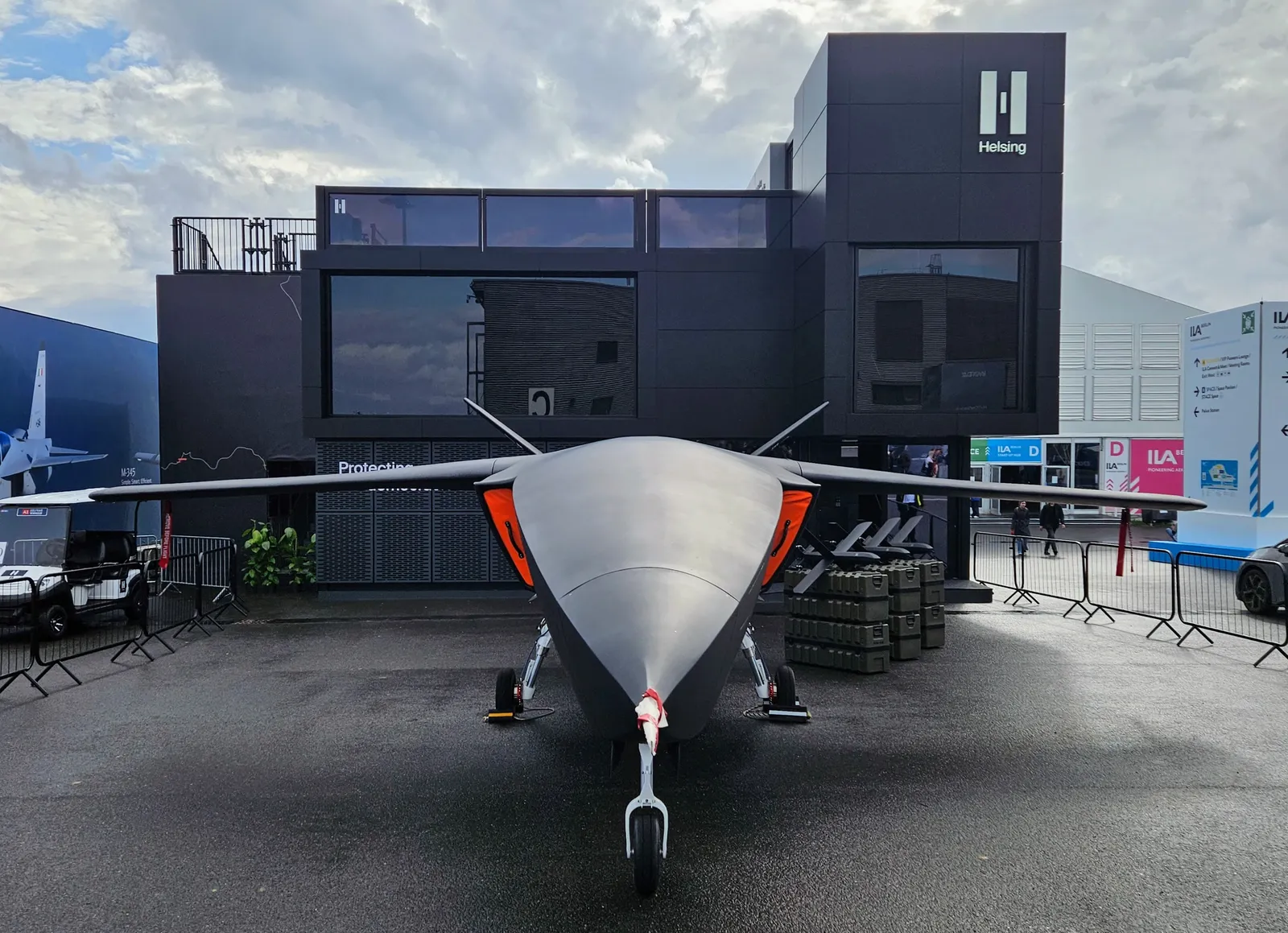
From software to strike drones
Helsing's first product was software: Altra, a system that fuses sensor data and helps commanders find and strike targets. Ukraine is where it moved into hardware. By February 2025 it was delivering 4,000 HF-1 strike drones built with Ukrainian industry, and it announced 6,000 more of its own design, the HX-2, an electrically driven X-wing munition with a range of up to 100 km and onboard AI to resist electronic warfare. Several HX-2s can be flown as a swarm by one operator through Altra.
The same month it opened its first Resilience Factory, RF-1, in southern Germany, with initial capacity of more than 1,000 HX-2 a month; capacity, not published output. In July 2026 it chose West Virginia for its first US Resilience Factory and appointed a managing director for Ukraine. It has since moved into aircraft and the sea: the CA-1 Europa uncrewed combat aircraft, an agreement in June 2025 to buy the aircraft maker Grob, and the acquisition of Blue Ocean, a maker of autonomous underwater vehicles in the UK and Australia, announced in October 2025.
How was Helsing funded?
| Round | Amount | When | Led or notable investors |
|---|---|---|---|
| Series A | €102.5 million | first round | Prima Materia |
| Series B | €209 million | September 2023 | General Catalyst, with Saab joining |
| Series C | €450 million | July 2024 | General Catalyst, Accel, Saab, Lightspeed, Plural |
| Series D | €600 million | June 2025 | Prima Materia, with BDT & MSD Partners new |
| Series E | $1.8 billion, at an $18 billion valuation | July 2026 | Dragoneer, Lightspeed, Iconiq, Goldman Sachs Alternatives, JPMorganChase, CPP Investments and others |
The company has not published revenue. Its German government business became visible in February 2026, when the Bundestag approved loitering-munition contracts of about €269 million each with Helsing and Stark, as reported.
Has it worked in the field?
Not without questions. In January 2026 reporting based on Bloomberg said Ukraine was holding off on further orders, with concerns about the HF-1's effectiveness and problems in HX-2 launch tests; Helsing disputed the findings. Ukraine's drone war punishes any design that cannot change every few weeks, as American guided shells, rockets and glide bombs found before it (I go through them in why Western weapons stumbled in Ukraine), and a company building at scale in Germany is further from that loop than a Ukrainian maker a few hours from the line. That is also why the German model of pairing Ukrainian designs with German plants exists; see German-Ukrainian defense joint ventures.
Where does Helsing go next?
I expect Helsing to become one of a small group of European "neo-primes", companies that sell systems across domains and compete with the established groups for programmes, not just contracts. The acquisitions of Grob and Blue Ocean, the combat aircraft and the underwater gliders all point there. Two things will decide whether the valuation holds.
- Delivered output, not announced capacity. A factory rated at more than 1,000 drones a month means little until the deliveries are public. The first full year of RF-1 output and the first US factory will be the test.
- Combat feedback. Appointing a managing director for Ukraine in July 2026 is a sign the company knows where its weakness was. If it moves design and testing closer to Ukrainian units, the HF-1 questions fade; if it does not, Ukrainian makers will keep winning the orders it wants.
Signals worth watching: Ukrainian reorders, Bundeswehr call-offs on its loitering-munition contract, and the first published delivery numbers from its factories.
What will the market need next?
Helsing's path says where the money goes in defense AI: toward companies that own a platform, a factory and a feedback loop from the field. That leaves two markets for everyone else. Software companies without hardware need partners whose platforms they can run on, so integration deals with drone, robot and munition makers are worth more to them than another software contract. And hardware makers without software need autonomy they can license rather than build, which is the business of companies that will not become the next Helsing and should not try.
Field feedback is the product Helsing had to buy and the one smaller companies can sell. Teams with a working channel to Ukrainian units, where Russia's jamming and drones test every system every day, can offer validation and data that a well-funded German company had to work to get.
Signals worth watching: Helsing's delivered units against its announced factory capacity, licensing deals for autonomy software with hardware makers, and new orders from Ukraine after its 2026 pause.
What does Helsing mean for a defense founder?
- Investors pay for production, not only for code. Helsing's valuation rose as it built factories and hardware. A defense software company should expect to be asked what it will build, or whose hardware it rides on.
- The money is concentrated. One company raised $1.8 billion in a year when all of Europe's ground-robotics startups raised $77.6 million, by Dealroom's count; the context is in what Europe's defense funding numbers mean.
- Combat feedback is the edge Helsing has to buy. A startup with a real feedback loop from Ukrainian units owns something capital cannot fast-track; the route is in how to get a drone tested in Ukraine.
- AI is mostly algorithms so far. Real autonomy is a group of drones that receives a target and chooses its own tactic, shares information and picks targets. Ask a company selling "AI" which of those its product does today.
- Scale is the claim to test. Factory capacity is announced; output is rarely published. Ask for units delivered, as I set out in from 20 to 2,000 drones a month.
Its German peer on the reconnaissance side is Quantum Systems.
Sources (8)
- Helsing, Helsing raises US$1.8bn in Series E, July 2026
- Helsing, Helsing raises €600m (Series D; Series C of €450m in July 2024), June 2025
- Helsing, Helsing raises €209m Series B, September 2023
- Helsing, Helsing to produce 6,000 additional strike drones for Ukraine, February 2025
- Helsing, Helsing acquires Blue Ocean, October 2025
- Helsing, Helsing acquires Grob Aircraft, June 2025
- DroneXL, Germany approves Helsing and Stark loitering-munition contracts, 25 February 2026
- TVP World, Ukraine holds off on orders from Helsing, January 2026
Where this comes up on the site
- German-Ukrainian defense joint ventures: who builds what, where, and who pays
- Quantum Systems bought what no German factory can make: combat feedback from Ukraine
- Western weapons in Ukraine did not fail because they were bad. They failed where they had never been tested against Russian jamming and drones.