
German-Ukrainian defense joint ventures: who builds what, where, and who pays
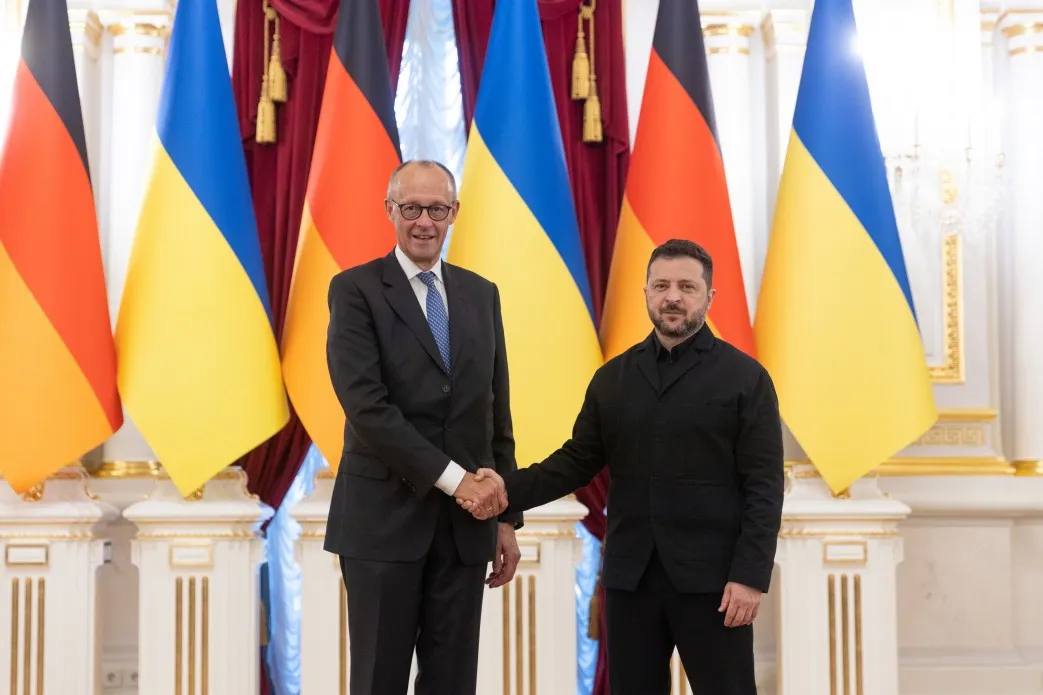
On 4 October 2026 Chancellor Merz brought a €1.3 billion package and an industry delegation to Kyiv, and Ukraine counted 15 agreements with Germany worth more than €8.5 billion. Behind the totals sit a handful of joint ventures with a common design. Here is the map, the money and where a supplier fits.
German-Ukrainian defense joint ventures became the main way Germany turns money for Ukraine’s defense against Russia’s invasion into production. On 4 October 2026 Chancellor Friedrich Merz came to Kyiv with the economy minister and a delegation of defense, industrial and energy companies, announced about €1 billion of military aid and about €350 million for the power grid, and named one item first: funding for the joint production of interceptors against jet-powered attack drones. President Zelensky counted 15 agreements and documents with Germany, worth more than €8.5 billion in total. Most of them cover production, procurement, Ukrainian orders for German industry and joint projects in Ukraine. The totals tell a supplier little. The joint ventures behind them tell a lot, because the new ones share one pattern. Below is the map, how the money flows and where a company from either country fits.
The map: who builds what, and where
| Joint venture or program | Partners | Product | Built in | Money and volume | Since |
|---|---|---|---|---|---|
| Quantum Frontline Industries (QFI) | Quantum Systems (DE), Frontline Robotics (UA) | Frontline's multi-purpose drones, including Linza 3.0 | Germany | up to 10,000 drones a year, all for Ukraine's forces, as Zelensky described it | announced December 2025, first drone February 2026 |
| Quantum WIY Industries (QWI) | Quantum Systems, WIY Drones (UA) | STRILA and other interceptor drones | Ukraine | 15,000 interceptors for Ukraine's National Guard (March 2026); German funding for "several tens of thousands" more (October 2026) | April 2026 |
| Quantum Tencore Industries (QTI) | Quantum Systems, Tencore (UA) | TerMIT tracked ground robot | Germany, with an established industrial partner | 2,000 robots in 12 months, funded by the German Ministry of Defence | April 2026, first contract June 2026 |
| Auterion Airlogix | Auterion (DE/US), Airlogix (UA) | mid-range X-wing and delta-wing strike drones | Germany, under Ukrainian export permissions | first German contract for "thousands" | February 2026, contract April 2026 |
| ARX Industries | ARX Robotics (DE), Roboneers (UA) | Rys Pro ground robots | Ukraine and Germany | not disclosed | June 2026, expanded 4 October 2026 |
| Gereon at DEUTZ | ARX Robotics, DEUTZ (DE engine maker) | Gereon ground robots | Ulm, Germany | first robots delivered after a 12-week ramp-up | September 2026 |
| Helsing | Helsing (DE) with Ukrainian industry | HF-1, then HX-2 strike drones | HX-2 at Helsing's Resilience Factory in southern Germany | 4,000 HF-1, then 6,000 HX-2; factory capacity over 1,000 HX-2 a month | February 2025 |
| Rheinmetall–UDI | Rheinmetall (DE), Ukrainian Defense Industry | repair of combat vehicles; Lynx KF41 | Ukraine (repair); Germany (Lynx) | first five Lynx, a mid-double-digit million euro order financed by Germany | repair since June 2024; Lynx order December 2025 |
Volumes in this table are contracts, targets and capacities as each company or government stated them. None of them is published output, and nobody has published cumulative deliveries for any of these plants.
What is the "German model"?
The name comes from Quantum Systems, which calls QFI "a new model of cross-border defence co-production: the German Model". It has four parts. The Quantum and Auterion ventures use all or most of them; Helsing and Rheinmetall are older arrangements of a different kind.
- A Ukrainian design. The product has been in combat and changed every few months on feedback from units. The Ukrainian partner licenses the design and supplies training and lifecycle support.
- A German plant and an industrial partner. Quantum provides the factory and the production operations; QTI builds with "an established industrial partner"; ARX builds Gereon at an engine maker's plant in Ulm.
- German government money. The German Ministry of Defence pays, as aid to Ukraine. QTI's 2,000 robots are its first contract.
- Ukraine's ministry sets the volume. For QFI, all of the German output goes to Ukraine's forces in quantities Ukraine's Ministry of Defence defines.
The reason for the German half is stated by the Ukrainian side: Frontline Robotics said that in wartime it is hard to find safe places to manufacture inside Ukraine. The reason for the Ukrainian half is a design already changed many times through combat use. The October interceptor money goes the other way, to production in Ukraine, because interceptors have to change as fast as the jet drones they chase; that bottleneck is the subject of the jet-interceptor engine problem.
How does German money reach these plants?
Through contracts, not through an open program. A supplier hoping to apply somewhere should know this first.
- Bilateral aid with a production line attached. The October package names joint production of interceptors, stand-off weapons, combat drones and satellite technology. Merz declined to publish quantities and dates. On 28 May 2025 the two defence ministers signed an agreement under which Germany finances the production of long-range weapons in Ukraine.
- Direct German contracts with the joint ventures. QTI and Auterion Airlogix each announced a first contract funded by Germany for delivery to Ukraine.
- Ukrainian orders for German industry. Part of the €8.5 billion is Ukraine buying from German companies, Lynx among them.
- EU money on top. The EU's €90 billion support loan for 2026–2027 sends about €60 billion to defense, and 15 of the 19 national SAFE loan plans submitted to the Commission include projects with Ukraine, according to the EU Institute for Security Studies.
The €8.5 billion is the total of 15 documents. Zelensky did not call it new money, and some of the documents are declarations of intent rather than purchase contracts; one signed that day, on countering unmanned systems, was between Ukraine's interior ministry and the German ambassador. Read it as the size of the relationship, not as a budget you can bid into. How that money compares with Denmark's route is in Build with Ukraine, the Danish model and the Drone Alliance.
Where does a supplier fit?
Where a supplier can enter depends on which side you are on.
- A German or European component maker. The plants in the table build Ukrainian designs with European parts where they can. Motors, batteries, harnesses, composite airframes, machined parts and electronics that can replace Chinese supply are what a German line needs and a Ukrainian design was built around. The first buyer to convince is usually the joint venture's purchasing and quality team, not a ministry.
- A German industrial company with spare capacity. DEUTZ, an engine maker, built ground robots in its Ulm plant within 12 weeks; QTI went looking for "an established industrial partner". A German automotive or machinery supplier with a free line, quality systems and skilled staff is what this model consumes. I would expect more of these pairings, not fewer.
- A Ukrainian maker without a German partner. The model rewards a design with combat history, a team that can train others and documentation good enough for someone else's factory. If you have the first and not the third, fix the third first; how to find a European partner for a Ukrainian drone company is the playbook.
- A non-German company. Germany is the most active partner so far, not the only one. Ukraine's Fire Point is building a rocket-propellant plant in Denmark, delayed to late 2027; France authorised licensed production of SCALP missiles in Ukraine in July 2026. The same parts apply wherever the money comes from.
What will the market need next?
Every German-Ukrainian line needs suppliers the Ukrainian partner never qualified, and that is the first market: German and European component makers that can pass a German line's qualification, document traceability and offer a second source. The Ukrainian supplier list does not travel with the design.
The plants create a second market in security. Estonia blamed Russian services for an arson attack on a ground-robot maker in September 2026, and every plant that builds Ukrainian designs in Europe is now a target for sabotage. Physical security, vetted staff and resilient supply for these sites are bought by the ventures and, increasingly, required by the governments that fund them.
The third is the licence after the war. Sales of these products to the Bundeswehr and to third countries are where the value goes later, so advice on territory, royalties and improvements, settled now, is work both sides will pay for before they need it.
Signals worth watching: new ventures announced under the German model, the first German order for a Ukrainian-designed product from a German plant, and sabotage incidents at European defense sites.
What to settle before you sign
From my years inside a European aircraft manufacturer, the hard part of building someone else's design is never the assembly. It is everything around it. In Ukrainian-foreign talks the deal rarely stalls on price. It stalls on one clause, most often who may change the design and who owns the change, and the side that wrote that clause first usually gets the deal it wanted.
- Who holds design authority. The Ukrainian partner changes the design on battlefield feedback; the German plant needs a frozen build standard and qualified suppliers. Agree who approves a change, how fast, and who pays for retooling.
- The export permission for each project. Auterion Airlogix builds in Germany "under Ukrainian export permissions"; Ukraine's export rules apply to the design and the data (see Resolution 875), and Germany's war weapons law applies to manufacture and transfer. Neither is automatic because a government announced a partnership.
- What happens to the licence after the war. Quantum describes its network as building "longer-term production capability for Germany and allied forces". Sales to the Bundeswehr and to third countries are where the value goes later; settle territory, royalties and improvements now.
- Three parties to a contract that has two signatures. The German ministry pays, the Ukrainian ministry sets the volume, the joint venture delivers. Find out who can change the quantity and what happens to your component order if they do.
- Who qualifies your part, and who pays before delivery. A German line will want its own supplier qualification, traceability and a second source; it may not inherit the Ukrainian partner's supplier list. Ask who carries the inventory between a government order and the payment, and what happens to it if the order pauses.
- Security of the site. Estonia blamed Russian services for an arson attack on Milrem, a robot maker, in September 2026, and Zelensky raised sabotage at Leipzig airfield in the 4 October talks. A plant in Germany is safer than one in Ukraine, not safe.
Names to know
Quantum Systems, Frontline Robotics, WIY Drones, Tencore, Auterion, Airlogix, ARX Robotics, Roboneers, DEUTZ, Helsing, Rheinmetall, Ukrainian Defense Industry (UDI), Fire Point, the German Federal Ministry of Defence and its procurement office BAAINBw, Ukraine's Ministry of Defence. The products: Linza 3.0, STRILA, TerMIT (read with the numbers in Ukraine's ground robots, decoded), Rys Pro, Gereon, HX-2, Lynx KF41.
Sources (19)
- President of Ukraine, results of the meeting between Zelensky and Merz, 4 October 2026
- Federal Government of Germany, press conference of Chancellor Merz in Kyiv, 4 October 2026
- Quantum Systems, Merz announces interceptor-drone package produced by Quantum Systems, 4 October 2026
- Quantum Systems, first joint co-production of Ukrainian drones in Europe with Frontline Robotics, December 2025
- Kyiv Independent, Zelensky unveils first drone produced by German-Ukrainian joint venture, February 2026
- Quantum Systems, 15,000 interceptor contract and WIY Drones investment, 23 March 2026
- European Security & Defence, Quantum Systems announces additional German-Ukrainian joint ventures, 14 April 2026
- European Security & Defence, Quantum Systems and Tencore to co-produce 2,000 TerMIT UGVs, June 2026
- Auterion, Auterion and Airlogix launch German-Ukrainian joint venture, 13 February 2026
- Auterion, Auterion Airlogix joint venture receives first contract from Germany, 14 April 2026
- European Security & Defence, ARX Robotics and Roboneers, 5 October 2026
- Defence Industry Europe, ARX Robotics and DEUTZ deliver Gereon systems for Ukraine in 12 weeks, October 2026
- Rheinmetall, a powerful partner at Ukraine's side (Rheinmetall Ukrainian Defense Industry), updated September 2026
- Helsing, Helsing to produce 6,000 additional strike drones for Ukraine, 13 February 2025
- Rheinmetall, Rheinmetall to supply Lynx to Ukraine, 12 January 2026
- German Federal Ministry of Defence, Pistorius on Ukraine support of around €5 billion, May 2025
- EU Institute for Security Studies, Building together: how Europe and Ukraine should deepen their defence industrial partnership, 22 September 2026
- BAFA, export control legal bases
- Defense News, Estonia blames Russia in arson attack on military robotics firm Milrem, 29 September 2026
Where this comes up on the site
- Quantum Systems bought what no German factory can make: combat feedback from Ukraine
- Ukraine's ground robots by the numbers: 22,000 contracted, nearly 20,000 missions a month, and $77.6 million of European venture money
- Three ways Western money and partners reach Ukrainian defense producers, and what each one leaves out