
THAAD: a year and a half of production spent in twelve days, and what that says about defending against mass
THAAD is the US Army's high-altitude interceptor against ballistic missiles. Each one costs about $15 million and Lockheed has made about 96 a year. In the June 2025 war with Iran the US fired more than 150. Here is what THAAD is, what that war cost it, and why its production limit matters more than its performance.
THAAD, the Terminal High Altitude Area Defense system, is a US Army missile defense system built by Lockheed Martin that destroys incoming ballistic missiles high in the atmosphere, in the last phase of their flight, by hitting them directly. It sits above Patriot in the American air defense stack: Patriot defends a point against missiles lower down, THAAD covers a wider area higher up. The US has deployed it to defend Israel and Gulf partners against Iranian ballistic missiles.
My argument is that THAAD shows the extreme of the problem every Western air defense now has. It works, and there is almost nothing that can replace it against a ballistic missile. But it is made at about 96 a year and costs about $15 million each, and in June 2025 the US fired more than 150 of them in twelve days. A weapon that is irreplaceable, slow to make and spent faster than it is built cannot be the answer to an enemy who fights by volume. Its value depends on everything below it being cheap enough to save it.
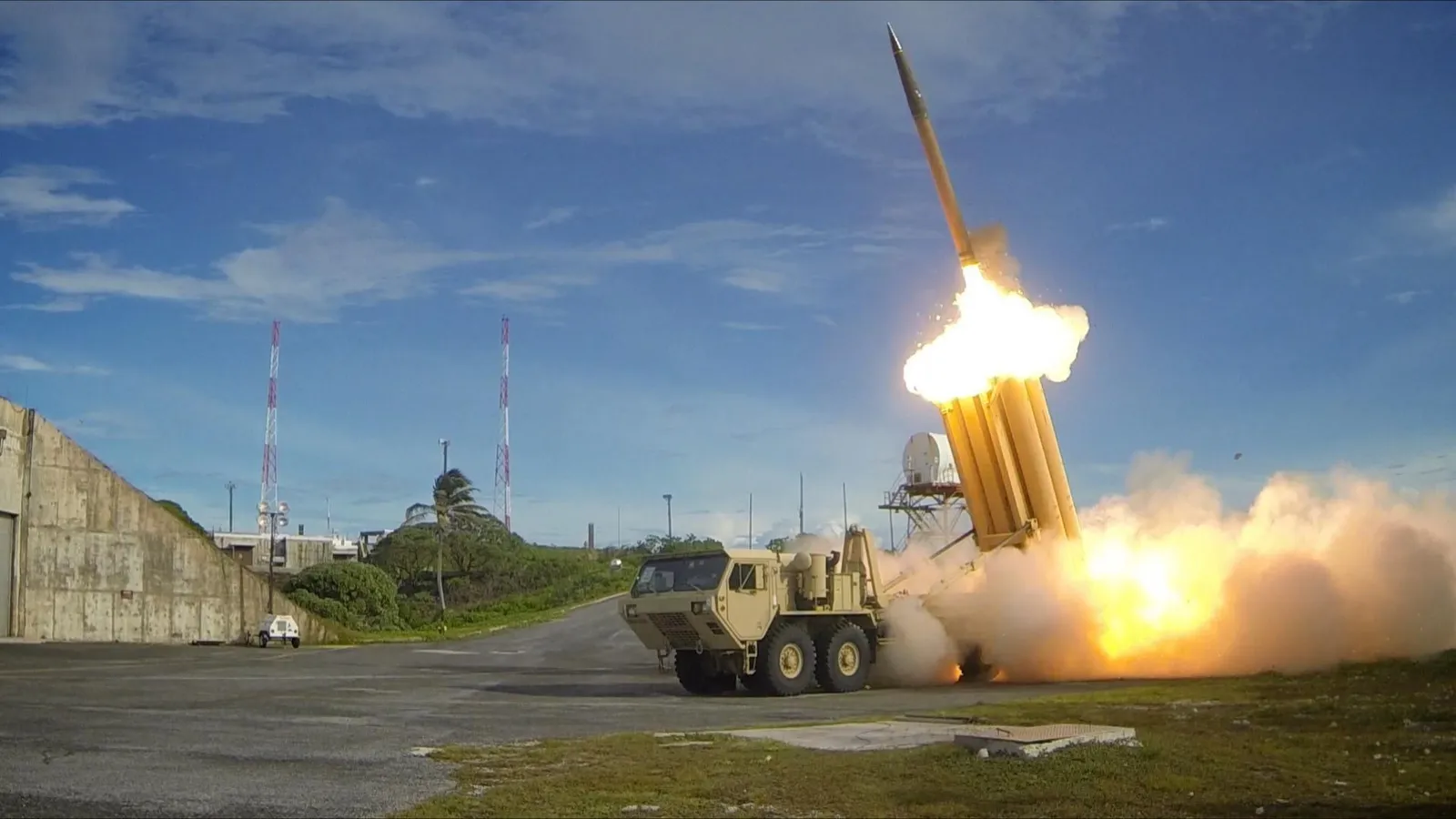
THAAD in numbers
| Maker | Lockheed Martin |
|---|---|
| Role | intercepts ballistic missiles at high altitude, in the terminal phase, hit-to-kill |
| Price | about $15 million per interceptor in the FY2026 budget estimate, by CSIS |
| Delivered | 534 interceptors to the Missile Defense Agency, by CSIS's reading of procurement data |
| June 2025 | more than 150 fired in the twelve-day war, as reported and cited by CSIS; about 28% of those delivered |
| July 2026 | about 250 left, by CSIS's estimate, after the 2026 war with Iran |
| Production | 96 a year; a January 2026 agreement aims for 400 a year over seven years |
What did the Iran wars cost it?
A large share of the stock. During the twelve-day war in June 2025, when Iran fired about 550 ballistic missiles at Israel and the US joined the fighting, the US reportedly fired more than 150 THAAD interceptors, CSIS noted, about 28% of everything delivered and roughly a year and a half of production at 96 a year. The 2026 war drew the stock down further: CSIS estimated about 250 left by July 2026 and judged that THAAD and Patriot will take three or more years to return to prewar levels. At $15 million each, the June 2025 firings alone are worth more than $2 billion at today's price. The Navy's interceptor above the atmosphere took the same hit: about 80 SM-3s fired in those twelve days, roughly two years of deliveries, which I go through in SM-3.
Why can't it simply be built faster?
Because it is a precision product made in small numbers for a peacetime demand. Lockheed and the Pentagon agreed in January 2026 to quadruple THAAD output, from 96 to 400 a year, but over seven years. Each interceptor carries a seeker and a kill vehicle that have to hit a missile directly at very high speed; that kind of product scales slowly, and its suppliers scale slower still. The same limit appears for Patriot's seeker, as I describe in Patriot. Startups are betting on the other answer, interceptors designed for volume from the first drawing: the Missile Defense Agency funded flight testing of one, Long Wall's Cyclops, in October 2026, which I go through in Long Wall's Cyclops interceptor.
There is also no cheap substitute for its job. Interceptor drones and guns can save Patriot and THAAD from drones, but not from a ballistic missile. That is the uncomfortable arithmetic: the only way to make THAAD last is to keep everything else off it.
Where does THAAD go next?
I expect three things.
- It becomes the last line, guarded. Commanders will keep THAAD for the missiles nothing else can stop and invest in cheaper layers so it is not used on anything else, the logic of the cost tiers in cost-exchange ratio.
- Production rises slowly, demand faster. THAAD is also one of the ground layers of Golden Dome, the US homeland missile-defense program, which adds its own demand. Gulf states, allies in Asia and the US itself all want more. The 400-a-year target is years away; every war before then takes from the same stock.
- Adversaries aim at the stock, not the target. Iran showed that a mix of cheap drones and missiles drains the most expensive interceptors; the full story is in how Iran made the US pay for its air defense.
Signals worth watching: THAAD deliveries a year against the 96 baseline, any official inventory figure, and new THAAD orders from Gulf and Asian partners.
What will the market need next?
- Sensors that decide early. The cheapest way to save a $15 million interceptor is to know sooner whether a target needs it. Early warning and classification that hand each threat to the cheapest layer able to stop it are worth more than another interceptor. The sensor is also the part an enemy aims at: Iran's strikes hit THAAD's own radar in Jordan in March 2026, a loss worth twenty to thirty interceptors, as I go through on the AN/TPY-2 radar.
- Suppliers for the ramp from 96 to 400. Quadrupling output means new capacity for seekers, kill vehicles, motors and precision parts, most of it outside Lockheed. That is the opening for qualified suppliers in the next seven years.
- Everything below THAAD. Each layer that keeps drones and cruise missiles off the top tier, from interceptor drones to mid-priced interceptors, extends the life of a stock that cannot be rebuilt quickly.
What THAAD means for a defense founder
- The high end is closed; the layers below are open. You will not build a THAAD. You can build what keeps it from being wasted: sensors that classify targets early, and cheap interceptors for everything that is not a ballistic missile, such as interceptor drones.
- Suppliers of the high end are short too. Seekers, motors and precision parts for interceptors are a constraint the Pentagon is paying to remove.
- Speak in years of production. The buyer's real question is not what one interceptor costs but how long it takes to replace a war's worth of them. Frame your product in those terms, the volume problem in why one to a thousand is the hard part.
Sources (4)
- CSIS, Depleting the missile defense interceptor inventory, 5 December 2025
- CSIS, Renewed Iran war would test diminished interceptor inventories, 27 July 2026
- CSIS, Rebuilding the US missile inventory is a multiyear project, 27 May 2026
- Lockheed Martin, framework agreement to quadruple THAAD interceptor production capacity, 29 January 2026
Where this comes up on the site
- The AN/TPY-2 radar is worth twenty to thirty THAAD interceptors, and a THAAD battery has one. In March 2026 Iran showed the world where to aim.
- Iran did not have to beat American air defense. It made America pay for it, and the Patriot interceptor shortage is the bill.
- Long Wall's Cyclops: whoever makes intercepts above the atmosphere cheap will change the arms race, in orbit as well as on Earth