
The Tomahawk is the cruise missile America cannot afford to run out of, and four weeks of war against Iran spent eight years of its production
Tomahawk is the US Navy's long-range cruise missile, and in the 2026 war with Iran it was fired faster than it can be made. I explain the Block V, what it costs, how many were fired and built, why the factory cannot catch up quickly, and where the money is in fixing that.
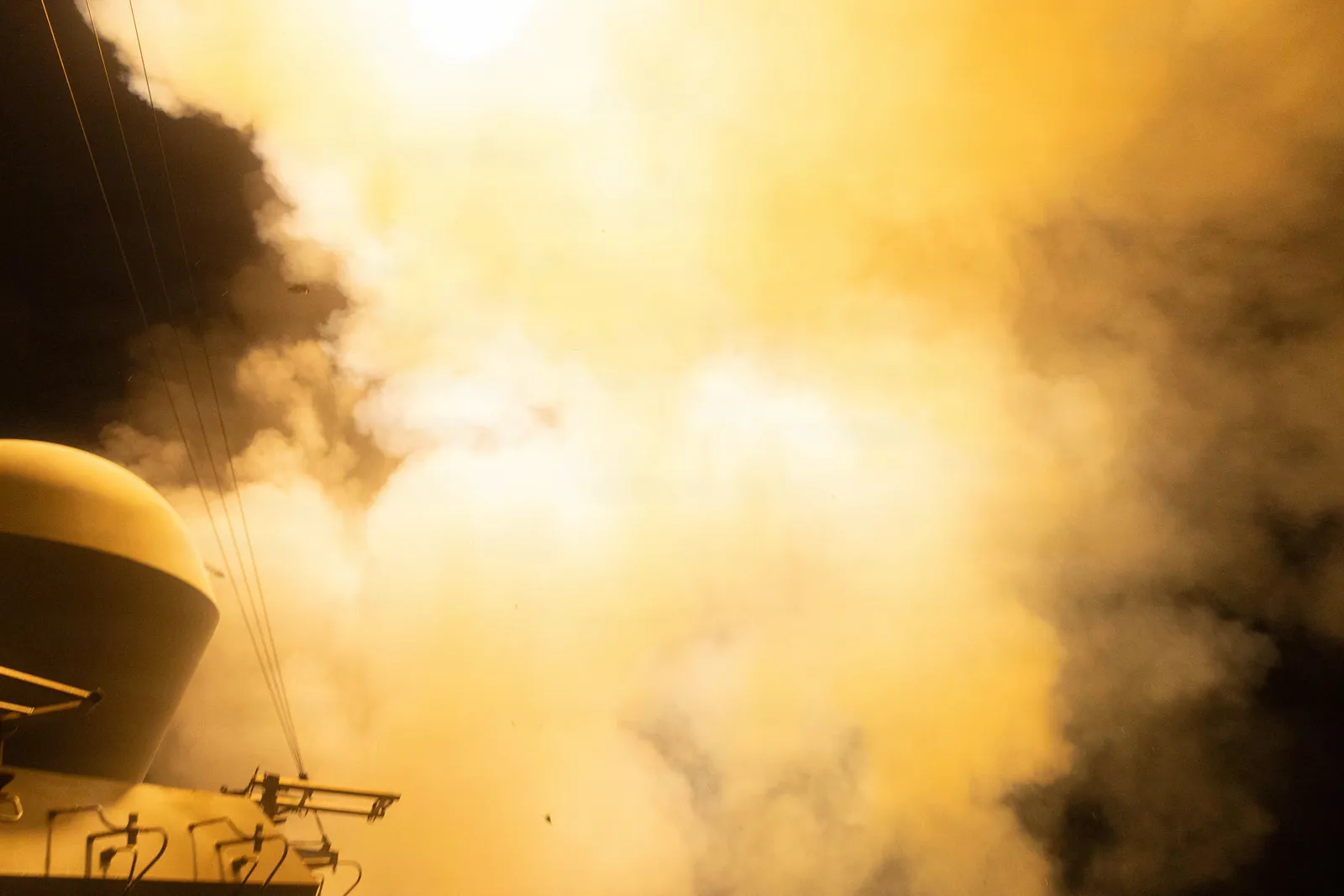
In the first four weeks of the US-Israeli war with Iran, which began at the end of February 2026, the US Navy fired more than 850 Tomahawk cruise missiles, The Washington Post reported. RTX, which makes them, had built 100 new Tomahawks in all of 2025, according to Bloomberg. One month of war used eight and a half years of the previous year's output. The same war drained the defensive side of the arsenal as fast, as I show in Iran's drones and the Patriot shortage.
Tomahawk is the US Navy's long-range land-attack cruise missile, fired from surface ships and submarines. It flies below the speed of sound, low over the ground, for about 1,600 km, and carries a warhead of about 450 kg. The current version, Block V, costs about $3.64 million.
My argument is that Tomahawk's limit is no longer the missile. It is one of the most proven weapons the US owns, and the Navy keeps improving it. The limit is that it is made at the pace and price of a weapon for a few hundred targets a year, and the war with Iran consumed it by the thousand. Everything interesting about Tomahawk today, from the 1,000-a-year contract to the cheap missiles being bought next to it, follows from that gap.
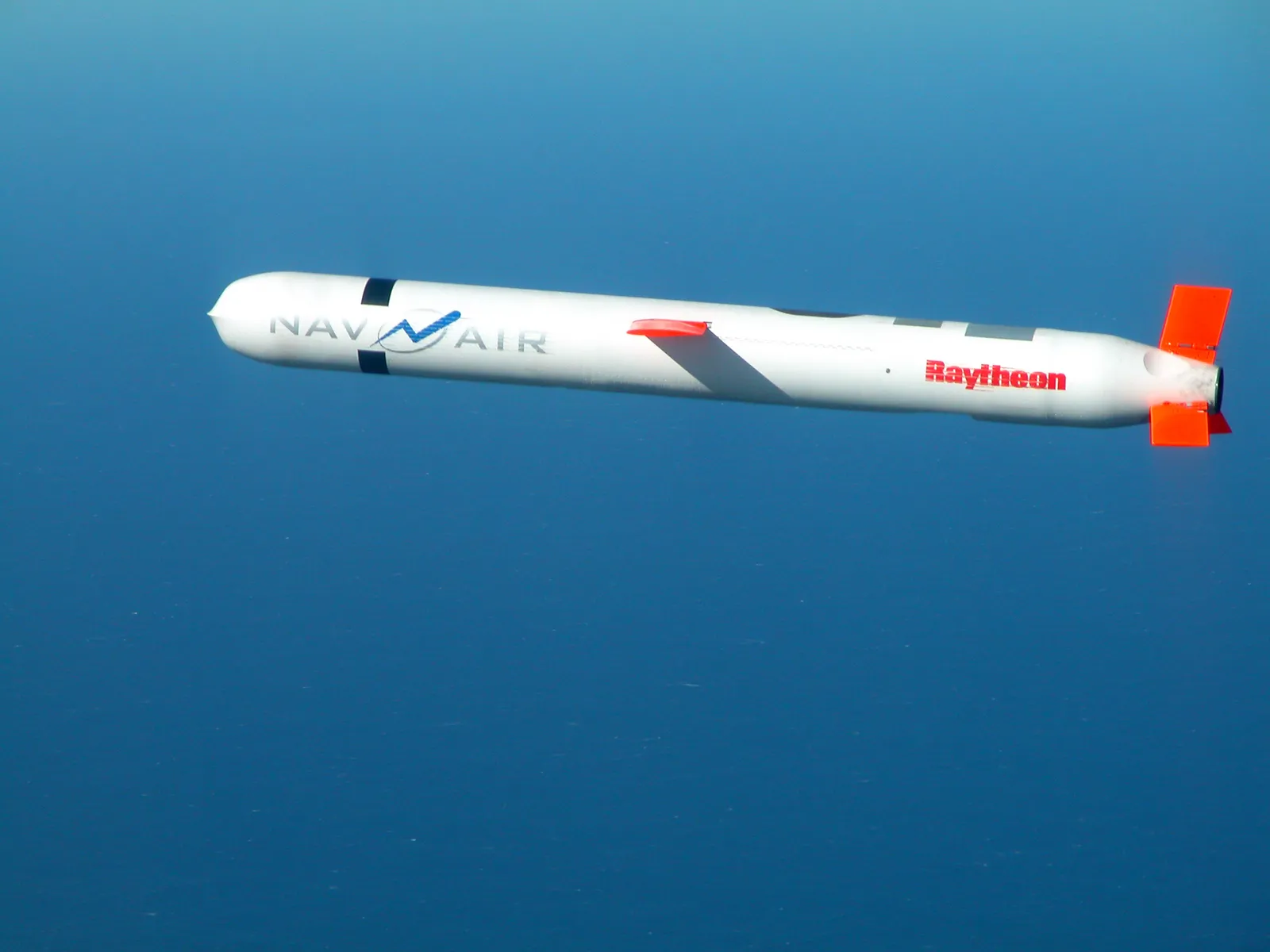
Tomahawk in numbers
| Maker | Raytheon, part of RTX |
|---|---|
| Type | subsonic long-range cruise missile, ship- and submarine-launched |
| Range | about 1,600 km (1,000 miles) |
| Warhead | about 450 kg |
| Unit cost | about $3.64 million, Block V, in 2026 dollars (NAVAIR) |
| Versions of Block V | Va, Maritime Strike, with a seeker for moving ships; Vb, with a new penetrating warhead for hardened targets |
| Built in 2025 | 100 new missiles (Bloomberg) |
| Bought in FY2026 | 55 missiles for about $258 million |
| Requested for FY2027 | 785 missiles for about $3 billion |
| Fired at Iran | more than 850 in four weeks; later reports say more than 1,000 |
| Stock before the war | estimates from about 3,000 to 4,500 |
Why can the factory not keep up?
Because it was sized for a different kind of war. The US has been buying Tomahawks in dozens a year, 55 in FY2026, enough to replace what was tested and what was fired in short campaigns. In January 2024, when US ships and the submarine USS Florida struck the Houthis in Yemen over their attacks on Red Sea shipping, Tomahawks were among the weapons fired. Each campaign like that drew down a stock that was being refilled at a trickle, and war games of a conflict with Iran showed precision stocks running out in weeks or days.
The supplier base shrank with the orders. In 1990, 13 companies supplied the Pentagon's tactical missiles; by 2020 there were three, and they produced 90% of US missiles, the Defense Department wrote in 2022. Each Tomahawk depends on a chain of sub-suppliers for its engine, guidance, warhead, booster and electronics, and a ten-fold ramp needs every one of them to grow at the same time. CSIS names Tomahawk among the US systems exposed to China's restrictions on rare earths and magnets, announced in October 2025: China makes 93% of the world's permanent magnets.
So the orders came before the capacity. In February 2026 RTX signed framework agreements with the Pentagon to raise Tomahawk output to more than 1,000 a year, and in August the Navy awarded Raytheon a $22.9 billion contract for that ramp, over a multi-year period with no published timeline. For FY2026, before the ramp, the Navy expected about 110 deliveries.
What does one Tomahawk buy?
A Tomahawk at $3.64 million with about 450 kg of warhead costs about $8,100 per kilogram of explosive delivered 1,600 km away. That is the right price for the right target. A hardened command post, a deep bunker or a target that must be destroyed with one shot needs a heavy warhead in one place, and a missile that flies far enough to be launched outside the enemy's reach.
The wrong target is the one a 45 kg warhead would destroy just as well: a radar, a launcher, a parked aircraft, a fuel depot. In the opening days of a war those are most of the targets, and each Tomahawk spent on one of them is a Tomahawk not available for a bunker. That is the opening for the cheap cruise missiles the US is now buying in volume. Anduril's Barracuda is priced at $150,000 to about $216,000 with a 45 kg warhead; for the $3 billion the Navy requested for 785 Tomahawks, it would buy about 14,000 to 20,000 missiles. I go through the per-kilogram comparison on that page and in FAMM and LCCM.
The economics run the other way as well. A US destroyer that fires its Tomahawks still has to defend itself, and the interceptors it carries cost millions each against drones that cost tens of thousands, the problem I describe in cost-exchange ratio. The US is paying top prices on both the attacking and the defending side at once.
Where does Tomahawk go next?
I expect Tomahawk to stay in production for the targets that need it, and its share of US long-range strike to fall as cheaper missiles take the bulk of the target list. Signals that show the pace:
- Deliveries against the 1,000-a-year contract. The first year in which RTX delivers more than 300 will show the sub-suppliers growing with the prime; a plateau below that will show which one has not.
- Congress's answer on the 785. Whether the full FY2027 request, most of it through reconciliation, becomes appropriated money.
- The Block Vb warhead. The Navy plans to integrate the new penetrating warhead in early FY2027; it would make Tomahawk more of a bunker weapon and less of a general-purpose one.
- Recertification numbers. Older Block IV missiles are being rebuilt to Block V. The FY2027 request for Tomahawk modifications is about $1.5 billion, a sign that a rebuilt missile is the fastest Tomahawk the Navy can get.
What will the market need next?
A ten-fold ramp of a forty-year-old missile is a supply-chain business more than a missile business.
- Second sources for the part that sets the ceiling. A ten-fold contract at the prime means little if one propulsion, energetics, seeker or electronics supplier can only double. The 1,001st missile is decided by that one supplier, and a second source for it is worth more than a second source for anything else on the missile. Castings, harnesses, connectors, guidance electronics and booster components all sell to Raytheon and its tier-one suppliers, under a ramp contract with a $22.9 billion ceiling.
- Recertification and rebuild capacity. Depots and contractors that inspect, rebuild and upgrade older missiles to Block V. Rebuilding is faster than building, and the FY2027 request for it is about $1.5 billion.
- Magnets and rare-earth parts outside China. Every US missile needs them, and Tomahawk is named among the exposed systems. Qualified non-Chinese magnets sell to every missile line at once.
- The cheap missiles beside it. Small turbojets, navigation units and airframes for the affordable-mass programs, at $150,000 to $450,000 a round, where the volume is moving.
What Tomahawk means for a defense founder
- The bottleneck is the old missile's sub-tier. A company that can qualify as a second source for a Tomahawk part sells into a contract with a $22.9 billion ceiling and an urgent schedule. Qualification is slow, so start by finding the single supplier that caps output today.
- Do not compete with Tomahawk on its targets. Its buyer pays $3.64 million because few cheaper weapons can hit a bunker 1,600 km away. Sell the product that keeps Tomahawks for those targets.
- Price per target, not per missile. The war against Iran showed that the cost that matters is the cost of covering a target list, and the number of rounds a factory can make in a year.
Sources (12)
- The War Zone, US is burning through its Tomahawk stockpile, citing The Washington Post, 27 March 2026
- SOFX, Navy requests 785 Tomahawks for FY2027 while RTX can deliver 110, citing Bloomberg and CSIS, 9 April 2026
- NAVAIR, Tomahawk product page, unit cost
- USNI News, New Navy budget wants $3B for new Tomahawks, 6 April 2026
- Army Recognition, US Navy seeks $7.3 billion for 785 Tomahawks and 540 SM-6 missiles, April 2026
- RTX, Raytheon partners with Department of War on five agreements to expand munition production, 4 February 2026
- Breaking Defense, Raytheon gets massive contract to boost Tomahawk production, August 2026
- Naval News, US Navy to upgrade more Tomahawks with anti-ship capability, July 2025
- DOT&E, FY2024 annual report, Tomahawk Weapon System
- USNI News, US hits Houthi targets in Yemen with strike fighters, warships and submarines, 11 January 2024
- US Department of Defense, State of Competition within the Defense Industrial Base, February 2022
- CSIS, China's new rare earth and magnet restrictions threaten US defense supply chains, 9 October 2025
Where this comes up on the site
- Anduril's Barracuda sells aim points rather than explosive, and its real product is a cruise missile any partner can assemble
- A Flamingo costs $600,000 and carries a ton of explosive, and at the Crimean Bridge a person steered it
- Ukraine's Neptune matters less as a warhead than as a cruise missile line the country built itself, and in June 2026 Europe asked to join it