
Ukraine's Neptune matters less as a warhead than as a cruise missile line the country built itself, and in June 2026 Europe asked to join it
The R-360 Neptune is a Ukrainian subsonic cruise missile from Kyiv's Luch Design Bureau. It sank the cruiser Moskva in 2022, grew into the 1,000 km Long Neptune in 2025, and in November 2026 was one of the weapons Zelensky named for the Kerch Bridge rail section. I cover the versions, the price nobody has confirmed, and where the missing parts are.
The R-360 Neptune cruise missile was designed to sink ships, and the ship that made it famous was the Moskva. On 13 April 2022, seven weeks into Russia's full-scale invasion of Ukraine, Ukraine said two Neptunes had hit the flagship of Russia's Black Sea Fleet. Two days later a senior US defense official told reporters that the United States assessed the same thing, and the cruiser went down.
Four and a half years on, the same missile family is in a different job. On 17 November 2026 Ukraine's president named Neptune among the 11 weapons used in a month-long operation against the Crimean (Kerch) Bridge, the bridge Russia built to connect its mainland to occupied Crimea. Zelensky said Neptune missiles, Ruta drones and Fire Point's FP-5 Flamingo hit the railway section. I cover the operation in the Kerch Bridge article.
My argument is that the Neptune matters less as a warhead than as a production line. A 150 kg warhead is a modest payload. What Luch built is a complete cruise missile that Ukraine designs, makes and changes at home, and the June 2026 decision of Europe's MBDA to co-develop the next version says that is the asset.
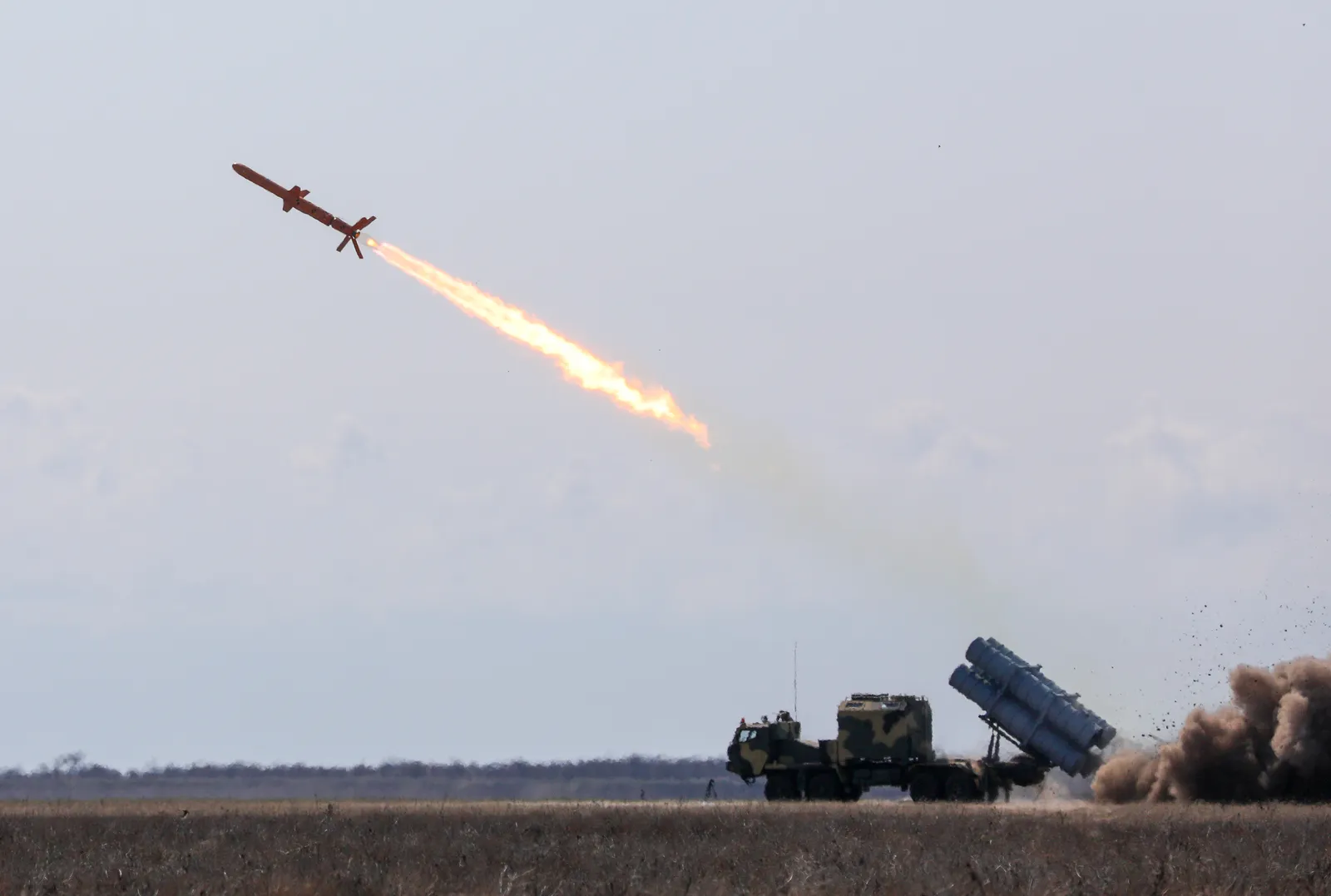
R-360 Neptune in numbers
| Neptune (base) | Long Neptune (RK-360L) | |
|---|---|---|
| Maker | Luch Design Bureau, Kyiv | the same |
| Range | about 280 to 300 km | up to 1,000 km, as reported by Ukraine |
| Warhead | 150 kg | 260 kg, as reported by Ukrainian outlets |
| Mass and size | 870 kg, 5.05 m long, 38 cm wide | about 6 m long without the booster, about 50 cm wide |
| Engine | Motor Sich MS400 turbofan, with a solid-fuel booster for launch | not published |
| Speed | subsonic | subsonic |
| Guidance | inertial navigation with an active radar seeker; a land-attack version with an imaging-infrared seeker reported from 2023 | not published |
| Launch | truck-mounted launcher, four missiles; in service with the Navy since 2021 | ground launch; vehicle not shown in detail |
| Price | no official figure; one commentator's estimate is $1.5 million | no official figure |
Sources for the table are in the list below. Two caveats matter. The base missile's range appears as 280, 300 and even 400 km in different outlets, and the Long Neptune's range and warhead come from Ukrainian officials and defense press, not from any test an outsider has seen.
Where does the Neptune come from?
Luch showed it at Kyiv's Arms and Security fair in September 2015, and it reached initial operational capability in 2021, months before Russia's full-scale invasion. It is widely described as a descendant of the Soviet Kh-35 anti-ship missile, with new electronics and a bigger range. The original job was coastal defense: a launcher on a truck, four missiles, a reload vehicle and a command vehicle, firing at ships up to roughly 300 km out.
The Moskva strike is why Western readers know the name. The land-attack work came next. A modified Neptune reportedly destroyed an S-400 radar at Cape Tarkhankut in Crimea in August 2023, and a version with a seeker for land targets was reported from that month. Zelensky said on 14 March 2025 that a 1,000 km ground-launched missile based on the Neptune had passed combat tests; the Tuapse refinery on Russia's Black Sea coast had been hit the day before, and unofficial sources tied the strike to the new missile. It was shown publicly as the Long Neptune (RK-360L) in late August 2025.
Why is a 150 kg warhead the wrong number to look at?
Because the Neptune is a slow missile with a small warhead, and it was never going to break a bridge arch on its own. A reported 150 kg of explosive cuts a radar, a launcher or a fuel tank. It does not bring a steel arch into the water.
What a missile like this needs is a defense that has already been blinded, and that is how the Kerch operation was built. Zelensky described seven stages. The air defenses, radars and electronic warfare equipment around the bridge were destroyed first. The railway section was hit by Neptunes, Ruta missiles and the Flamingo. No public source says how many Neptunes were fired, which version, or from where.
The economics are a second place where the headline number misleads. If the $1.5 million estimate from a Ukrainian military commentator is right, which is unofficial, the base Neptune costs about $10,000 per kilogram of warhead. The Tomahawk comes to about $8,100 on the figures in my Tomahawk page. The Neptune is a more expensive way to deliver explosive than the American missile it is sometimes compared to. The Long Neptune, at the same price and 260 kg, would fall to about $5,800. That is why I think the 1,000 km version matters more than the 280 km one: if Luch holds the price near the base missile's, a bigger airframe that carries more is the cheapest way to fix the economics.
What limits how many are built?
Parts. Luch has said little, and the available estimates of monthly output range from about 10 Long Neptunes a month to 30 to 40 Neptunes, from experts speaking in different years. The company aimed for about 100 missiles in 2024, and no official 2026 figure exists. The experts behind those estimates name the engine, the navigation units and other parts as the limit; the engine is a Motor Sich turbofan. Small jet engines are the same bottleneck that limits interceptor drones.
This is where the June 2026 deal fits. At Eurosatory in Paris, MBDA, the European maker of Storm Shadow, signed a memorandum with Luch to develop a Neptune 2 with deep-strike capability. A memorandum has no specifications, no money and no production plan. What it shows is the direction of travel I find more interesting than the missile: a European prime is looking for a design team that has been taught by combat, and Ukraine has one.
What has not been shown yet?
Four things are open, and I would not claim any of them.
- A confirmed Long Neptune range. One thousand kilometers is Ukraine's figure. Missile Matters, a respected analysis newsletter, calls the range and the warhead unconfirmed.
- Output. There is no audited rate for any version.
- The bridge. Zelensky listed Neptune for the rail section. The General Staff said the rail arch is damaged and the section still stands. Which variant was used and how many is not public.
- The unit price. The only per-missile figure is a commentator's. Luch's chief designer has spoken about a whole Neptune battery costing about $40 million, which counts vehicles and launchers as well, and that is a different number.
Where does the Neptune go next?
I expect two lines to run side by side over the next two years. A cheap land-attack Neptune, with an imaging seeker, stays in the arsenal as the 300 km workhorse for radars, aircraft on the ground and ammunition depots, and the Long Neptune takes the 1,000 km targets that Ukraine's drones cannot reach with a heavy enough warhead. Neptune 2, if MBDA and Luch deliver, becomes the line that European money pays for.
The signals that tell you which way it is going:
- A named European production site. A line outside Ukraine would show the design is exportable. None has been named.
- A unit price in a contract. The first official number settles the argument about whether it competes with Barracuda-class missiles or with Tomahawk.
- Strike counts. Repeated launches of a dozen or more in a single night would mean the engine supply has improved.
- A published specification for Neptune 2. If the range or the warhead is pinned down, the memorandum has become a program.
What will the market need next?
The Neptune's gaps are the gaps of every European cruise missile that wants to be built in numbers.
- Small turbofans. An engine in the Neptune's thrust class, built at volume outside the war zone, sells to Luch, to MBDA's Neptune 2 and to every rival that does not want a single source. I put it first because everything else waits on it.
- Land-attack seekers. An imaging-infrared seeker that recognizes a radar or an aircraft in a jammed environment, priced for a missile that one commentator puts at $1.5 million.
- Jam-resistant navigation. The same box, sold across several missiles, with a software layer that the user updates each month.
- Truck launchers and reload vehicles. A battery is a launcher, a reload vehicle and a command vehicle, and Luch's chief designer put a whole complex at about $40 million. A cheaper launcher that moves faster is a product on its own.
- Test ranges and acceptance. Anyone who can fire and measure a dozen missiles a month, in Europe, for a customer that wants a certificate. The buyers are European ministries paying for Ukrainian programs; the budget line is the one that financed Ruta, which I describe in how Western money reaches Ukrainian producers.
What the Neptune means for a defense founder
- A proven design is a negotiating position. Luch got a European partner after its missile hit ships and radars. Combat evidence is what lets a design team set terms with a prime.
- Sell the part that limits the line. The most credible supplier relationship in this program is whoever solves the engine or seeker constraint.
- Know which price you are quoting. When the buyer asks about unit cost, say whether it covers the missile or the battery, and whether the number is yours or someone's estimate. Both numbers circulate here, and they differ by a factor of ten.
- Read memoranda as direction. The MBDA and Luch paper shows where European prime money is heading, and it carries no specification, money or production plan yet.
Sources (9)
- TWZ, What we know about Ukraine's strikes that cut Russia's Kerch Bridge road vehicle span, 17 November 2026
- Defence Industry Europe, Ukraine develops 1,000 km range cruise missile based on R-360 Neptune project, March 2025
- Missile Matters, Ukraine's conventional long-range strike forces at the end of 2025
- RBC-Ukraine, Ukraine unveils new long-range Neptune missile for the first time, 25 August 2025
- Ukrinform, European missile manufacturer to join development of new version of Neptune cruise missiles, 17 June 2026, from MBDA's announcement
- The War Zone, Ukrainian anti-ship missiles struck the Russian cruiser Moskva, US officials, April 2022
- Focus.ua, Serge Marko, what Ukrainian cruise missiles cost and where they hit, 2 October 2026 (commentator's estimate, not official)
- Wikipedia, R-360 Neptune, compilation of specifications and reported strikes
- NAVAIR, Tomahawk product page, unit cost
Where this comes up on the site
- Palianytsia is the weapon the SSU credits with dropping the Kerch Bridge span, and its limit is the Czech-Ukrainian engine rather than the warhead
- Ukraine spent a month taking apart the Crimean Bridge's defenses, then hit one arch two nights running. How eleven Ukrainian weapons dropped the span
- The An-197 was named in the Crimean Bridge strike and described nowhere. What is known, and what it is most likely built on