
A Flamingo costs $600,000 and carries a ton of explosive, and at the Crimean Bridge a person steered it
The FP-5 Flamingo is Ukraine's heavy ground-launched cruise missile, built by Fire Point around an off-the-shelf bomb and a Soviet trainer-jet engine. I explain what it carries, what it costs per kilogram against a Tomahawk and a Barracuda, what ten confirmed strikes show about how often it arrives, and why the part that mattered on the Crimean Bridge was the link that let a person fly it.
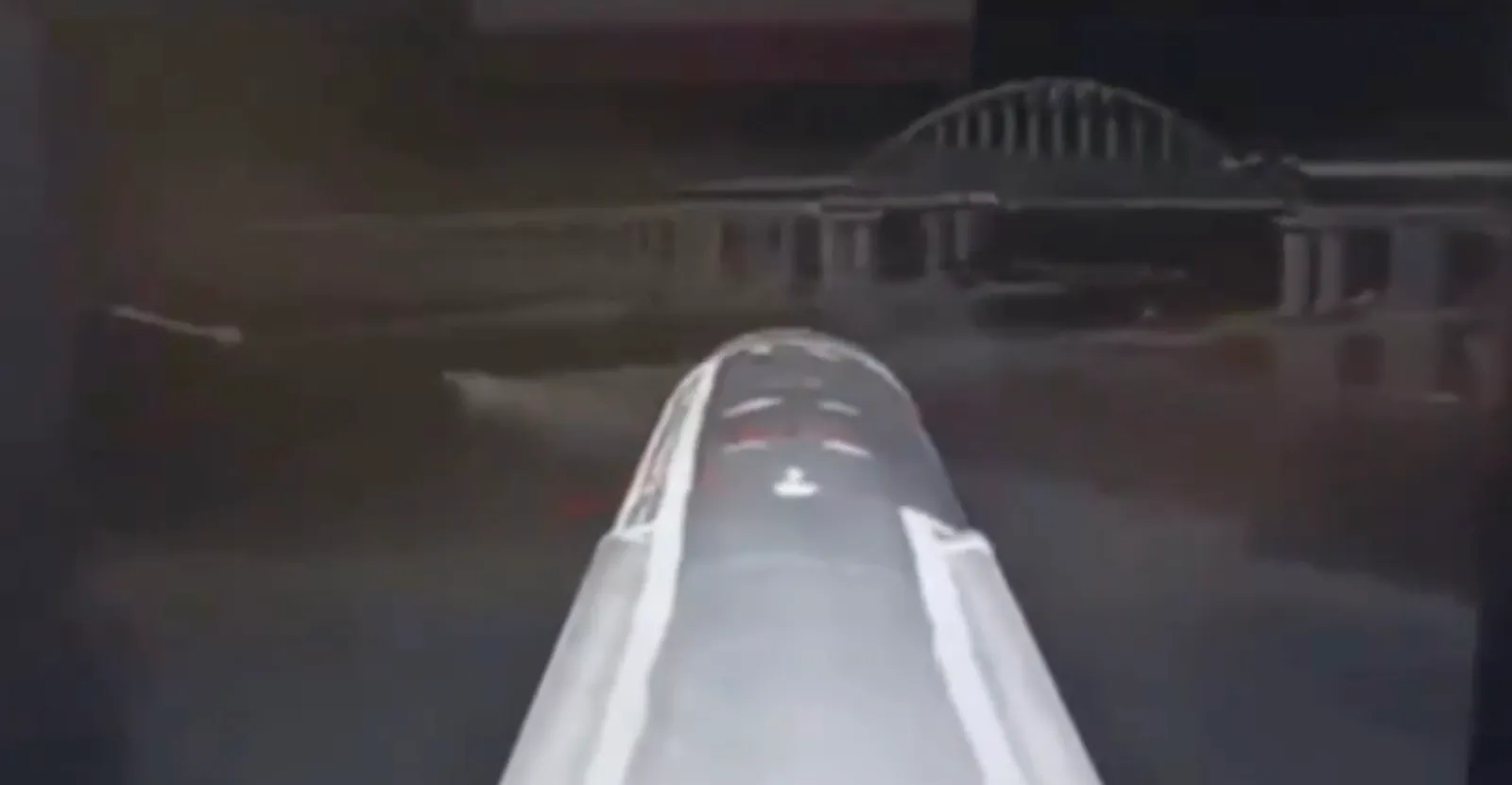
On the night of 16 to 17 November 2026, a video from a Ukrainian missile showed the Crimean Bridge arch growing in the frame in the last seconds before impact. Volodymyr Zelensky said the missile was guided into the target and that the communications link "worked flawlessly until the very last seconds." The missile was the FP-5 Flamingo. The bridge, which Russia built across the Kerch Strait to connect occupied Crimea with its mainland, lost a section of its road that night, and the Flamingo was one of several weapons used, as I describe in the operation itself.
The Flamingo is a ground-launched cruise missile made by Fire Point, a Kyiv company that took its present name in February 2023, a year into Russia's full-scale invasion of Ukraine. It takes off from a truck on a rocket booster, and flies below the speed of sound on a jet engine toward a target the crew picked before launch. The maker lists a payload of nearly 1,150 kg, roughly two and a half times the warhead of a Tomahawk.
My argument is that the Flamingo should be read as a cheap way to deliver a bomb of about a ton, not as a cheaper Tomahawk. Its weakness has been arriving, and its strength is that a missile that arrives one time in three or four can still beat a Tomahawk on cost. What changed on 17 November is that a person flew the last seconds. That makes the datalink the product the next buyers will want.
The FP-5 Flamingo in numbers
| Maker | Fire Point, Ukraine |
|---|---|
| Type | ground-launched subsonic cruise missile, truck launcher with a rocket booster |
| Payload | nearly 1,150 kg (the maker, via Janes, June 2026); Fire Point's own page says up to 1,200 kg |
| Range | up to 3,000 km (the maker); about 1,800 km flown in combat, according to Fire Point's CEO |
| Speed | up to 950 km/h; cruise 650 to 700 km/h |
| Engine | Ivchenko AI-25TL, a Soviet turbofan built for trainer aircraft, from stock; a Fire Point turbojet is in prototype |
| Guidance | satellite navigation with a jam-resistant antenna and inertial backup; an operator-in-the-loop version flew on 17 November |
| Warhead | not published; Defense Express judges it an off-the-shelf 2,000-pound-class bomb, about 430 kg of it explosive if it is a Mk 84 |
| Price | "a little under $600,000" (Fire Point CEO Iryna Terekh, The Guardian, 27 July 2026) |
| Output | about 100 a month (Terekh, July 2026); seven a day was the October target, which Terekh described as maximum capacity, not current output |
| First use | 30 August 2025, an FSB outpost in Crimea |
| Confirmed strikes | ten by July 2026 (Fabian Hoffmann of Missile Matters), then Kirov on 24 July and the bridge on 17 November |
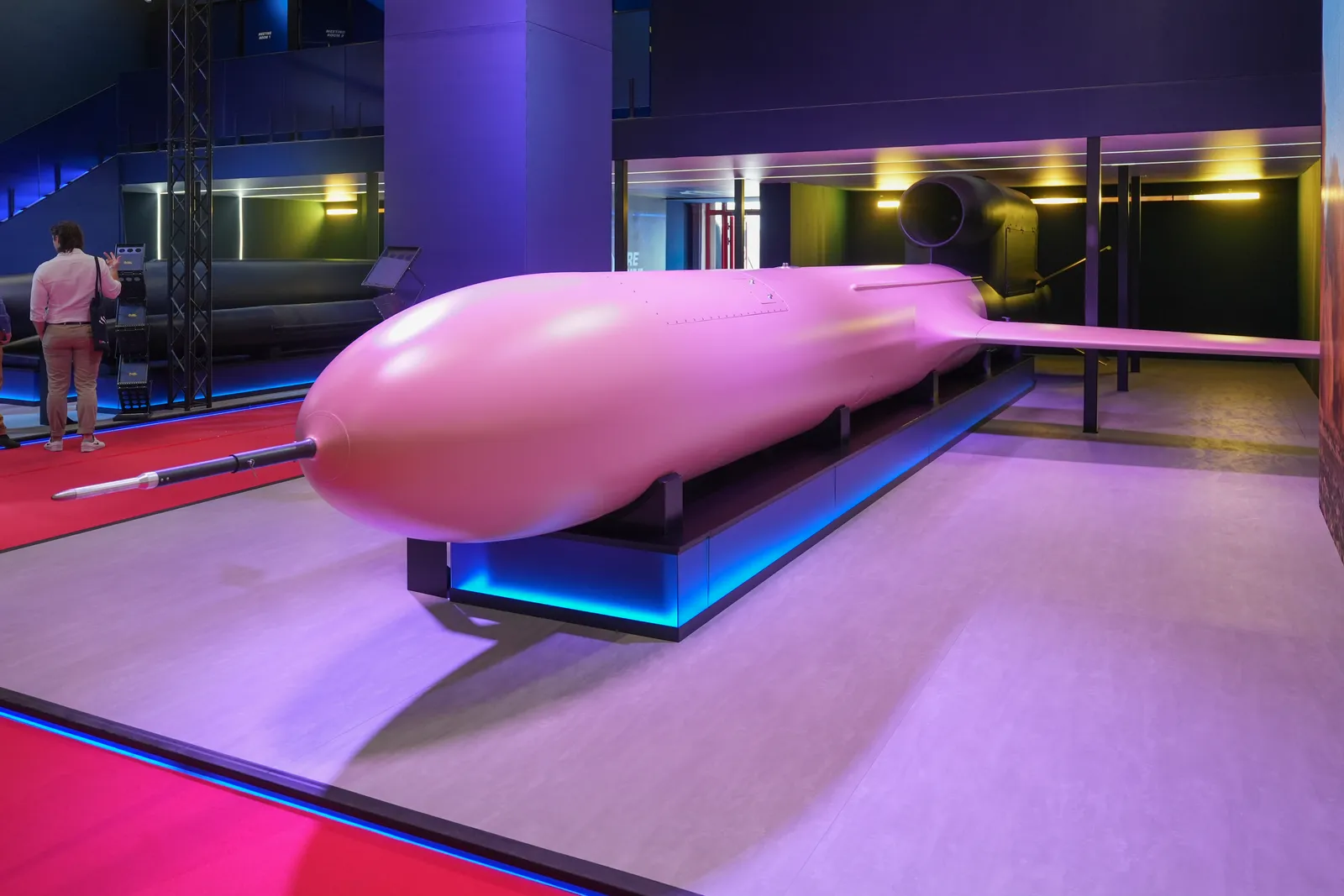
Two warnings sit on that table. Fire Point's own site gives a payload and no range or speed; the range and speed come from specification sheets Fire Point shared with the defense publication Janes. And the 3,000 km has not been shown. The longest strike Terekh cited was about 1,800 km, which she called the longest in the history of cruise missile missions. That is far beyond the Western missiles Ukraine has been given, but it is not 3,000.
Why a ton of explosive on a used engine?
Because a bomb is the cheapest part of a missile, and the Flamingo appears to be built around one. The warhead is described by Defense Express, a Ukrainian defense outlet, as an aerial bomb of the 2,000-pound class, the kind air forces stock by the thousand. The engine is the AI-25TL, a Soviet turbofan made for trainer jets, bought as surplus, and Defense Express has flagged the limited supply as one of the program's main weaknesses.
Put the arithmetic on a table. I take Fire Point's price of $600,000, the maker's 1,150 kg, the site's Tomahawk at $3.64 million and about 450 kg, and the Barracuda-500M at Anduril's $150,000 to $200,000 and 45 kg.
| Flamingo | Tomahawk Block V | Barracuda-500M | |
|---|---|---|---|
| Price of one missile | about $600,000 | about $3.64 million | $150,000 to $200,000 |
| Warhead | about 1,150 kg payload | about 450 kg | about 45 kg |
| Price per kg of warhead | about $520 | about $8,100 | $3,300 to $4,400 |
| Range | up to 3,000 km claimed, about 1,800 km flown | about 1,600 km | more than 930 km |
Per kilogram of warhead the Flamingo is about fifteen times cheaper than a Tomahawk and six to eight times cheaper than a Barracuda. If I count only the explosive, assuming the Mk 84 fill of about 430 kg, the Flamingo costs about $1,400 a kilogram of explosive. That is still about a sixth of what a Tomahawk costs per kilogram of its whole warhead, and only part of that warhead is explosive. Terekh's own comparison, six times cheaper per missile, is the cautious version.
That is the company's price, and it is not audited. It does not include the launcher, the ground station, the datalink or the cost of the bomb itself. Anduril shrank the warhead so Barracuda can be built in thousands; Fire Point sized the airframe around an existing heavy bomb and paid for it with a surplus engine.
How often does it arrive?
Less often than its price suggests, and that is the number to put beside the price. Fabian Hoffmann, a missile analyst, counted ten confirmed Flamingo strikes between August 2025 and July 2026, with three to six missiles in each. Early ones hit little: Hoffmann records no hits on the power plant in Oryol in November 2025 or on the Kapustin Yar test range in January 2026. The last four, he writes, reached their target twice and missed the likely aimpoint both times. The best case was Titan-Barrikady in Volgograd on 26 and 27 June 2026, where five missiles were launched and three hit, damaging two workshops at a plant linked to the production of Russian ballistic missiles, the kind Russia fires at Ukrainian cities.
The Ukrainian count is harsher. Razom UA, a Ukrainian outlet, reported in May 2026, citing the analyst known as Garbuz, that of 23 verified launches six reached their targets and two hit the object. That is about one in four reaching the area. At that rate a missile that arrives costs about $2.3 million, which is the fair number to set against a Tomahawk's $3.64 million, whose own arrival rate is not public and can only push its cost per arrival higher. So the Flamingo stays cheaper per arrival, though by far less than the six times of the sticker price.
The reasons are the ones the design predicts. The AI-25 is a trainer-jet engine doing a missile's job. The navigation is satellite-based and inertial, the same family of weakness I describe in Excalibur, and a few dozen meters of error still damages a factory.
What did the Flamingo do on the Crimean Bridge?
It carried the heavy warhead to a point target and, according to Zelensky, a person steered it onto that point. The official account says the operation ran for about a month in seven stages. The SSU, Ukraine's security service, credits Palianytsia missile-drones with the road span. Zelensky said Neptune, Ukraine's own cruise missile, Ruta, a low-cost cruise missile from Destinus, a company with Dutch venture money, and Flamingo struck the railway section. He called the operation a response to Russian strikes on Ukrainian bridges. Fire Point's co-founder Denys Shtilerman reposted a video captioned as a Flamingo hitting the bridge arch, and dedicated it to two colleagues who died. Monitoring channels counted at least four cruise missiles; that is unconfirmed, as is which structure each hit. I have no source that settles what each weapon hit, and the accounts differ.
The point that matters is Zelensky's remark about the link. TWZ, the defense news site, read the footage as a version of Flamingo's man-in-the-loop control, an operator who steers the weapon in flight to the aimpoint. It put the warhead at about 2,500 lb, roughly 1,130 kg, and set Zelensky's line against recent reports that Ukraine's access to Starshield, SpaceX's military satellite service, had been disrupted. SpaceX denied that. No source says what carries the Flamingo's link, and I will not guess.
What follows is plain. Hoffmann found that in two of the last four uses the missile reached the target and missed the aimpoint. A person steering the final seconds closes exactly that gap, and a bridge arch is a target where a miss of a few dozen meters is a miss. Ukraine's interceptor drones already work this way, a cheap airframe, a person and a link, and precision moves out of the round and into the operator. It also moves the weapon's cost, because the $600,000 price covers the missile and leaves out the link that made it hit.
Who is behind it?
The company is young. Fire Point was registered as a casting agency called Centrocast and renamed in February 2023, according to the Kyiv Independent's review of company records. Its co-founders include Iryna Terekh, now CEO, and Denys Shtilerman, chief designer, who said in May 2026 that he holds 97.5% of the shares. By July 2026 it had 83 factories in Ukraine, one in Denmark and 6,000 employees, and executives told the New York Times it held $1 billion in contracts in 2025.
There is also a roadmap question. In late summer 2026 Terekh called the Flamingo more a political statement than a wonder weapon, which led to reports that production had stopped. Fire Point said production continues. Its development effort is moving to the FP-7 and FP-9 ballistic missiles; Zelensky announced the FP-7's first combat use on 1 October 2026. Its interceptor derivative is the center of FREYJA, the ten-nation program for which Fire Point is prime integrator.
Where does the Flamingo go next?
I expect it to survive as the heavy end of a Ukrainian mix, and three signals will show it. First, an engine that is not a museum piece. Terekh told TWZ that Fire Point's own turbojet will finish testing by the end of 2026 and enter serial production in 2027, and Forbes Ukraine reported the first ten prototypes in assembly. Until then, output is capped by how many AI-25TLs remain. Defense Express reported in October that the seven-a-day target had not been reached, and Terekh blamed too few orders. Second, the arrival rate. If the next five or six confirmed strikes show three hits of five as Titan-Barrikady did, the price per arrival falls toward $1 million and the Flamingo becomes a serious weapon. If the rate stays near one in four, Ukraine will buy fewer and ask for a seeker. Third, who pays. Denmark has guaranteed a DKK 750 million loan, about $113 million, for Fire Point's propellant plant. More European money for serial production would settle whether this becomes an export product.
What will the market need next?
The gaps are around the missile, because the missile is the cheap part.
- Datalinks that survive and reach 1,000 kilometers. Jam-resistant, beyond-line-of-sight links with a camera feed small enough for a missile nose. The buyers are every Ukrainian long-range strike maker, and any Western army that wants a person in the loop on a one-way weapon.
- Seekers priced for a $600,000 round. An imaging infrared or radar seeker that works when the satellite signal is jammed, priced as a small fraction of a $600,000 round. Buyers: Fire Point and its European partners, and anyone fielding the low-cost cruise missiles in FAMM and LCCM.
- Small turbofans in the 16 kN class. The AI-25TL is the bottleneck, the same kind of engine shortage I describe in the interceptor-drone engine bottleneck. Any qualified European or Ukrainian engine in that thrust, made by the thousand, sells to every program in this class.
- Low-altitude terrain data and route planning. Digital elevation and obstacle maps of the target country, plus planning software that shapes a route around known air defenses. Buyers are ministries and missile makers, priced as a subscription or per mission.
- Battle damage assessment. Hoffmann says the evidence for even the best strike is too thin for confidence. Satellite imagery services and analytics that turn a strike into a damage figure sell to the General Staff and to every sponsor that wants proof its money worked.
What the Flamingo means for a defense founder
- Sell the part the missile lacks. The airframe and warhead cost little. The money is in the link, the seeker, the engine and the planning software, and each can be sold to more than one missile maker.
- Quote the price per arrival. A buyer who watched Flamingo strikes counted the hits. Show the hit rate your component adds and the cost per target destroyed.
- Ask for the full-system cost. Fire Point's $600,000 leaves out the launcher, the ground station and the link. A partner should ask for the price build-up before it signs.
- Plan around the engine. Any program on a surplus engine has an end date. A supplier with a qualified replacement before that date has a customer waiting.
Sources (20)
- TWZ, What we know about Ukraine's strikes that cut Russia's Kerch Bridge road vehicle span, 17 November 2026
- Kyiv Post, From Flamingo to Neptune: Zelensky reveals details of Crimea Bridge strike, 17 November 2026
- Euromaidan Press, Missile-drones, cruise missiles and a Flamingo guided to the last second, 17 November 2026
- Janes, Eurosatory 2026: Fire Point's FP-1, FP-2 and FP-5 UAVs used in near-daily strikes on Russia, June 2026
- Ukrinform, Fire Point CEO: Ukrainian Flamingo missiles cost six times less than Tomahawks, citing The Guardian, 27 July 2026
- TWZ, Ukraine's Fire Point CEO on how it's making missiles and drones, 3 August 2026
- Missile Matters (Fabian Hoffmann), Is the FP-5 Flamingo cruise missile starting to deliver? Evidence from ten confirmed strikes, 7 July 2026
- Razom UA, FP-5 Flamingo: 3,000 km on paper, hit rate in practice, 6 May 2026
- Ukrainska Pravda, Where is Flamingo? Analysis of all known attacks using Ukrainian FP-5 missiles, 3 May 2026
- Defense Express, Ukrainian Fire Point FP-5 Flamingo in detail: warhead from the US, possibly bunker buster
- UNITED24 Media, Ukraine may have broken the biggest FP-5 Flamingo production bottleneck, 3 August 2026
- Forbes Ukraine, Fire Point developed its own turbojet engine for the Flamingo, 4 August 2026
- Reuters, Ukraine's Fire Point starts to integrate European tech into missile defence system, 4 August 2026
- Army Recognition, Flamingo FP-5 cruise missile
- Fire Point, company website
- Associated Press, Mike Pompeo named adviser to Ukrainian defense company, 17 November 2025
- Reuters, Ukraine's Fire Point gets $113 million state loan guarantee from Denmark, 21 October 2026
- Reuters, Ukraine deploys FP-7 tactical ballistic missile in combat for the first time, Zelenskiy says, 1 October 2026
- The New York Times, 3 Years Ago It Was a Casting Agency. Now It Has $1 Billion in Drone Contracts, 26 October 2025
- NAVAIR, Tomahawk product page, unit cost
Where this comes up on the site
- Per kilogram of warhead the FP-1 is no cheaper than a Flamingo, and it flies four times slower
- Ukraine spent a month taking apart the Crimean Bridge's defenses, then hit one arch two nights running. How eleven Ukrainian weapons dropped the span
- Palianytsia is the weapon the SSU credits with dropping the Kerch Bridge span, and its limit is the Czech-Ukrainian engine rather than the warhead