
FAMM and LCCM, the two programs through which the Pentagon is buying cheap cruise missiles by the thousand
The US is buying low-cost cruise missiles through two linked programs: the Air Force’s Family of Affordable Mass Missiles and the Pentagon’s Low-Cost Containerized Missiles. Here is what each buys, from whom, at what price and on what schedule.
The Family of Affordable Mass Missiles, FAMM, and its sister program LCCM are how the United States is answering the same question Russia answered with the Banderol: what if a cruise missile cost hundreds of thousands of dollars instead of millions, and you bought it by the thousand? They are linked but separate efforts, with different launch concepts and partly different vendors, and together they plan for tens of thousands of missiles over five years.
My argument is that FAMM and LCCM are the Pentagon admitting that a cruise missile priced in millions cannot be bought in the numbers a modern war consumes. Russia uses its cheap cruise missiles to terrorise Ukrainian ports and cities; the United States is building cheap ones to deter, and to have enough of them. The idea that matters is the price, not the airframe.
What are FAMM and LCCM, and how do they differ?
FAMM is the Air Force’s umbrella procurement program for low-cost, high-volume long-range strike weapons. Its 2027 budget documents describe “palletized and lugged” rounds: missiles carried under aircraft in the usual way, or rolled out of cargo aircraft on pallets.
LCCM, Low-Cost Containerized Missiles, is a Defense Department effort to buy inexpensive cruise missiles launched from commercial shipping containers on land or at sea. It grew from the same experimentation lineage, the Enterprise Test Vehicle work of the Defense Innovation Unit and the Air Force, but it is not formally part of FAMM.
The numbers
| FAMM | LCCM | |
|---|---|---|
| Run by | US Air Force | Department of War |
| Launch | from aircraft, carried or palletized | from 20-foot shipping containers, ground or ship |
| 2027 request | $355 million for 1,000 rounds ($55 million discretionary for an extended-range version, $300 million mandatory) | no standalone public appropriation |
| Five-year plan | about 28,000 weapons for about $12.6 billion, FY2027 to FY2031 | at least 10,000 missiles over three years |
| Annual ramp | 1,000 in FY2027, 5,300 in FY2028, about 8,000 a year by 2031 | Anduril planning 1,000 a year; Leidos an initial 3,000 |
| Vendors | Anduril, CoAspire, Zone 5 Technologies (framework agreements, July 2026) | Anduril, CoAspire, Leidos, Zone 5 Technologies |
| Contract type | multiyear framework agreements | fixed-price framework agreements; material unit prices not public |
| Milestones | first Barracuda deliveries early 2027 | experimentation from June 2026; live launch at White Sands on 19 August 2026; production buys from FY2027 |
What are the missiles?
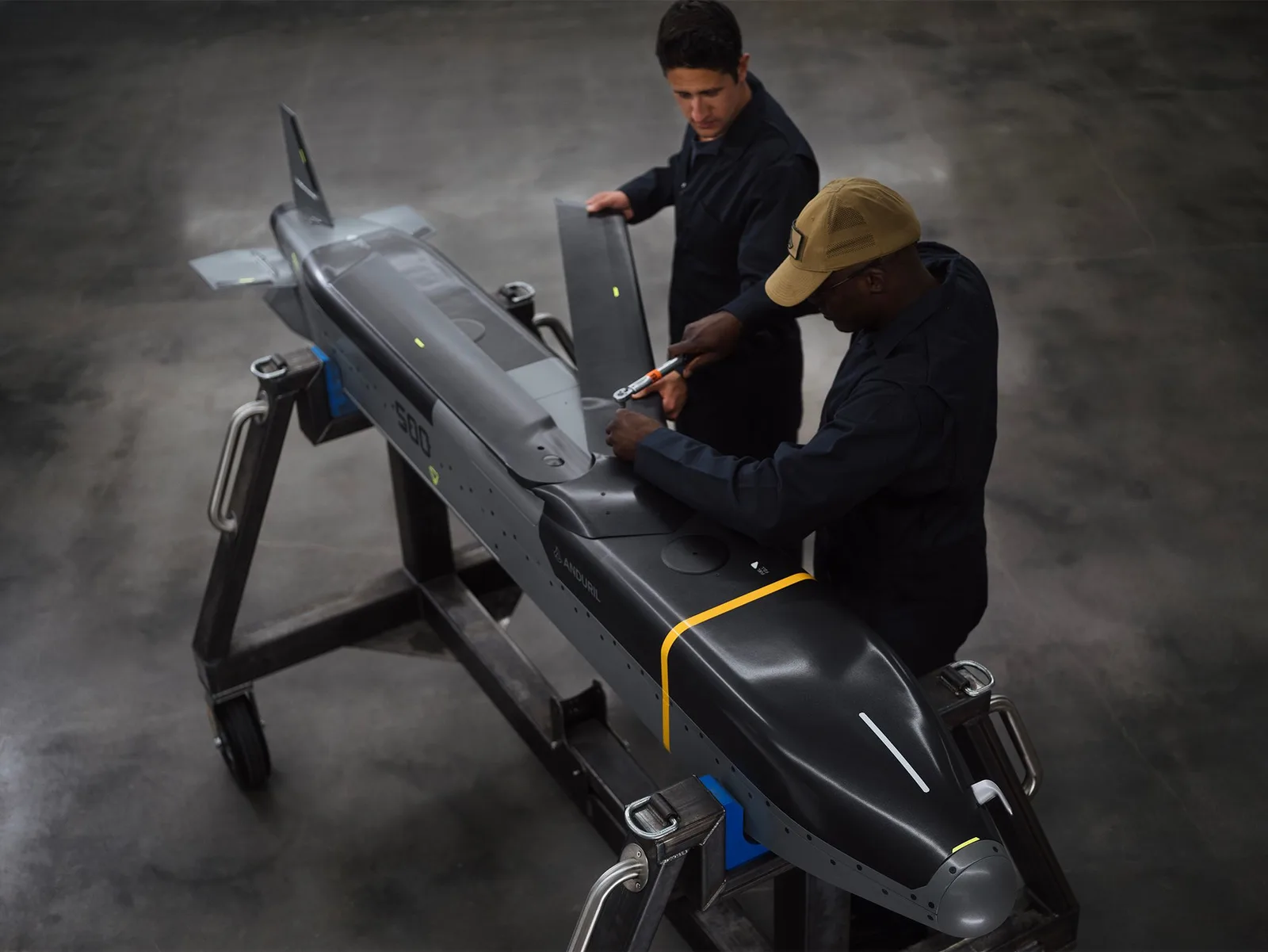
- Anduril Barracuda. The Barracuda-M family is Anduril’s air-launched entry; on 23 September 2026 the Air Force Research Laboratory certified it as compliant with the Weapon Open Systems Architecture, so components can be changed without depending on one vendor’s closed design. For LCCM Anduril offers the Surface-Launched Barracuda-500M: over 500 nautical miles of range, a payload of about 100 lb, up to 16 missiles in one 20-foot container. Anduril has said a production missile should cost no more than $150,000. In May 2026 the Army signed a framework for at least 3,000 of them over three years, the first LCCM contract; what that buys per kilogram of warhead against a Tomahawk is on the Barracuda page.
- Leidos. A larger derivative of its AGM-190A Small Cruise Missile, known as Black Arrow, about twice its size.
- CoAspire. GHOST, a ground-launched version of its Rapidly Adaptable Affordable Cruise Missile Extended Range.
- Zone 5 Technologies. Its FAMM candidate is reported as Rusty Dagger; its LCCM design had not been disclosed in May 2026.
What does one missile cost?
Three different numbers circulate and they measure different things. The FY2027 request divided by quantity gives about $355,000 a round. The five-year plan divided by quantity gives about $450,000, a figure that includes whatever else the program buys besides missiles. And Anduril’s own target for a production Barracuda is $150,000 or less. A Western long-range missile such as JASSM-ER is cited at about $1.5 million. Russia’s Banderol, by comparison, is estimated at $50,000 to $300,000, and its Kh-101 at $10 to $13 million.
My reading: the US is aiming at the price band of Russia’s Banderol, a missile built to terrorise Ukrainian ports and cities by the hundred, with longer range and better guidance, and it has not yet shown it can build at that price at volume.
Where does affordable mass lead?
I expect three consequences over the next few years.
- The missile becomes a production problem. Once a price target of hundreds of thousands of dollars is set, engines, seekers and airframes have to be made like consumer goods. Small turbojets become the bottleneck, as they already are for jet interceptors.
- New entrants beat the incumbents on cost. Programs built around price and volume favour companies that design for manufacturing from the start. Expect the traditional missile primes to buy or partner with them rather than compete head-on.
- The defender's cost problem comes home. If cheap cruise missiles work for the United States, they work for every adversary that can build them. The other side of this program is the need for interceptors cheap enough to answer them, the subject of cost-exchange ratio.
Signals worth watching: the unit prices in the first production contracts, which engine makers win, and how many vendors are still in the program after the first production lots.
What will the market need next?
A missile priced in hundreds of thousands of dollars and bought by the thousand changes who earns the money inside it. The missile prime keeps the integration; the margin moves to the suppliers that make engines, seekers, inertial units and airframes at consumer-goods cost. Small turbojets are already the bottleneck, and a US or allied line for engines in that class sells to several FAMM and LCCM bidders at once, as well as to interceptor makers short of the same part.
The less obvious market is the test range. Thousands of cheap missiles need acceptance tests at a rate and a cost that today's ranges, built for a few expensive rounds a year, cannot offer. Test services priced for volume, and cheap jet target drones to shoot at, will be bought by the same programmes.
Signals worth watching: unit prices in the first FAMM and LCCM production awards, small-turbojet makers announcing US capacity, and test ranges offering volume acceptance testing.
Why does it matter for a founder?
Because the hard part is not the missile, it is the ramp. Going from 1,000 rounds in FY2027 to 8,000 a year by 2031 across three vendors is a supply-chain problem first: engines, seekers, airframes, warheads and test capacity all have to scale together, at a fixed price. That is where suppliers below the primes have an opening and where most of the program risk sits, the problem I describe in what breaks first between prototype and series production.
It also sharpens the strategic question. Buying offensive mass this way is the right industrial model; the gap is that the US is not yet buying its defense against cheap missiles the same way. That argument is in the US does not need its own Banderol, it needs cheap interceptors, and the arithmetic under it is in cost-exchange ratio.
Sources (10)
- US Air Force, FY2027 budget overview
- US Air Force, FY2027 aircraft and missile procurement justification
- Air & Space Forces Magazine, Air Force five-year plan for cheap cruise missiles, 29 April 2026
- Air & Space Forces Magazine, AFRL certifies Anduril Barracuda as open architecture, September 2026
- DefenseScoop, low-cost containerized missile contracts, 15 May 2026
- Army Recognition, US tests containerized missile, August 2026
- Militarnyi, Anduril plans to manufacture 7,000 Barracuda cruise missiles in 2027
- Tech Times, Pentagon bets $12.6 billion on 28,000 low-cost cruise missiles, 17 July 2026
- RealClearDefense, destruction on a budget, 1 October 2026
- Defense News, US Army to receive thousands of Barracuda-500M cruise missiles in Anduril deal, 15 May 2026
Where this comes up on the site
- The US does not need its own Banderol. It needs cheap interceptors, made at the same pace.
- A Flamingo costs $600,000 and carries a ton of explosive, and at the Crimean Bridge a person steered it
- Anduril's Barracuda sells aim points rather than explosive, and its real product is a cruise missile any partner can assemble