
Anduril's Barracuda sells aim points rather than explosive, and its real product is a cruise missile any partner can assemble
Barracuda is Anduril's family of small, subsonic jet cruise missiles built for volume. The US Army has a framework for at least 3,000, Anduril plans 7,000 in 2027, and Poland's PGZ will assemble it too. I explain the family, how it is built, what it costs per kilogram of warhead against a Tomahawk, and where the money is for suppliers.
In May 2026 the Pentagon signed a three-year framework with Anduril Industries for at least 3,000 ground-launched cruise missiles, 1,000 a year from 2027, fired from 20-foot shipping containers. For fiscal 2026, the US Navy expected to receive about 110 new Tomahawks. The missile in the Anduril deal is the Barracuda-500M, and its maker, a nine-year-old company from Costa Mesa, California, says it will build 7,000 Barracudas in 2027.
Barracuda is a family of small autonomous jet aircraft. The versions with an M in the name carry a warhead, which makes them cruise missiles. Each one is a tube with folding wings, tail fins and a small turbojet, flying below the speed of sound at about 930 km/h and navigating by satellite and inertial sensors.
My argument is that Barracuda is not a cheaper Tomahawk, and it is a mistake to compare them on the price of one missile. Per kilogram of explosive delivered, Barracuda is only about half the price of a Tomahawk. What it sells cheaply is the number of things the enemy must shoot at. And the most important thing Anduril makes may be the design itself: simple enough that a partner in Poland or Taiwan can build the missile from parts on the open market.
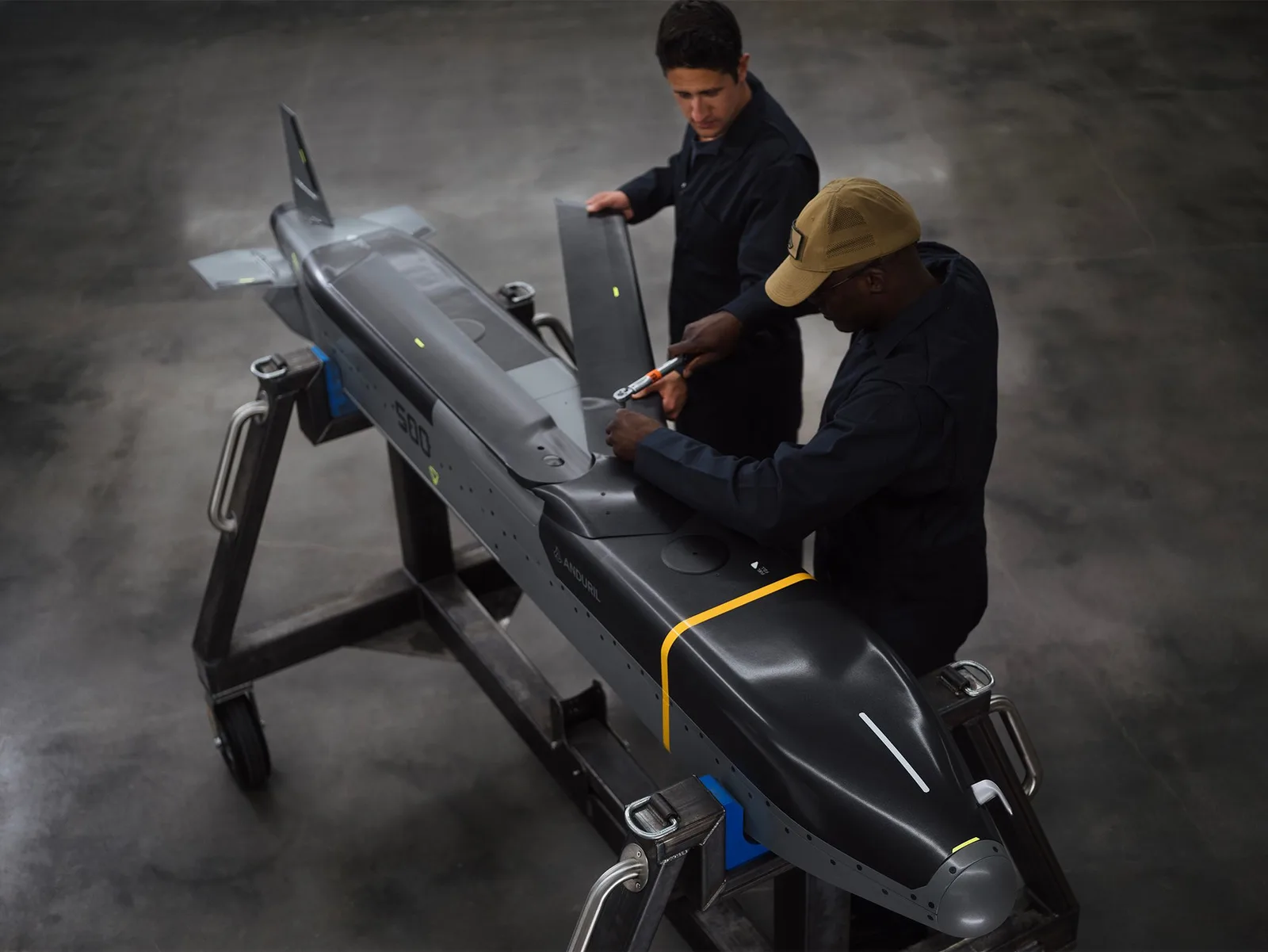
Barracuda in numbers
| Barracuda-100 | Barracuda-250 | Barracuda-500 | |
|---|---|---|---|
| Range | more than 220 km (120 nmi) | about 370 km (200 nmi) | more than 930 km (500 nmi) |
| Payload | 16 to 18 kg | 16 kg | 45 kg |
| Speed | up to 500 knots, about 930 km/h | the same | the same |
| Carried by | Apache and Viper attack helicopters, fighters' external rails | the internal bay of stealth fighters such as the F-35 | F-15E, F-16, F/A-18; pallets from C-17 and C-130 cargo aircraft; 20-foot containers on the ground, up to 16 a box |
| Guidance | satellite navigation and inertial | the same | the same |
Anduril's production claims for the family: half the build time, half the parts, 95% fewer tools and on average 30% lower cost than competing missiles, with no named baseline. The surface-launched Barracuda-500M can be assembled in about 30 hours with ten ordinary hand tools; 70% of its components are commercial parts bought on the open market, and the Barracuda-500 versions share more than 90% of their parts.
Three prices circulate, and they measure different things: Anduril's own production target of $150,000 or less, a reported price of about $200,000 for the SLB-500M, and Taiwan's co-production target of NT$6.5 million, about $216,000. The Air Force's five-year affordable-missile budget works out at about $450,000 a round, which I cover in FAMM and LCCM.
Why is the problem the factory, not the missile?
The US makes excellent cruise missiles. Tomahawk, JASSM and LRASM are accurate, long-ranged and expensive, and they are made slowly. A Tomahawk Block V costs about $3.64 million. In the US-Israeli war with Iran that began at the end of February 2026, the Navy fired more than 850 Tomahawks in four weeks, as The Washington Post reported; RTX had built 100 new ones in all of 2025, according to Bloomberg. War games of a conflict with Iran had shown the same thing before it happened: precision stocks run out in weeks or days, and rebuilding them takes years.
The years come from the industry, not the budget. In 1990, 13 companies supplied the Pentagon's tactical missiles; by 2020 there were three, the Defense Department wrote in 2022. Lines were closed, suppliers left, and the skills went with them. An order can be signed in a month; a supplier base cannot be rebuilt that fast.
The same imbalance appears on the defensive side, where a drone that costs $35,000 to $50,000 is shot down with a Patriot interceptor at about $4 million. Ukraine, fighting Russia's full-scale invasion since February 2022, answered that problem with interceptor drones that cost a few thousand dollars and are made like consumer electronics. Barracuda is the American attempt to do the same on the attacking side: a cruise missile built the way Detroit builds cars, cheap enough to be bought by the thousand.
What does a kilogram of warhead cost?
Here is the comparison most coverage skips. I take the Tomahawk at $3.64 million and 450 kg of warhead, and the Barracuda-500M at Anduril's $150,000 target and the reported $200,000, with 45 kg.
| Tomahawk Block V | Barracuda-500M at $150,000 | Barracuda-500M at $200,000 | |
|---|---|---|---|
| Price of one missile | $3.64 million | $150,000 | $200,000 |
| Warhead | about 450 kg | about 45 kg | about 45 kg |
| Price per kg of warhead | about $8,100 | about $3,300 | about $4,400 |
| Missiles for $3 billion | about 820 | 20,000 | 15,000 |
| Warhead for $3 billion | about 370 tonnes | about 900 tonnes | about 675 tonnes |
For the $3 billion the Navy asked for 785 Tomahawks in its 2027 budget, Barracuda delivers two to two and a half times the explosive and 18 to 24 times the missiles. Most of the gain is in the count.
That changes what the weapon is for. A Tomahawk is the right tool for a hardened target that needs a heavy warhead in one place. A 45 kg warhead does not bring down a bunker, but it destroys a radar, a launcher, a parked aircraft, a fuel tank or a ship's antennas, and in my reading those make up much of the target list in the opening days of a war. Twenty missiles in place of one also mean twenty tracks on the enemy's radar and twenty interceptors to fire. A missile at $150,000 to $200,000 that draws an interceptor costing millions puts the enemy where Ukraine and the US have been against drones. That is why Barracuda is meant to complement the expensive strike weapons rather than replace them: the expensive missile goes through the hole the cheap ones open.
What does 70% commercial parts really mean?
It means the supply chain is the commercial one, and that has three consequences the brochure does not draw.
- Surge capacity already exists. A commercial part already has civilian makers and civilian buyers, so volume can be bought without waiting for a defense supplier to expand, once the part is qualified for the missile. This is how Anduril can talk about 7,000 missiles in a year.
- The risk concentrates in the other 30%. In my reading it holds the parts that decide the schedule: the small turbojet, the navigation unit, the warhead and fuze, and the magnets in the motors that move the fins. Those are where a production plan will stall. China mines about 70% of the world's rare earths and makes 93% of its permanent magnets, CSIS calculated in October 2025, and from 1 December 2025 China said it would largely deny export licences to companies tied to foreign militaries. A missile that is 70% commercial can still be stopped by a few grams of magnet.
- Supplier changes become a design feature. With more than 90% common parts across the 500 line and an open architecture, Anduril can change the engine or another unit when one supplier fails. In September 2026 the Air Force Research Laboratory certified Barracuda against its open weapon architecture. For the buyer this is insurance; for a component maker it is an open door, because the slot can be filled by whoever qualifies.
Who else wants to build it?
In July 2026 Poland's state defense group PGZ signed an agreement to produce the surface-launched Barracuda-500M in Bydgoszcz, following a memorandum from October 2025, with a stated goal of several thousand a year. PGZ says local production could make the missile eligible for other EU buyers under SAFE, the EU's defense loan instrument. Taiwan's state institute NCSIST has a co-production price target; Latvia and Brazil's Embraer have expressed interest.
This is the part I find most interesting. A missile that takes 30 hours and ten hand tools to assemble, from parts sold on the open market, can be built near the war that needs it. Anduril is selling a design and a production system that a partner can run, the way a carmaker licenses a platform. For Europe it means a second source of an American missile on European soil, paid for with European money, and not dependent on the schedule of one factory in Ohio.
What has not been shown yet?
Everything signed so far is a framework. The Army's agreement depends on tests going well and on money actually being appropriated each year, and Anduril's production claims have not been verified by any government or audit body. Barracuda production has been moving from a Southern California facility to Arsenal-1, Anduril's new plant near Columbus, Ohio, planned at about 5 million square feet (about 465,000 m²) and supported by state grants and tax incentives; drone production started there in March 2026, and the Barracuda line is expected by the end of the year. The other weakness is guidance. Satellite navigation and inertial sensors are cheap, and satellite signals are what electronic warfare attacks first, a lesson the US already paid for with the Excalibur shell in Ukraine.
Where does Barracuda go next?
I expect Barracuda, or something like it, to become the default way the US and its allies buy long-range strike in volume within three years, with Tomahawk-class missiles kept for the targets that need them. The signals that will show whether that is happening:
- The first production contract with a unit price. A firm price under $250,000 confirms the economics in the table above; a price near the $450,000 budget average weakens them.
- Deliveries from Arsenal-1 in 2027. The 7,000 target is a statement; the first quarterly delivery numbers are the evidence.
- The Polish line's first missiles. If Bydgoszcz delivers before 2028, Anduril's model of production by partners works, and others will follow.
- A guidance upgrade. A version with terminal seekers or jam-resistant navigation will tell you the Pentagon expects to use it against defended targets, not only in permissive airspace.
What will the market need next?
The money in a missile bought by the thousand moves from the integrator to the parts that are not commercial, and to the services that let thousands of rounds be accepted.
- Small turbojets in the 150 lb thrust class. Every cheap cruise missile and every jet interceptor needs one, and it is already the bottleneck I describe in the interceptor-drone engine bottleneck. A US or allied engine line sells to all four suppliers in the Pentagon's container-missile program at once.
- Magnets and actuators outside China. Fin actuators and motors with magnets from non-Chinese supply, qualified for munitions. The buyer is every missile maker in the affordable-mass programs, and every interceptor maker short of the same parts.
- Jam-resistant navigation at a missile-sized price. A navigation unit that holds course under jamming, priced for a round of $150,000 to $200,000, not for a $3.6 million one.
- Acceptance testing at volume. Ranges and test services built to accept thousands of rounds a year, priced per round at a small fraction of the missile, and cheap target drones to fire at.
- Owning the qualification. If the engine, the navigation unit and the actuators are interchangeable, someone decides which supplier's part is approved, keeps the test data and manages the configuration. That position, the qualified interface and the approved-vendor process, may be worth more than making any single component, and it is open to an independent test and certification house as well as to Anduril.
- Partner production kits. Tooling, work instructions and quality systems that let a partner like PGZ stand up a line quickly. If production by partners spreads, the companies that set up and certify those lines in Europe and Asia will have steady work.
What Barracuda means for a defense founder
- Compare per aim point, not per missile. The buyer of a cheap missile is buying the number of targets it can hold at risk and the number of interceptors it forces the enemy to spend. Show those numbers.
- The open slot is the opportunity. An open-architecture missile with interchangeable parts can take your engine, actuator or navigation unit if it qualifies. Design to the interface, find out who signs off a new supplier, and get on the test schedule early.
- Build where the war is. Poland and Taiwan want to assemble the missile themselves. A component maker with a line in Europe can sell to the European production and qualify for European money.
- Watch the 30% that is not commercial. That is where the program will stall, and that is where a supplier is worth the most.
Sources (15)
- Defense News, US Army to receive thousands of Barracuda-500M cruise missiles in Anduril deal, 15 May 2026
- Quwa, Profile: Anduril Barracuda autonomous air vehicle family, 16 September 2026
- Defense News, Anduril unveils modular high-production Barracuda cruise missiles, 12 September 2024
- Air & Space Forces Magazine, AFRL certifies Anduril Barracuda as open architecture, September 2026
- Militarnyi, Anduril plans to manufacture 7,000 Barracuda cruise missiles in 2027
- Defense News, Polish defense giant PGZ to produce Anduril's Barracuda cruise missile, 7 July 2026
- Aviation Week, Anduril and PGZ team up for Poland Barracuda production, October 2025
- Breaking Defense, As Fury production starts, Anduril pledges a different production approach at Arsenal-1, March 2026
- Manufacturing Dive, Anduril's $1 billion Arsenal-1 facility in Ohio
- NAVAIR, Tomahawk product page, unit cost
- The War Zone, US is burning through its Tomahawk stockpile, citing The Washington Post, 27 March 2026
- SOFX, Navy requests 785 Tomahawks for FY2027 while RTX can deliver 110, citing Bloomberg and CSIS, 9 April 2026
- USNI News, New Navy budget wants $3B for new Tomahawks, 6 April 2026
- US Department of Defense, State of Competition within the Defense Industrial Base, February 2022
- CSIS, China's new rare earth and magnet restrictions threaten US defense supply chains, 9 October 2025
Where this comes up on the site
- FAMM and LCCM, the two programs through which the Pentagon is buying cheap cruise missiles by the thousand
- A Flamingo costs $600,000 and carries a ton of explosive, and at the Crimean Bridge a person steered it
- Anduril looks like a weapons maker, but its core is Lattice, and Ukraine showed what its data had not yet seen