
Per kilogram of warhead the FP-1 is no cheaper than a Flamingo, and it flies four times slower
The FP-1 is Fire Point's long-range one-way strike drone, a propeller aircraft that Ukraine has flown more than 2,500 km to hit a refinery in Omsk. I explain what it carries and costs, why per kilogram of warhead it is no cheaper than the Flamingo missile, what a drone of this size can and cannot do to a refinery, what is public about its role in the Crimean Bridge operation, and where the market around it is.
On 6 July 2026, about seven Ukrainian drones flew more than 2,500 km across Russia and hit the oil refinery in Omsk, in Siberia. It was the deepest Ukrainian drone strike of Russia's war against Ukraine, which began as a full-scale invasion in February 2022. Two distillation units were damaged, and the refinery suspended its sales on the St. Petersburg exchange the next day, according to the analyst David Axe in Euromaidan Press. The drones were FP-1s, built by Fire Point, a Kyiv company.
The FP-1 is a one-way strike drone: a fixed-wing aircraft with a six-meter wingspan, a small piston engine and a propeller, launched from a truck with a rocket booster and flown to a target it does not return from. On 17 November 2026 Zelensky named it among the 11 weapons used to cut the road across the Crimean Bridge, in the operation I describe here, and gave it no role.
My argument is that the FP-1 should be priced against its sister weapon, the Flamingo cruise missile, and the comparison runs against expectation: per kilogram of warhead the drone is no cheaper than the missile. The extra money for a Flamingo buys speed, and what Fire Point sells with the FP-1 is numbers, several drones for the price of one missile.
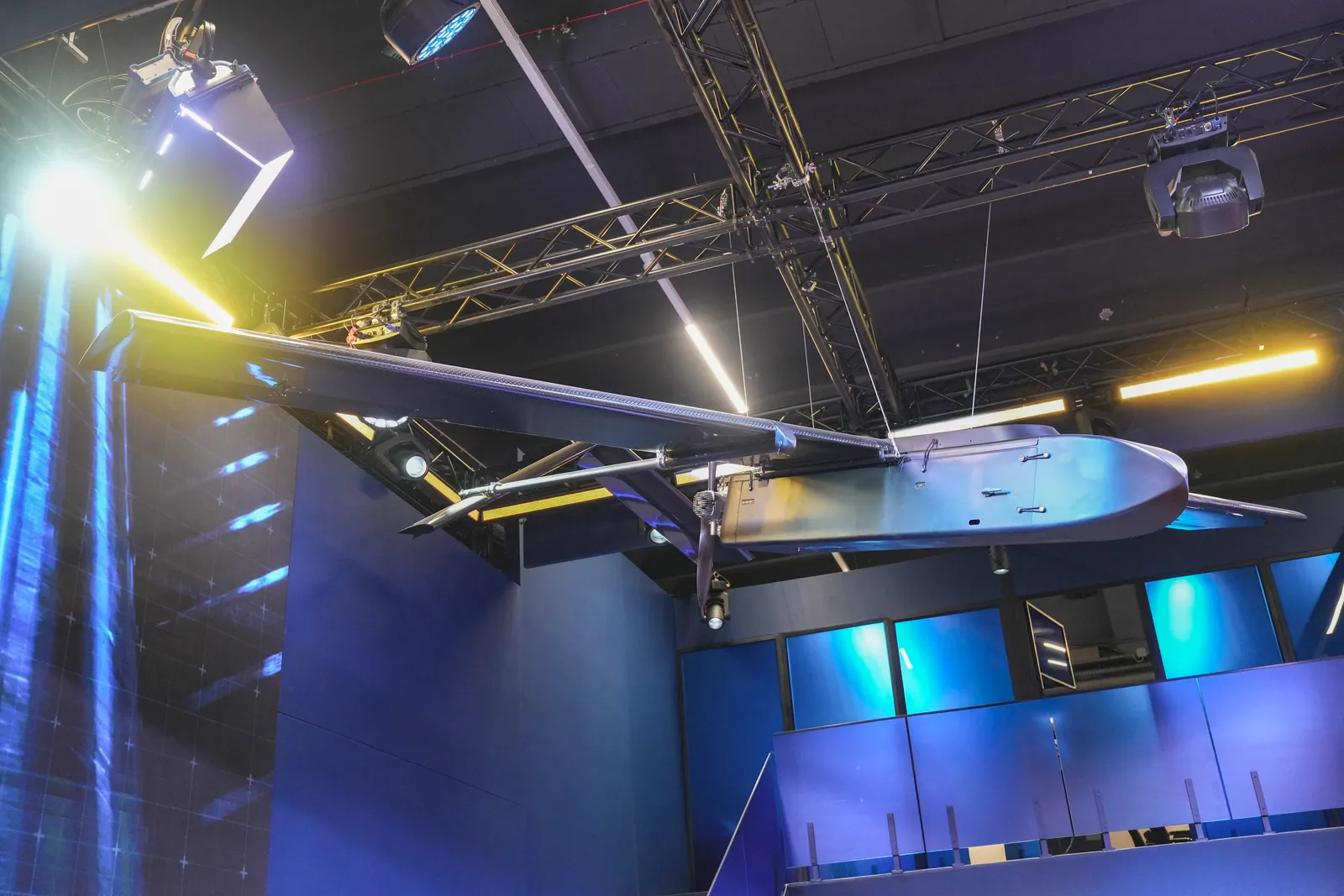
The FP-1 in numbers
| Maker | Fire Point, Ukraine |
|---|---|
| Type | one-way strike drone, fixed straight wing, piston engine with propeller |
| Range | up to 3,400 km (the maker); up to 2,700 km (specification sheets given to Janes in June 2026); 1,600 km (AP, August 2025); more than 2,500 km flown to Omsk |
| Payload | up to 60 kg (the maker); a 105 kg warhead after a redesign, said co-founder Denys Shtilerman |
| Speed | cruise 140 to 180 km/h, maximum 205 km/h |
| Flight time | 20 hours (the maker); 18 hours (Janes) |
| Size | wingspan 6 m, maximum take-off weight 330 kg |
| Launch | rocket booster from a stationary platform or a truck, 18 minutes to prepare |
| Guidance | not given on the maker's page |
| Price | $55,000 (AP, August 2025); $55,000 to $75,000 (Fire Point CEO Iryna Terekh, The Guardian, 27 July 2026) |
| Output | about 100 a day (AP, August 2025); 300 FP-1 and FP-2 a day (Fire Point, July 2026); "hundreds per day" (Terekh, July 2026) |
| Variants | FP-2, the short-range sibling: up to 700 km and up to 200 kg per the maker; the long-range FP-1(ER) has a different wing with extra fuel |
Two cautions on that table. The range and payload move together: the maker lists 60 kg at 3,400 km, and the redesign that raised the warhead to 105 kg moved fuel tanks into the wings to make room. Nobody has published the warhead at the longest range. And the prices and output figures are the company's own. I found no procurement document with a unit price.
Why does it cost as much per kilogram as a missile?
Because both are built around the same economics: a cheap airframe, a cheap engine and a bomb. The FP-1 started, Terekh told TWZ, as a Shahed-style design, the Iranian-origin type that Russia launches at Ukrainian cities in the thousands, and in its first version it flew about 700 km. Fire Point says it now makes more than 97% of the engine components itself, according to Kyiv Post in March 2026. The arithmetic below is mine and rests on the company's prices and on the redesigned 105 kg warhead at one end and the maker's 60 kg at the other.
| FP-1 | FP-5 Flamingo | |
|---|---|---|
| Price | $55,000 to $75,000 | about $600,000 |
| Warhead | 60 to 105 kg | about 1,150 kg payload |
| Price per kg of warhead | about $520 (at $55,000 and 105 kg) to about $1,250 (at $75,000 and 60 kg) | about $520 |
| Cruising speed | 140 to 180 km/h | 650 to 700 km/h |
| Time over Russia for 2,500 km | about 14 to 18 hours | about 4 hours |
Per kilogram the missile is never the expensive option: it matches the FP-1 at the drone's best figures and costs less than half at its worst. What the Flamingo buys with the extra $500,000 is time. A drone cruising at 160 km/h needs most of a day to cross 2,500 km, which gives air defense an afternoon of tracking and a night of interception. A missile at 700 km/h is over the target in a few hours. The drone answers by arriving in numbers: seven FP-1s at the quoted prices cost $385,000 to $525,000, less than one Flamingo.
Russia's own Shahed-class drones, which I cover in the Shahed and Geran explainer, cost an estimated $35,000 to $50,000 and fly at about 185 km/h. The FP-1 is the same class of aircraft built to fly three to five times as far. Ukraine's intelligence put Russian output at about 2,800 piston-engine Geran-2s a month by August 2026. Fire Point's claim of 300 FP-1 and FP-2 a day would be about three times that daily rate, and no one outside the company has confirmed it.
What can a 60 to 105 kg warhead do to a refinery?
Less than the headline distance suggests, and more than a single hit shows. Axe wrote that a single FP-1 flying 2,000 km probably does not do much damage by itself, and that repeated strikes are what matter. The Ukrainian analysis group Frontelligence Insight made the structural point in June: a bigger warhead needs a change to weight, fuel and design, so range is bought with explosive. Defense Express argued that the fire did more damage than the warhead when a drone hit the corvette Boikiy in drydock at Kronstadt on 3 June 2026; the variant used was not stated.
The refinery record is the point of the weapon. The Guardian reported in July 2026 that FP-1 attacks on Russian refineries had cut production by 20% and caused long fuel queues, and said so in its own voice, with no source named. After Tyumen on 20 June and Omsk on 6 July came Ryazan and, on 30 October 2026, Novokuibyshevsk in the Samara region, where Fire Point said the drones hit a diesel hydrotreating unit. A refinery is a plant of a few critical units, and the drone's job is to find them. This is the business case against a cheap, slow, repeated threat that I describe in cost exchange ratio, turned around and aimed at Russia's fuel supply.
The record also has a weak point. The commander of Ukraine's Unmanned Systems Forces, Robert "Madyar" Brovdi, said in April 2026 that six FP-2 drones with 100 kg warheads were needed to destroy a building that should have taken two. That complaint concerned the FP-2. Shtilerman answered that Fire Point checks every tenth warhead and had dropped a supplier that put good explosive over layers of weaker filler.
What did the FP-1 do on the Crimean Bridge?
No public source says. Zelensky listed it among the 11 weapons, TWZ, Euromaidan Press and Kyiv Post repeat the list, and none gives it a target. The first six of the operation's seven stages, over about a month, cleared Russian air defenses, radars and electronic warfare equipment on the approach. The documented air-defense work by Fire Point drones is the FP-2's: in one night on 6 March 2026 Brovdi reported a Buk, an S-300V, a Pantsir-S1 and a Tor destroyed in occupied Zaporizhzhia and Kherson regions, and 19 air-defense elements between 1 and 12 March. The FP-1 is the long-range sibling on the same airframe class.
My reading is that it added reach and endurance to the strikes that blinded or exhausted Russian air defense before the final stage. That is inference, and no public source gives a count.
Who is behind it?
Ukrainian state procurement pays for the FP-1; executives told the New York Times the company held $1 billion in contracts in 2025. The fuller company record is in the Flamingo explainer.
Where does the FP-1 go next?
I expect Ukraine to keep buying it by the thousand and to ask for two things: more warhead at the same range, and more of them surviving the last stretch to the target. Three signals will show which.
- A published unit price from a procurement document. If the Defence Procurement Agency's price lands near $55,000, the claim holds. If it lands near $75,000 or above, the economics in the table above move.
- Whether the "hundreds a day" shows up as strikes. Janes quotes Terekh at five to 20 FP-1 and FP-2 strikes a day. A strike and a drone are different units, so the two figures do not contradict each other, but they do not confirm each other either. The Guardian reported that large-scale manufacturing paused during the delay of the EU's loan to Ukraine, so output follows funding.
- Copies. A long-range drone built around a small piston engine is a design Western makers can replicate. Watch for European and American licensed versions.
What will the market need next?
- Piston and small-turbine engines for 15 to 20 hours of flight. Fire Point says it localised more than 97% of its engine components, which tells a supplier where the demand sits. Any engine maker that can deliver reliable engines by the thousand has a buyer in every long-range one-way program. The selection logic is in small aircraft engine selection.
- Navigation that holds over 2,500 km. Jam-resistant antennas, inertial units and terrain matching at a price near the drone's own. A drone that flies 15 hours is exposed to jamming for all of them.
- Warhead production with a test. Brovdi's complaint shows the buyer will count hits per building. A warhead maker that can show fill quality, batch testing and a standard initiator interface sells to every drone maker at once.
- Strike assessment. Satellite imagery and analysis that turn a refinery hit into a damage figure and a repair time. The buyers are Ukraine's General Staff, its partners who fund the strikes, and commodity traders. The Guardian's 20% figure shows the value of a defensible number.
- Production-scale tooling. Line fixtures, wing and fuselage tooling, test benches and quality systems that let a second factory build the same drone. The stages are in drone manufacturing ramp-up, and Fire Point's own long-range variant, which Terekh says cannot be built at 300 a day because of its different wing, shows where lines stall.
- Launchers and boosters. Every flight burns a rocket booster, and every launch site, a truck or a fixed platform, needs a place to hide. The buyers are Ukraine and any army that wants a one-way drone it can launch without a runway. The mirror image of this market is the interceptor drones that Ukraine builds to stop the same class of aircraft.
What the FP-1 means for a defense founder
- Price per unit of effect. A buyer will compare your part to a drone that costs $55,000 and a missile that costs $600,000. Show what it adds per kilogram delivered or per target hit.
- Capacity claims are not orders. Fire Point's own production paused when its funding paused. Check that a customer's volume is on a contract before you build to it.
- Sell to the factory, not only the flight. The scarce things are engines, warheads, navigation and tooling. Each is sold to every drone maker.
- Keep your price build-up ready. Every FP-1 price in public is a company quotation with no procurement document behind it. A buyer who compares your part with those prices will ask for yours line by line.
Sources (17)
- Euromaidan Press (David Axe), A $50k Ukrainian drone just hit a refinery 2,500 km inside Russia, 8 July 2026
- Euromaidan Press, Ukraine's $50,000 drone just did what only $500,000 munitions could, 21 June 2026
- Euromaidan Press, Ukraine's drones got bigger warheads. A Russian corvette in the Baltic just found out, 6 June 2026
- Fire Point, UAV Systems FP-1 / FP-2, retrieved 17 November 2026
- Janes, Eurosatory 2026: Fire Point's FP-1, FP-2 and FP-5 UAVs used in near-daily strikes on Russia, June 2026
- The Guardian (Dan Sabbagh), The Ukrainian startup taking the missile fight deep into Russia, 27 July 2026, AOL republication
- TWZ, Ukraine's Fire Point CEO on how it's making missiles and drones, 3 August 2026
- Associated Press, A Ukrainian startup develops long-range drones and missiles, 21 August 2025
- Kyiv Post, Ukraine cuts reliance on Chinese drone components, 11 March 2026
- Euromaidan Press, "Air defense zoo": Ukraine's drones took out Russian Pantsir, Tor, Buk and S-300V in one night, 6 March 2026
- Kyiv Post, USF commander: Ukraine knocks out 19 Russian air defense systems in 12 days, March 2026
- Defense Blog, Ukraine's top drone commander calls out warhead quality problems, 24 April 2026
- The New Voice of Ukraine, Inside Fire Point's secret lab where Ukraine's newest strike drones take shape, 27 May 2026
- RBC-Ukraine, Ukraine's FP-1 drones fly 3,400 km to strike, 6 July 2026
- Interfax-Ukraine, Ukraine hits Russian oil refinery with FP-1 drones, 30 October 2026
- TWZ, What we know about Ukraine's strikes that cut Russia's Kerch Bridge road vehicle span, 17 November 2026
- Kyiv Post, From Flamingo to Neptune: Zelensky reveals details of Crimea Bridge strike, 17 November 2026
Where this comes up on the site
- Ukraine spent a month taking apart the Crimean Bridge's defenses, then hit one arch two nights running. How eleven Ukrainian weapons dropped the span
- The Sichen carries 40 kg for 1,400 km at 200 km/h, and the interesting number is that nobody has said who builds it or what it costs
- The An-196 Liutyi was built to be spent on one target, and Antonov has now shown it as a reusable carrier for four missiles