
Sky Fortress, the air-defense network built from phones on poles, and why the scarce thing in air defense is the track
Ukraine detects low-flying Shaheds and cruise missiles with thousands of microphones wired to ordinary smartphones. The whole network costs less than a pair of Patriot missiles. Here is how it works, what it cannot do, and why NATO armies are now testing it.
Sky Fortress is Ukraine’s acoustic detection network for air defense: thousands of microphones on poles, each wired to an ordinary Android smartphone, listening for the lawnmower engine of a Shahed drone and the jet whine of a cruise missile. It does not shoot anything. It hears a target, works out its route from several sensors at once, and puts that route on the tablet of a mobile fire team that drives to meet it. A network of about 14,000 such sensors cost, in hardware, less than a pair of Patriot missiles.
My argument is that Sky Fortress shows where the real scarcity in air defense is. It is not the missile; it is the track, knowing where a low, slow target is early enough to send something cheap to meet it. Ukraine solved that with consumer hardware at a scale no military procurement would have approved, and the idea is worth more than the microphones.
Where did it come from?
The idea started with two Ukrainian engineers and a prototype built in a garage from a microphone and a phone on a pole. Deployment near the front began in the winter of 2022, as Russia started sending Shahed drones that flew too low and too slowly for radar-heavy air defense to handle economically. Representatives of Skyfortress, which Janes describes as a Ukrainian non-governmental organization, presented the network publicly at an air-defense conference in London in November 2023. In July 2024 the commander of US Air Forces in Europe, Gen. James Hecker, described it at a British air show: about 9,500 sensors at roughly $400 to $500 each, as reported.
How does it work?
| Element | What it is |
|---|---|
| Sensor node | a microphone and an off-the-shelf Android phone with a backup battery, in a box about 30 × 30 × 5 cm, on a pole |
| Connectivity | ordinary mobile networks |
| Processing | detections from many nodes are combined, with machine-learning classification, to identify the target and compute its track |
| Output | a predicted route shown on tablets to mobile fire teams; data feeds Virazh, Ukraine’s national air-defense command-and-control network |
| Emissions | none; the network is passive, so a sensor does not give away its position the way a radar does |
| Scale | about 9,500 nodes in July 2024, about 14,000 by mid-2025 |
| Unit cost | about $400 to $1,000 per node; a US Army paper put a production sensor at just over $500 |
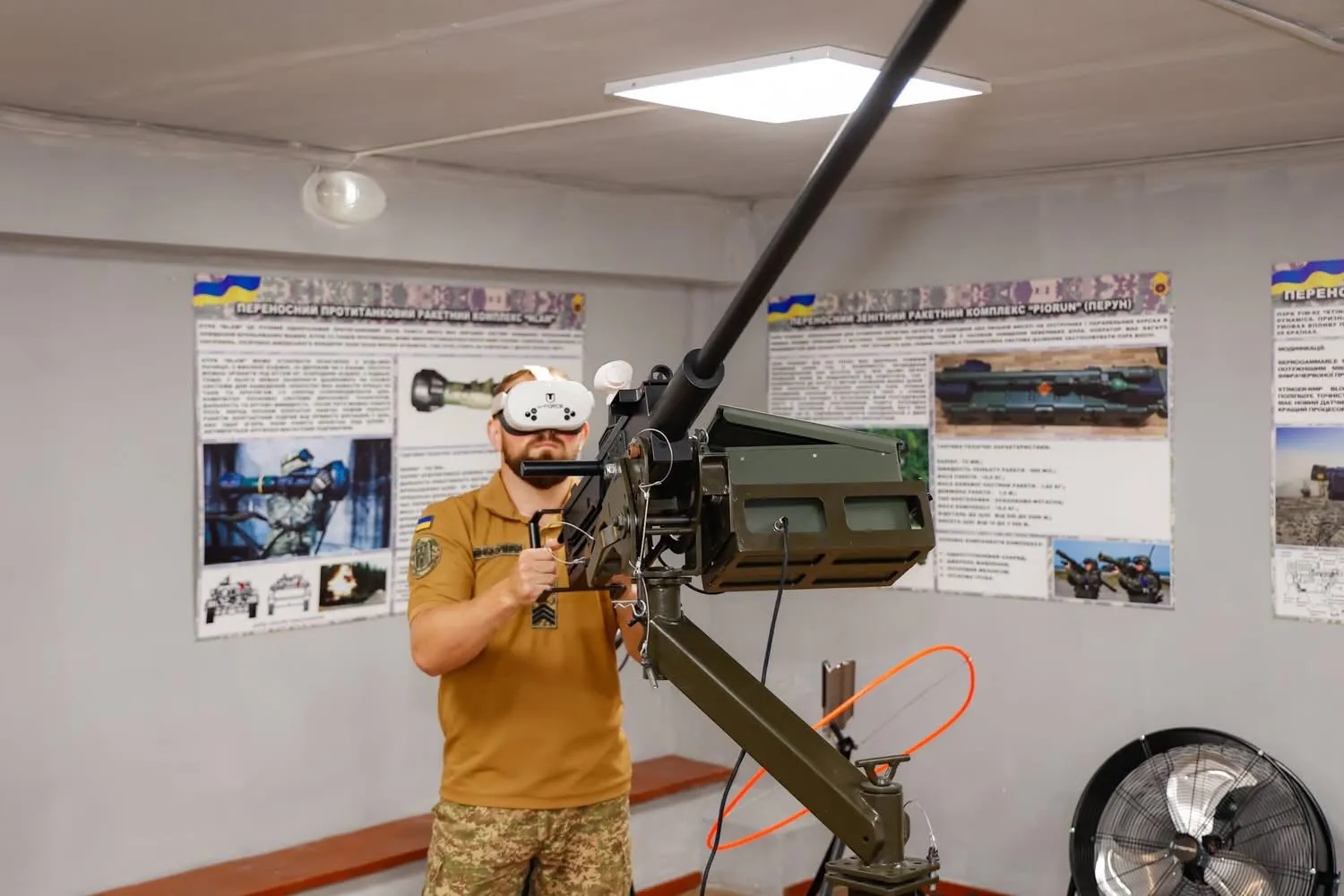
The shooters at the end of the chain are cheap too: mobile teams with machine guns and anti-aircraft guns, and increasingly interceptor drones. Gen. Hecker cited six hours as the training time for an operator, as an example rather than a standard.
What does it cost next to a Patriot?
At $400 to $1,000 a node, 14,000 nodes come to roughly $5.6 million to $14 million in sensor hardware, before servers, communications and people. A newly produced Patriot battery, by a CSIS estimate cited by the US Congressional Research Service, is about $1.1 billion including its missiles. The comparison is not a like-for-like one: Sky Fortress detects and cues, Patriot detects, tracks and kills, including ballistic missiles a microphone will never hear. What it shows is where the money goes. Against slow, low, cheap threats, the expensive part of air defense is often the sensing, and Ukraine made the sensing cheap enough to deploy by the thousand. The arithmetic of the shooter side is in cost-exchange ratio.
What can it not do?
Acoustic sensing has physical limits. Wind, terrain, background noise, sensor spacing and target altitude all change how far and how well a node hears, and a change of engine or propeller changes the signature it is trained on. There is no public figure for the network’s detection probability, false-alarm rate, latency or detection range against a Shahed; a 25 km figure in a NATO lessons-learned paper refers to artillery fire, not drones. That is why Sky Fortress complements radar rather than replacing it, and why faster threats such as the jet-powered Geran and the Banderol cruise missile compress the time between hearing a target and reaching it.
Who else wants it?
In 2026 the network was shown privately to representatives of 11 NATO countries at a European training ground, tracking simulated cruise missiles and drones. A US Army paper in April 2026 recommended studying Ukrainian acoustic systems for NATO’s eastern flank and for the Indo-Pacific. On 2 October 2026 Lithuania’s defense ministry announced it would test SkyFortress for acoustic and radio-frequency detection of low-flying drones and cruise missiles, which suggests the export version will be a multi-sensor system rather than microphones alone. US bases in the Gulf had no such network in March 2026, and the interceptor drones flown to them could not find their targets, The Atlantic reported; that gap is the subject of what saying no to Ukraine's interceptors cost.
Where does cheap sensing go next?
Acoustic sensing has a natural limit, and the war is now testing it. A jet drone is louder but faster, so the network has less time to hand a track to a fire team, and quieter, higher-flying threats are harder to hear at all. The pressure also runs the other way. A fiber-optic FPV drone emits no radio for a detector to pick up, so against it sound, optics and radar are the only sensors left, and cheap acoustic nodes become more valuable, not less. I expect the next generation to be fusion: acoustic sensors combined with radio-frequency detectors, small radars and cameras on the same cheap nodes, with software deciding which sensor to trust.
The second shift is outward. Lithuania is testing Sky Fortress for acoustic and radio detection, and every NATO country with bases, power plants and cables has the same problem as Ukraine at a smaller scale. A network of cheap sensors built by the thousand is a product a homeland-defense buyer can afford, which is why the Pentagon's counter-drone directed energy pilot still depends on someone finding the drone first.
Signals worth watching: NATO countries buying networked acoustic or passive sensors at scale, the share of jet drones that cheap sensing still tracks in time, and whether the sensor network becomes the platform that other air-defense layers plug into.
What will the market need next?
Sky Fortress shows a market for cheap sensing that goes well beyond Ukraine. Any country that has to watch thousands of kilometres of border, coast or power lines for low-flying drones faces the same arithmetic: a network of about 14,000 nodes at $400 to $1,000 each cost less in hardware than a pair of Patriot missiles. NATO's eastern members, Gulf states and operators of critical infrastructure are buyers.
What they will pay for is not the microphones. It is the classification models trained on years of Russian attacks on Ukrainian cities, the link into their own command system, and the maintenance of thousands of nodes in the field. That points to a service model: the network installed, run and updated by the year, with data rights settled in the contract.
Signals worth watching: acoustic or passive sensor networks ordered outside Ukraine, export permits for Ukrainian sensing systems, and NATO exercises that test cheap sensing alongside radar.
What a founder should take from it
Sky Fortress is the clearest example of a pattern I see across Ukrainian defense tech: take a commercial device that already exists in the millions, put it in a box, and win on the network and the software rather than the hardware. The moat is not the phone. It is the classification models trained on years of real Russian attacks, the integration with the national command system and the logistics of keeping 14,000 nodes alive. For a company selling this kind of system abroad, those are the things a buyer is paying for, and they are the things that take the longest to replicate. How a Ukrainian product like this gets to a foreign buyer is in Ukraine’s defense export rules for buyers.
Sources (9)
- Janes, Ukrainian air defence employs passive sensors for detection and tracking
- UNITED24 Media, Sky Fortress acoustic detection, 1 July 2025
- UNITED24 Media, SkyFortress will track low-flying drones and missiles over Lithuania, October 2026
- Militarnyi, NATO shows interest in Ukrainian acoustic detection networks
- US Army, listening to the sky: acoustic drone detection systems in Ukraine, April 2026
- ITC.ua, in Ukraine 9,500 phones detect Shaheds by sound, July 2024
- US Army Air Defense Artillery journal, mobile air defense in Ukraine
- Congressional Research Service, Patriot air and missile defense system
- The Atlantic, The Pentagon ignored a warning about the danger of Iran's drones, 15 November 2026
Where this comes up on the site
- Virazh and Sky Map built Ukraine's air picture from dozens of small programs, and the US military now relies on one of them
- Merops shows that a cheap interceptor is cheap only inside a system. Over Ukraine it downed more than 1,000 Shaheds; in the Gulf, 13,000 of them reportedly downed one.
- The Geran-5 and the end of the cheap-drone era: Russia's jet Shahed, and why only 57% are shot down