
Three ways Western money and partners reach Ukrainian defense producers, and what each one leaves out
Build with Ukraine, the Danish model and the Drone Alliance are mentioned in one breath and are three different things. If you are choosing which to approach, the difference is the decision.
"Build with Ukraine", "the Danish model" and "the Drone Alliance", three ways allies pay for weapons Ukraine needs against Russia’s invasion, get mentioned in the same breath, and they are three different things. If you are deciding which one to approach, the difference is the whole decision. Here they are side by side, then one section on each row where the table needs a footnote.
The comparison
| Danish model | Build with Ukraine | EU–Ukraine Drone Alliance | |
|---|---|---|---|
| Who pays | Partner governments, in part interest on frozen Russian assets | In the documented case, Denmark, through an initial allocation | Not described as a fund; a €1 billion Commission pledge for Ukraine’s drone capabilities is reported separately |
| Where it is made | In Ukraine | In the partner country | Joint, place not fixed |
| Who buys | Ukrainian forces | Depends on the project | Depends on the venture |
| What a company gets | Paid contracts | An agreed route to production abroad | A place at a table with named companies |
| What it leaves out | Foreign supplier relationship, foreign production, technology transfer | A factory: a Letter of Intent is an intention | An export licence |
| Best fit | A Ukrainian producer with capacity | A producer ready to relocate part of production | A European company seeking a Ukrainian partner |
Danish model: the footnotes
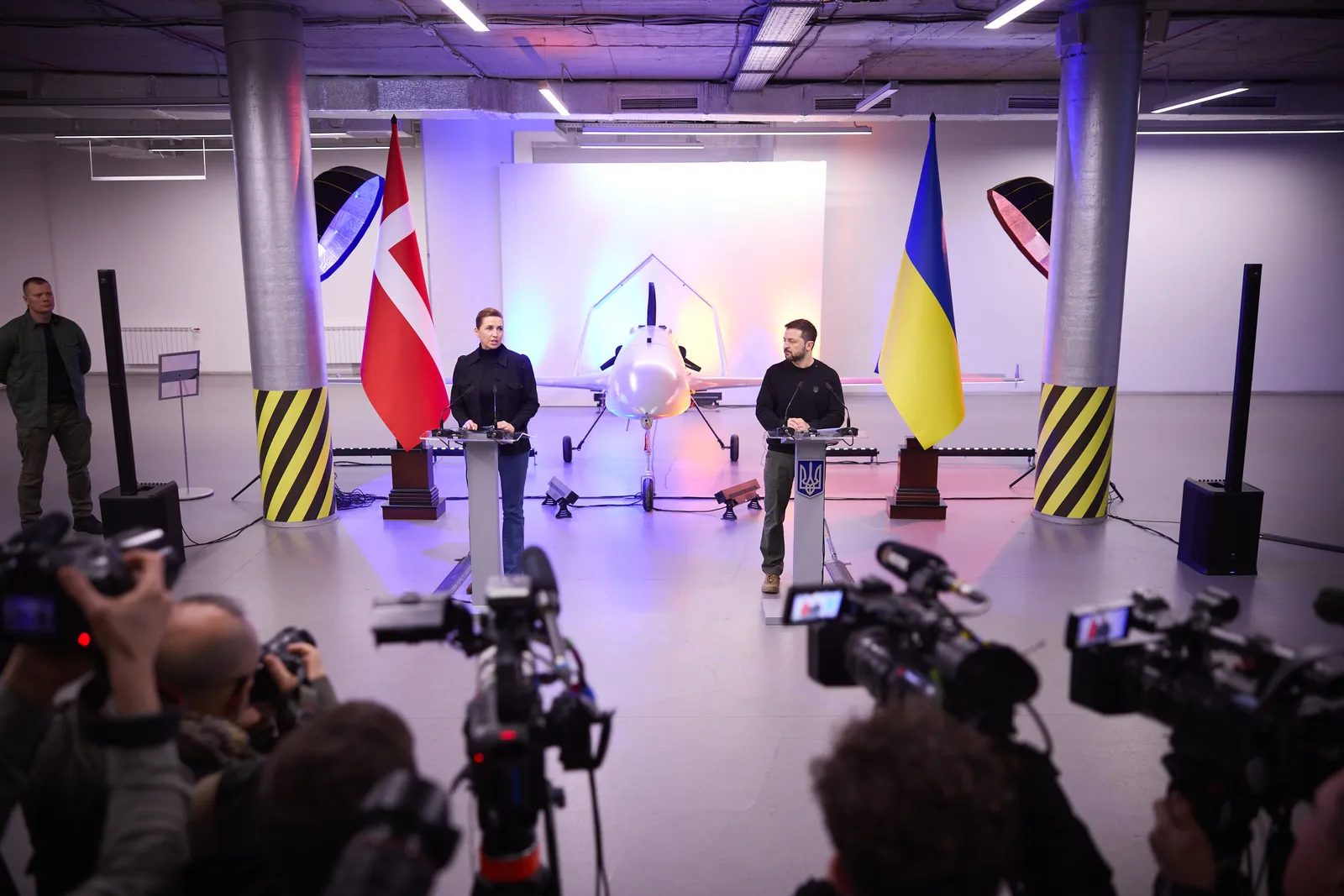
Ukraine’s Ministry of Defence describes it as funding procurement for Ukraine’s armed forces by reimbursing contracts with Ukrainian manufacturers, so partners pay producers instead of transferring their own stockpiles. As of 6 February 2025 the ministry reported €597 million of weapons delivered this way: Denmark €175 million, Sweden €20 million, Iceland €2.7 million, and €390 million from interest on frozen Russian assets. The product stays in Ukraine and goes to Ukrainian forces.
Build with Ukraine: the footnotes
It is the initiative to produce Ukrainian defense products with partners. The clearest documented case is Denmark. On 24 June 2025, at the NATO summit in The Hague, the two defense ministers signed a Letter of Intent to establish Ukrainian defense production in Denmark, and Denmark allocated 500 million Danish kroner to launch it. The page I read does not describe a plant, a site or a production start. By September 2026 the EU Institute for Security Studies reported that Fire Point's rocket-propellant production in Denmark was delayed to late 2027. Germany got to a working line first: Quantum Frontline Industries, a joint venture of Quantum Systems and Ukraine's Frontline Robotics set up under Build with Ukraine, began building Ukrainian-designed drones in Germany in 2026, and two more joint ventures followed; the whole list is in the map of German-Ukrainian defense joint ventures.
Drone Alliance: the footnotes
The European Commission announced the Drone Deal on 15 July 2026 and launched the Alliance on 17 July as the platform to carry it out. The Commission’s page describes 18 founding members: nine EU-based organizations, including Indra Group and Fincantieri, and nine Ukrainian companies, including Skyfall Industries and Vyriy Industry. The first members’ meeting was scheduled for September in Brussels. Stated goals include a strong drone industry, new drone and counter-drone technology, and joint ventures between Ukrainian and European companies. Two larger EU instruments now sit next to these channels: SAFE, €150 billion of loans to member states that Ukrainian companies can supply, and EDIP, grants with a €300 million Ukraine Support Instrument; how each one pays a company is in SAFE and EDIP.
Breaking Defense reports that the Commission has pledged €1 billion, as part of the €90 billion Ukraine Support Loan, to support Kyiv’s drone capabilities. The Alliance page describes goals and members, not a budget, so I would not read the €1 billion as the Alliance’s own fund. Membership is not permission to export; Ukraine’s own conditions still apply, see the July export mechanism.
What will the market need next?
Each channel leaves out something a company then has to buy elsewhere. The Danish model pays for production in Ukraine but gives a Western supplier no relationship with the buyer. Build with Ukraine gives a route abroad but not a factory. The Drone Alliance gives a seat at a table but not an export licence. The services that fill those gaps are the market: finding and checking partners for the Alliance; site selection, permits and supplier qualification for production abroad; and the contract work that lets a Western component maker supply a line paid through the Danish model.
The scarcer product is a working plant abroad. Denmark's propellant production is delayed to late 2027, while Germany got Ukrainian-designed drones into production in 2026 through joint ventures. Industrial parks, contract manufacturers and landlords in partner countries that can host a Ukrainian line within months, with security and trained staff, will have more Ukrainian demand than they can take.
Signals worth watching: Danish-model totals, the first Build with Ukraine plant outside Germany in production, and Alliance ventures that sign a production contract.
Which channel fits your position?
- Ukrainian producer with spare capacity: the Danish model is the channel that already pays. Before you look abroad, ask whether your contract flow can carry a second buyer.
- Ukrainian producer that needs a foreign presence: Build with Ukraine is built for that, but a Letter of Intent is where it starts, not where it ends. Ask what has to happen before anything is built.
- European manufacturer: the Alliance is a way to find the right conversation. Prepare an offer first: in these deals, technology transfer with local production rights often moves a discussion further than a one-off sale. See how a joint venture is approached.
- Investor: none of the three is an investment product. They are channels through which a company can be paid or paired. Diligence still happens at the company level; see how I would evaluate a defense tech startup.
Why does NATO’s counting rule matter to all three?
The Hague declaration says allies will include direct contributions towards Ukraine’s defense and its defense industry when calculating their defense spending. I read that as a budget reason to use any of the three channels. It does not decide between them. I go through it here.
Does joining the Drone Alliance let a company export from Ukraine?
Nothing I read says so. Ukraine’s export conditions still apply.
Where I could be wrong
I am reading official pages and one trade-press report, and pages of intent are not pages of results. I have not seen a signed joint venture from the Alliance, a plant operating in Denmark, or any figure for what the Alliance itself will spend. If those exist, they change the picture.
The wider map is in Ukraine’s defense industry in 2026.
Sources (7)
- Ministry of Defence of Ukraine, the Danish model, 6 February 2025
- Ministry of Defence of Ukraine, Ukraine–Denmark agreement, 24 June 2025
- European Commission, DG DEFIS, EU–Ukraine Drone Alliance, 17 July 2026
- Breaking Defense, "EU, Ukraine sign Drone Deal to fast-track unmanned systems production," 17 July 2026
- NATO, The Hague Summit Declaration, 25 June 2025
- EU Institute for Security Studies, Building together: how Europe and Ukraine should deepen their defence industrial partnership, 22 September 2026
- Quantum Systems, first joint co-production of Ukrainian drones in Europe with Frontline Robotics, December 2025