
Ukraine’s Drone Deals, the format that turns battlefield experience into ten-year contracts
“Drone Deal” now means three things: Ukraine’s bilateral agreements with nine countries, a July 2026 framework with the European Commission, and the 18-company Drone Alliance launched to deliver it. Here is what each is, what money is attached, and what still blocks it.
A Drone Deal is the name Ukraine gives to its new kind of defense agreement: not a donation and not a single purchase, but a long-term partnership in which Ukraine sells its battlefield-tested drones and experience and the partner helps finance and co-produce them. By September 2026 Ukraine had nine such bilateral deals and fifteen more in negotiation, and in July 2026 it signed the first document toward one with the whole European Union. The word is now used for three different things, and it pays to keep them apart.
My argument is that Drone Deals are Ukraine turning combat experience into its main export: not drones alone, but the knowledge of what works against Russian weapons, sold as long partnerships rather than one-off sales. That is a stronger position than a seller of hardware, and it ties Ukraine's defense industry to its partners' for a decade.
What is a bilateral Drone Deal?
In President Zelenskyy’s own description, Ukrainian expert teams assess a partner country’s defenses, including its air defense, and propose solutions through cooperation lasting at least ten years. Ukraine gets stable funding for its manufacturers; the partner gets modern capabilities, rapid access to Ukrainian weapons and joint work between the two countries’ defense-tech companies. Ukraine had signed its seventh deal, with Estonia, by early July 2026; the Netherlands signed on 7 July 2026; by September the count was nine, with fifteen more in the works.
The Netherlands is a good example of how figures get inflated: it committed €9 billion in military support to Ukraine through 2029, which is broader than its Drone Deal and should not be reported as Drone Deal money.
What did the EU sign?
| Date | What happened |
|---|---|
| 15 July 2026 | In Kyiv, Zelenskyy and Commission President Ursula von der Leyen signed a Letter of Intent on a Strategic Defence Industrial Partnership, described as the first document underpinning the EU–Ukraine Drone Deal. Von der Leyen announced an additional €1 billion for drone production from the EU’s €90 billion loan package for Ukraine, on top of €4 billion already allocated to drones from it |
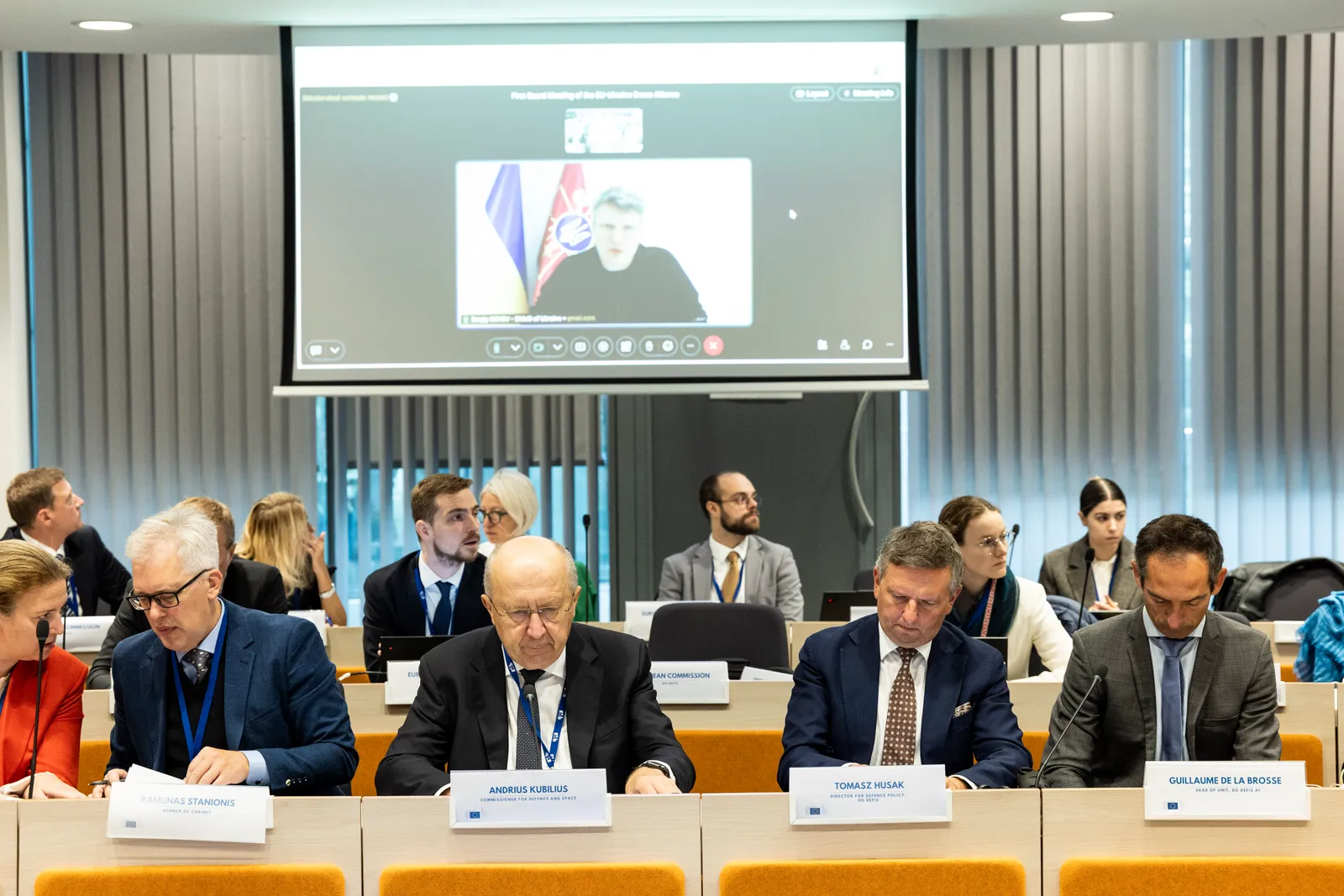
| 17 July 2026 | The Commission launched the EU–Ukraine Drone Alliance at the third EU–Ukraine Defence Industry Forum in Kyiv, with the goal of joint production of drones and counter-drone systems by the end of 2026, and announced a further €1 billion disbursement for drone procurement |
| September 2026 | First meeting of the alliance’s founding members planned in Brussels |
It is a framework, not a contract: no binding order quantities or company awards were published. Whether the two €1 billion announcements are the same money described twice has not been clarified, so they should not be added together.
Who is in the Drone Alliance?
Eighteen founding companies, nine from each side.
| EU-based | Ukrainian |
|---|---|
| ORQA (Croatia), Indra Group (Spain), Fincantieri (Italy), WB Electronics/WB Group (Poland), Destinus (Netherlands), Delair (France), RSI Europe, TERMA (Denmark), Quantum Systems (Germany) | Skyfall Industries, Greentech Harvest, Tencore, Deviro, Vyriy Industry, Athlon Avia, TAF Industries, UFORCE, F-Drones |
The mix is deliberate: large European primes, European drone specialists and the Ukrainian makers whose products are flying every night, among them SkyFall, maker of the P1-SUN interceptor drone. No incorporated joint venture, plant or contract value had been made public for any of them by early October 2026. How this alliance compares with the Danish model and Build with Ukraine is in how Western money reaches Ukrainian producers.
How does it connect to Ukraine’s export rules?
Through Resolution No. 875 of 1 July 2026, which created a faster export route for countries that have a defense cooperation agreement with Ukraine and was presented as the mechanism for the Drone Deal model. A Drone Deal does not replace an export permit: each Ukrainian exporter still needs one from the State Export Control Service. And as of late September 2026 no permit had been issued under the fast route, because the lists of eligible countries and critical products were not finished. The detail is in DSEK, Ukraine’s export regulator and Ukraine’s defense export rules for buyers.
What will these deals become?
I expect them to become the normal form of Ukraine's defense relations with Europe. A ten-year partnership that co-funds production, shares battlefield data and builds joint plants is closer to an alliance than to trade. The partners gain designs and combat feedback that only a country at war can supply; Ukraine gains money, capacity outside the reach of Russian strikes and political commitment.
The tension is the one inside every such deal: Ukraine needs the output now, while partners want production, jobs and know-how at home. The deals that work will divide that clearly, as the German-Ukrainian joint ventures begin to do.
Signals worth watching: how many of the fifteen deals under negotiation are signed, whether they include funding or only frameworks, and how much output from joint plants abroad actually reaches Ukraine.
What will the market need next?
A Drone Deal is a ten-year agreement between governments to co-fund production and share battlefield data, and those two promises create markets of their own. Shared data needs somewhere to live: secure platforms where Ukrainian combat footage, test results and failure reports can be exchanged with a partner's engineers under the rules both governments set. Few companies build that today, and every Drone Deal country will need it.
Co-funding needs a financial structure. When two governments pay into one production line, someone has to design the contracts, the reporting and the audit so that each can show its own parliament where the money went. That is public-finance work, close to what development banks do, and it barely exists for defense.
The simplified export route reserved for Drone Deal countries adds a third: export compliance specialised in that route, for producers who want to sell to a partner country without the full review.
Signals worth watching: data-sharing platforms announced under a Drone Deal, the first audited co-funded production line, and exports approved through the simplified route.
What I would do with it
For a European company, the Drone Deal is the political cover and the financing context, not the deal itself. The value is in the specific joint venture: who owns the IP, where production sits, who is the first buyer and under which export route the product moves. Settle those before the signing photo. For a Ukrainian maker, a country with a signed Drone Deal is the market to start with, because the political and financing work is done and the export route, once it works, is meant for exactly that destination. Remember too that a Drone Deal is an agreement between governments. Most of the actual buying happens several levels below it: one company selling to another that equips particular units, where the conversation is about specifications, delivery and support, not about policy. A Drone Deal opens that door; it does not walk through it for you. And on both sides, check the counterparty the way I describe in how I would evaluate a defense tech startup.
Sources (8)
- President of Ukraine, first step toward the Drone Deal signed with the European Commission, 15 July 2026
- European Commission, Commission launches EU–Ukraine Drone Alliance, 17 July 2026
- European Commission, press release IP/26/1624, July 2026
- President of Ukraine, address to heads of Ukraine’s diplomatic missions, September 2026
- President of Ukraine, Drone Deal with Estonia, July 2026
- President of Ukraine, meeting with the Prime Minister of the Netherlands, 7 July 2026
- Breaking Defense, EU and Ukraine sign Drone Deal to fast-track unmanned systems production, 17 July 2026
- The Kyiv Independent, why Ukraine’s fast-track arms export plan remains stuck on paper, 25 September 2026