
Merops shows that a cheap interceptor is cheap only inside a system. Over Ukraine it downed more than 1,000 Shaheds; in the Gulf, 13,000 of them reportedly downed one.
Merops is an American interceptor drone system built by Perennial Autonomy, the company Eric Schmidt founded, to shoot down Shahed-type drones for about $15,000 a round. Over Ukraine it downed more than 1,000. In the Gulf, 13,000 of them reportedly downed one. I read the gap as the clearest lesson in counter-drone economics: the price of the interceptor is the smallest part of the price of an intercept.
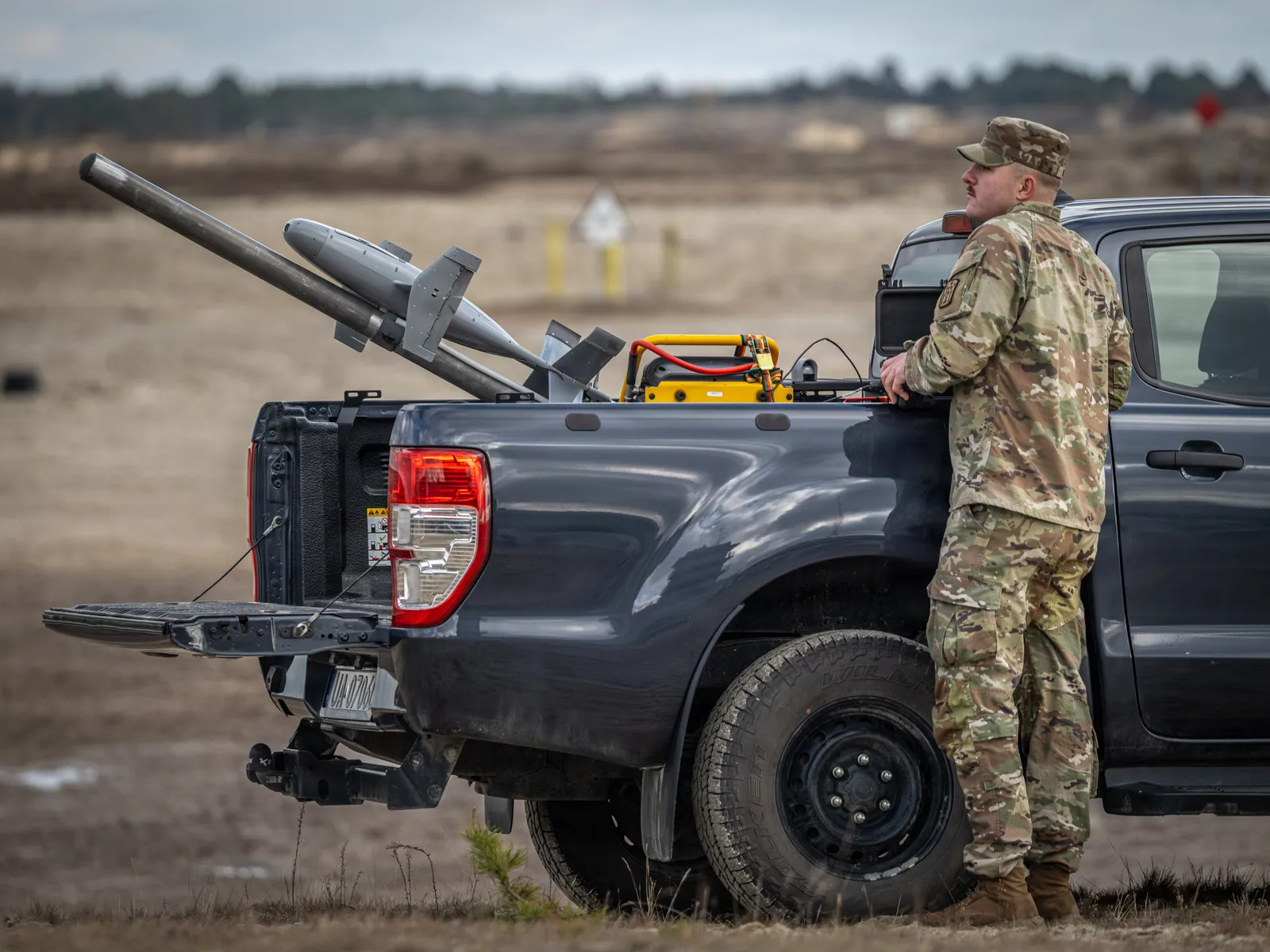
Merops is an American counter-drone system that shoots down Shahed-type attack drones with another drone. A pickup truck carries the whole kit: a radar, electro-optical sensors, a controller and a launcher for the Surveyor, a propeller-driven interceptor about three feet long that flies at about 280 km/h (175 mph) and hits its target or bursts beside it. Its maker is Perennial Autonomy, the company Eric Schmidt, the former Google chief executive, founded in 2023 under another name. One interceptor costs about $15,000, against $30,000 to $50,000 for the Shahed it is built to kill.
My argument is that Merops is the cleanest experiment the counter-drone business has had, because the same hardware ran in two theaters with opposite results. Over Ukraine, where Russia has launched Shaheds at cities almost every night since its full-scale invasion in February 2022, Merops downed more than 1,000 drones worth more than $200 million with about $15 million of interceptors. In the Gulf in 2026, 13,000 Merops, roughly $195 million of hardware, were in the theater for one reported kill of an Iranian Shahed. The drone did not change. Everything around it did, and that is where the price of an intercept is set.
Merops in numbers
| Maker | Perennial Autonomy, founded by Eric Schmidt in 2023 as White Stork, then Project Eagle, renamed in 2026 |
|---|---|
| System | radar, electro-optical sensors, controller and launcher, all on one pickup truck |
| Interceptor | Surveyor: about 3 feet long, up to about 280 km/h (175 mph), about 5 to 20 km of reach; flies on machine vision with thermal or radar sensors when radio and GPS are jammed |
| Price per interceptor | about $14,500 to $15,000 now; $3,000 to $5,000 in large orders, by the US Army secretary's estimate |
| Ukraine | in combat for at least six months by November 2025; more than 1,000 Shahed-type drones downed by then, as reported |
| NATO | fielded in Poland and Romania from November 2025 under Eastern Sentry; Denmark to use it; Lithuania bought 48 |
| United States | 13,000 bought within about eight days of the 2026 Iran war starting; program of record in 142 days; a Pentagon contract with a $500 million ceiling in May 2026 |
| Gulf result | first US combat kill over Kuwait in late July 2026, as reported; one Shahed downed by the account The Atlantic published in November |
The maker has not published a full specification. The figures above are those reported by the US Army, NATO and the defense press.
Why did the same drone work in Ukraine and fail in the Gulf?
Because an interceptor drone does not find its own target from far away. It needs someone to tell it where to fly. The Surveyor's own sensors take over in the last stretch, and its 5 to 20 km of reach means it has to be launched from roughly the right place at roughly the right moment. Everything before that moment is somebody else's work.
In Ukraine that work was already done. A national network of acoustic sensors, Sky Fortress, hears a Shahed's engine and passes the track on; command software such as Delta puts it on a map a launch team can read; and the crews had spent a year doing this every night. Merops dropped into the end of a chain that worked, and it did what it was built to do.
In the Gulf none of that was in place. Host governments had never operated the system and were slow to approve flights in their airspace, and there was no sensor network to cue the launchers, The Atlantic reported. The Army got the hardware there in days. Ukraine's offer to send experts and equipment, the rest of the chain, was declined, a story I take apart in what saying no to Ukraine's interceptors cost. Without the wider network, the launchers had none of the early cueing they had in Ukraine, and the first reported US kill came in late July, about five months after the trucks arrived.
The arithmetic follows, with one caution on what it measures. Over Ukraine, the defender spent about $15 million of interceptors to bring down more than $200 million of Russian drones: more than 13 to 1 in the defender's favor. In the Gulf most of the 13,000 rounds were never fired, so the honest figure is hardware bought per kill: about $195 million in the theater for one reported Shahed worth about $35,000. Bought hardware that does not fire is still money spent and production used, and on that measure the cheap round did worse in its first months in the Gulf than the Patriots it was meant to spare.
Why does Merops cost seven times a Ukrainian interceptor?
A Ukrainian STING costs about $2,000 and a P1-SUN about $1,000, at their makers' prices, as I set out in Ukraine's interceptor drones. Merops costs about $15,000. Two things sit in that price. The first is autonomy: the Surveyor is built to finish the attack on its own sensors when radio and satellite navigation are jammed. The second is a self-contained kit, radar and controller included, that a soldier with no drone experience can be trained to use in weeks: the US Army's train-the-trainer course in Poland ran 20 days for students most of whom had never flown a drone.
That second point is the American design choice, and I think it is the right instinct with the wrong conclusion. A kit that carries its own radar is easier to buy, ship and certify. It does not replace a network. One truck protects one site; Ukraine's acoustic network, about 14,000 nodes at $400 to $1,000 each, spreads across the country.
The difference is in utilization. In a network, every detected track can be handed to whichever launch team is best placed, so each team fires more often and the cost of detection and command is shared across many intercepts. A kit on its own waits for a target to come within its reach. The unit that decides the economics is the cost of defending an area against a given density of raids, per successful intercept, and on that unit a network of cheap teams beats the same teams standing alone by a wide margin.
The Army has learned part of this. In December 2025, at a NATO demonstration in Poland, it connected Merops to an Italian RPS-42 radar, and Romania's defense minister said the trials in his country were about integrating Merops into NATO's command and control. Those are the right tests. They are also the tests the Gulf deployment skipped.
Where does Merops go next?
I expect Merops to become a standard American counter-drone round, and to be outrun by the jet Shahed unless a faster successor follows. Four signals will show how fast.
- A published engagement count from the Middle East. The Army has praised the system without giving one. The first official number will show whether the Gulf deployment was fixed or just quieter.
- The price. $15,000 today, under $10,000 with scale, $3,000 to $5,000 in large orders by the Army secretary's estimate. Orders against the $500 million contract will show which of those prices is real.
- Integration contracts. Work that ties Merops to existing radars and to the air-defense command systems of the US and its allies, such as the RPS-42 demonstration in Poland, matters more than the next airframe.
- A faster successor. Russia's jet-powered Geran-5 flies faster than Merops. Ukraine fielded an interceptor for it in September 2026. An American answer at Merops prices would be the next test of whether the US learns before the war that needs it.
What will the market need next?
Merops proves that the US can buy a cheap interceptor in eight days. It also proves that the interceptor was never the hard part, and the products below are the ones that make a bought round turn into an intercept.
- Sensor-to-launcher integration. Software and data links that cue a Merops team from any radar, acoustic network or observer the host already has. Radar-agnostic integration is what the Poland trial tested, and each new base and ally needs its own. Priced per site per year, it stays a small fraction of one Patriot interceptor at $3.87 million.
- Deployment packages for bases abroad. Airspace approvals, frequency plans, rules of engagement and host-nation training, agreed before the trucks arrive. The first reported US kill in the Gulf came about five months after the trucks arrived.
- Training at scale. A 20-day course per cohort of 20 does not cover 13,000 interceptors. Simulators and instructors with Ukrainian combat time are a market beyond the services' own schools.
- Cheaper airframes at the Ukrainian price. At $1,000 to $2,000 a round, Ukrainian makers show where the price of the mass layer can go. American and European production of designs at that price, with components that meet US sourcing rules, will take volume from the $15,000 round.
- The jet-speed interceptor. Whoever brings a round that catches the Geran-5, with its cueing chain, to US and Gulf buyers first sells into a gap that already has a name.
What Merops means for a defense founder
- Sell the intercept, not the interceptor. The same hardware downed more than 1,000 drones in one theater and one in another. Price and present your product by what it costs to get one kill in the buyer's real setting.
- The contracts around the airframe are the advantage. Perennial Autonomy's lead is not the airframe, which others match on price. It is a program of record, a $500 million contract vehicle and trials inside NATO command systems. A newcomer needs a partner that owns those, or a plan to earn them.
- Read the buyer's geometry. A kit that protects one site is a different product from a layer that protects a region. Know which one you are selling and which one the buyer needs.
Sources (10)
- The Atlantic, Simon Shuster, The Pentagon ignored a warning about the danger of Iran's drones, 15 November 2026
- DroneLife, Perennial Autonomy wins Pentagon contract, 21 May 2026
- Militarnyi, Mysterious Merops intercepted more than a thousand Shahed-like drones over Ukraine, 21 November 2025
- Forces News, $200m worth of Russian drones taken out by $15m of Merops UAVs, 10 December 2025
- Notes from Poland, American anti-drone systems deployed in Poland, 7 November 2025
- Militarnyi, Merops counter-drone system gains integration with various radars, 10 December 2025
- The War Zone, Army explains how Merops became a program of record in 142 days, 14 October 2026
- The War Zone, Cheap interceptor drones proven in Ukraine sent to protect US troops against Iranian Shaheds, 16 April 2026
- Anadolu Agency, US has sent 10,000 interceptor drones to the Middle East, Army secretary says, 13 March 2026
- NV, Ukraine-tested US drone downs Iranian Shahed over Kuwait, July 2026